Your AI Coding Tools Are Delivering 10% ROI. Here's Why Top Teams Get 4-6x More

The Average Engineering Team Gets 10% ROI from AI Coding Tools. Top Quartile Gets 4-6x.
The gap between average and top-performing engineering teams using AI coding tools is not about which tool they picked. It is about how they adopted it. 84% of developers now use AI coding tools, but measured productivity gains average only 10-30%. Meanwhile, top-quartile teams achieve 4-6x ROI from the exact same tools. The difference is structured adoption, proper measurement, and CTO-level oversight of how AI fits into every stage of the SDLC.
The 10% Problem Is Real - and It's Not the Tool's Fault
I hear this constantly from CTOs and engineering leads: "We rolled out Cursor / GitHub Copilot / Claude Code six months ago. Everyone's using it. And we can barely measure the impact."
They're not wrong. The data backs this up. DX tracked 400 companies between November 2024 and February 2026 and found that even as AI tool usage increased by 65% across those organisations, median PR throughput grew by only 7.76%. In most engineering organisations, the gains were in the 5-15% range.
There's also a perception problem on top of the actual problem. METR's controlled study found that developers feel about 20% faster with AI tools but are measurably 19% slower - because of longer code reviews, higher bug rates, and the cognitive overhead of validating AI suggestions that are "almost right but not quite."
So why are some teams consistently delivering 4-6x ROI from the same tools everyone else is using? I've seen this up close running AI adoption engagements for engineering teams, and there are five things that separate the top quartile from everyone else. None of them are about which AI tool you bought.
5 Things Top-Quartile Teams Do Differently
1. They track ROI properly from day one - including token costs
Healthy ROI on AI coding tools is 2.5-3.5x for average teams and 4-6x for the top quartile - but only when you calculate the cost denominator correctly. Most teams look at seat licences and call it done. That's wrong.
Cursor Pro is £16/month per seat. But if your team is running agentic workflows with long context windows, your actual token consumption can be 3-5x the subscription price. Top teams measure cost as: seat licences + token consumption + review overhead + quality rework time. Average teams measure: seat licences. This alone explains a significant portion of the ROI gap.
2. They invest in training that mirrors real work
McKinsey found that 57% of top-performing organisations invested in hands-on AI workshops and coaching, compared to only 20% of bottom performers. The key word is "hands-on" - not a Confluence page of tips, not a lunch-and-learn, but actual workshops where developers are integrating AI into real code reviews, sprint planning sessions, and testing cycles.
The organisations that just handed out Copilot licences and said "go figure it out" got the 10%. The ones that ran structured onboarding and kept measuring got the 4-6x.
3. They have adoption depth, not just adoption breadth
A 70% adoption rate that's all casual users delivers a fraction of the value compared to a 70% adoption rate built on genuine depth. DX data shows that daily AI users merge approximately 60% more pull requests than non-users. Weekly active users show meaningful gains. Monthly touchbase users show almost nothing.
Elite teams in 2026 benchmark at 80%+ weekly active usage, 60-75% AI-assisted code share across the team, and sub-8-hour PR cycle times - all while maintaining code turnover ratios below 1.3x compared to human-only baselines. These are specific, measurable targets. Most teams don't even know these metrics exist.
4. They match the tool to the task complexity
Top-performing teams have learned something most haven't: expensive agentic AI tools should be reserved for medium and hard work, not the tasks that basic inline completion handles fine. Asking Claude Code to refactor an auth service is smart. Asking it to autocomplete a utility function you could write in 30 seconds is wasteful and inflates your token costs without proportional output.
AI coding tools can deliver 200-500% ROI over a two-to-three year horizon when usage patterns are matched to task complexity. The mistake is treating all AI tool usage as equivalent - it's not.
5. They have someone accountable for AI adoption outcomes
This is the most overlooked one. Top-performing teams have a named person - usually the CTO or a senior engineering lead - who owns AI adoption metrics, runs retrospectives on what's working, maintains a team prompt library, and iterates on the process. Average teams roll out the tool and assume adoption happens on its own.
In most of the engagements I've run, the single biggest unlock is assigning someone with actual technical authority to own this. Not a "digital transformation lead." A CTO or senior developer who can see the codebase, understand where AI is helping versus creating noise, and course-correct fast.

The Measurement Gap Is Where Most Teams Lose
Organisations with structured measurement programs capture three to four times more value from AI tools than those without. That's not a small premium - it's the difference between 10% gains and genuinely transformational returns.
Most teams track who uses AI. Full stop. They don't track what those users accomplish, whether quality is improving or degrading, whether senior engineers are spending more time on reviews, or whether velocity gains in one stage are being absorbed by bottlenecks in another.
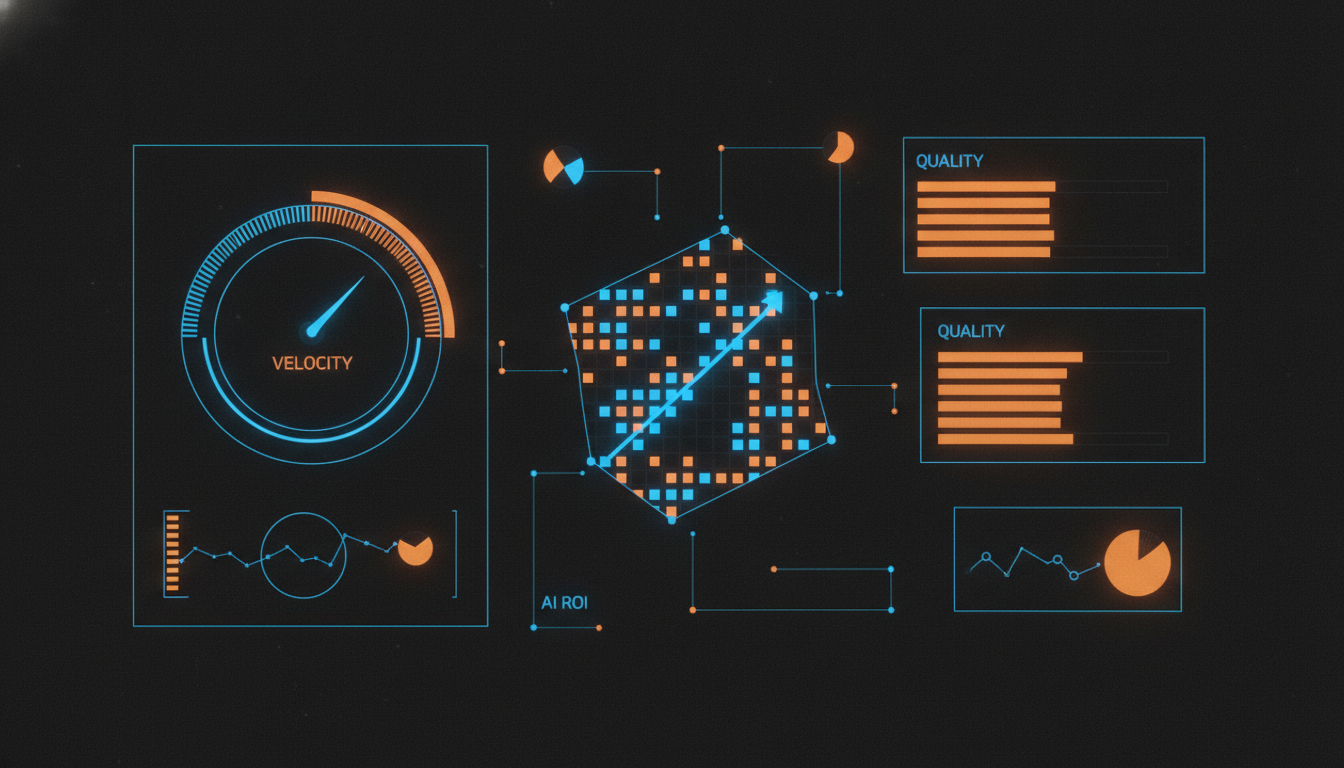
The DX Core 4 framework breaks AI measurement into four dimensions: speed, effectiveness, quality, and business impact. Every metric you care about sits somewhere in these four buckets: speed covers PR cycle time, deployment frequency, and time from feature request to production; effectiveness covers AI code share, acceptance rate of AI suggestions, and daily active usage depth; quality covers bug density in AI-assisted versus human-only code, code turnover ratio, and security findings per PR; business impact covers total cost including token consumption, revenue features shipped per quarter, and on-call incident frequency.
Without measuring all four, you're flying blind. And you can't improve what you can't see.
Structured vs. Unstructured AI Adoption: What the Difference Looks Like in Practice
| Aspect | Typical Unstructured Adoption | CTO-Led Structured Adoption (Metamindz) |
|---|---|---|
| Tool selection | Pick the popular tool, roll it out | Assess team workflow and stack first, then match tool to context |
| Onboarding | Share a Confluence doc, maybe a lunch-and-learn | Hands-on workshops integrated into real sprint work |
| Cost tracking | Seat licence cost only | Seat licences + token consumption + review overhead + rework time |
| Measurement | % of developers who activated the tool | Speed, effectiveness, quality, and business impact across DX Core 4 |
| Usage guidance | None - developers decide how they use it | Task-complexity matching: which tasks to AI, which to own |
| Security guardrails | None or vague policy document | Explicit "AI-off zones": auth, payments, data pipelines - with technical controls |
| Ownership | No named owner; everyone responsible = no one responsible | Named CTO or senior lead accountable for adoption outcomes |
| Review process | Standard PR review, no AI-specific checks | AI-specific CI/CD quality gates, code turnover ratio monitoring |
| ROI outcome | 5-15% productivity improvement (average teams) | 4-6x ROI (top quartile) through structured measurement and iteration |
How to Build Your Measurement Framework (Without Making It a Project)
I'm not going to suggest you build a three-month analytics project to measure your AI tools. You need a baseline and a direction. Here's what I'd do in the first 30 days:
In week one, pull your last 90 days of PR data - average cycle time, average PRs per engineer per week, average bug density per PR. This is your before-state. Also run a quick pulse survey: how often is each developer using AI tools, and for what tasks? You'll almost certainly find your usage distribution is extreme - a small cohort of power users, a large group of casual dippers, and a chunk who barely touched it.
In weeks two and three, compare the PR metrics of your daily AI users versus casual users versus non-users. Don't aggregate. The aggregated number is where the 10% average hides - it's a blend of 4-6x returners and near-zero returners. You need to understand both ends of your distribution to know what's actually happening in your team.
In week four, pull actual token consumption from your AI tool provider. Add it to your seat licence spend. Calculate your actual cost per developer per hour of AI-assisted work, then calculate the value of the hours saved using loaded developer cost, not just salary. This is your real ROI picture - and it's almost always different from what people assumed when they signed the licence agreement.
From there, the goal is straightforward: pull your casual users toward daily usage depth, and make sure your power users aren't creating review bottlenecks for everyone else. Both of those require someone with technical authority watching the data week by week. That's what a fractional CTO can own for teams that don't have dedicated technical leadership yet.
What Changes as Agentic Coding Matures
The shift from AI copilots to agentic coding - where the AI researches, acts, and iterates without step-by-step human direction - is already happening. Anthropic's 2026 Agentic Coding Trends Report marks this as the most significant workflow shift since the move to cloud infrastructure.
The ROI equation changes materially with agentic tools. Token consumption is dramatically higher. The output volume is higher. But the review surface area is also higher - and if your team doesn't have a structured review process already in place, agentic AI will amplify the bottleneck, not remove it.
Top teams building for agentic workflows in 2026 are doing two things: first, implementing AI-specific quality gates in their CI/CD pipelines to catch common AI failure patterns before human review; second, treating senior developer review of agent outputs as a distinct, planned activity - not something bolted onto standard PR review. Teams that haven't done this are already seeing code churn rates climb.
I'd rather you get the measurement framework and structured adoption approach right on standard AI tools before touching agentic coding. The ROI gap between structured and unstructured adoption is already significant today. With agentic AI, it's going to be severe.
What This Means for Your AI Tools Budget
If you're allocating budget for AI coding tools and you haven't also allocated budget for structured rollout, measurement setup, and ongoing adoption management - you're funding 10% ROI when you could be funding 4-6x. That's not a tools problem. That's a priorities problem.
The cost of structured AI adoption support through a CTO-led engagement is a fraction of the productivity delta you're leaving on the table. We run this as a distinct service - AI maturity assessment, workflow design, hands-on training, and measurement setup - because we've seen too many good engineering teams waste good tooling budgets through unstructured rollout.
McKinsey was direct about this: teams with structured measurement programs capture three to four times more value than those without. Not 10% more. Three to four times more. If you're spending £5K/year on AI tool licences across a ten-person team and only capturing 10% of the possible value, you're leaving £15K-£25K of productivity on the table annually.
The tools are genuinely good now. Most of the teams I talk to have actually picked decent tools. The gap is in everything that happens after the signup button is clicked.
Frequently Asked Questions
What is the average ROI of AI coding tools in 2026?
The average AI coding tool ROI for engineering teams in 2026 is 10-30% productivity improvement, or roughly 2.5-3.5x financial return over a two-to-three year horizon when calculated against proper costs including token consumption. Most teams see only 5-15% gains because they measure adoption breadth rather than depth, and don't account for review overhead or the increased bug rates that come with unreviewed AI-generated code.
How do top-quartile teams achieve 4-6x ROI from AI coding tools?
Top-quartile teams achieve 4-6x ROI through five practices: accurate cost measurement including token consumption, hands-on structured training integrated into real sprint work, deep daily usage rather than surface-level adoption, task-complexity matching to avoid overpaying for simple work, and a named technical owner accountable for AI adoption outcomes. The tool itself is rarely the differentiator.
How long does it take to see meaningful ROI from AI coding tools?
Most teams see clear signal within the first 60-90 days if they're measuring properly. The benchmark is daily AI users merging approximately 60% more pull requests than non-users within three months of structured adoption. If you're not seeing that, the issue is usually adoption depth or review bottlenecks - not the tool you chose.
What metrics should I use to measure AI coding tool ROI?
Use the DX Core 4 framework: speed (PR cycle time, deployment frequency), effectiveness (AI code share, suggestion acceptance rate, daily usage depth), quality (bug density in AI-assisted versus human code, code turnover ratio), and business impact (total cost including token consumption, features shipped per quarter). Tracking only activation rate is the most common - and most costly - measurement mistake.
Should early-stage startups invest in AI coding tools or focus budget elsewhere?
Yes, invest - but budget for structured rollout, not just licences. At seed or Series A, your team is small enough that a single CTO-led onboarding session can get everyone to daily usage depth within weeks. The cost is minimal; the velocity gain is real. The mistake is handing out licences without any adoption framework and assuming the tool does the hard work.