
AI-Native Engineering Teams: How Lean Beats Big in 2026
AI-Native Engineering Teams: How Lean Beats Big in 2026
An AI-native engineering team is one whose entire workflow, from requirements through to code review, has been rebuilt around AI being the default at every step. Buying a pile of Cursor licences doesn't make you AI-native; rewiring how the work actually flows does. In 2026 the payoff is stark: a handful of strong engineers now ship what used to take twenty, and investors have started pricing that in.
So, look. For about fifteen years the unspoken rule of startup engineering was simple: more output means more engineers. Need to ship faster? Hire. Backlog growing? Hire. Board wants velocity? Show them a bigger team. I sat in those planning meetings. I made those hires.
That rule broke this year. Not softly, and not just at the frontier labs. The small, sharp, AI-native team is now beating the big one on the metrics that decide funding rounds. And the gap isn't coming from a tool. It's coming from how the work is organised. I'll show you the numbers, the five shifts that actually move the needle, the trap that's quietly burning teams who got the first part right, and what your engineering org should look like if you're raising in the next twelve months.
What is an AI-native engineering team?
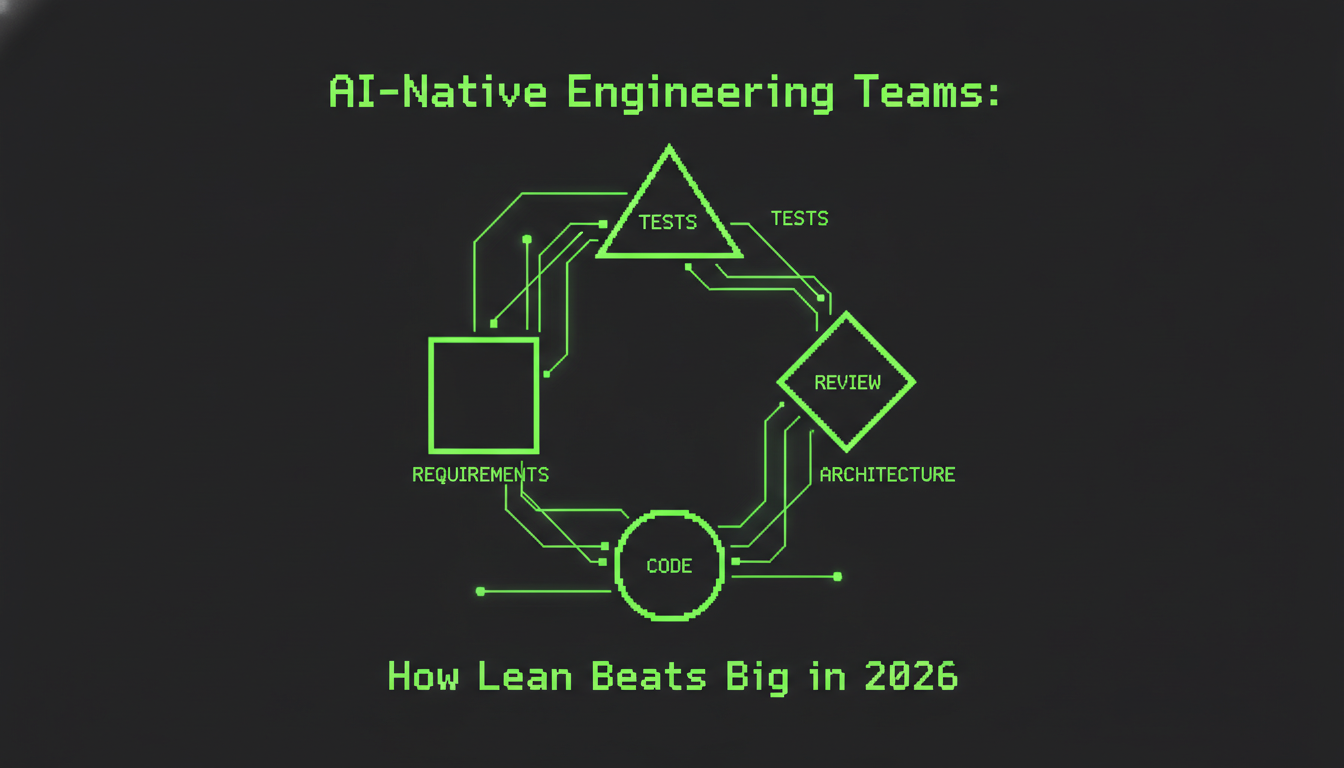
An AI-native engineering team is one that assumes AI assistance at every stage of the software lifecycle and has restructured its processes accordingly: how requirements are written, how tests get generated, how code is reviewed, how architecture decisions are recorded. The distinction matters because most teams have done the easy half. They bought the licences. They did not change the workflow. So they get a 10% bump and wonder where the revolution went.
The teams pulling ahead in 2026 have done the hard half. According to a 2026 analysis of the shift, an AI-first organisation isn't one that uses AI tools, it's one whose workflow has been restructured around the assumption that AI is the default at every step. That's the line that separates a 4x team from a 1.1x team. Same tools. Completely different result.
The numbers that ended the "more engineers means more output" era
Start with revenue per employee, because that's the metric investors now lead with. Top AI-native startups are reporting roughly five to six times the revenue per employee of leading SaaS companies, where the SaaS norm has historically sat around the $600k mark. The poster child is Midjourney: roughly $500m in revenue on a team of about 40, bootstrapped, zero raised. That used to be a freak outlier. In 2026 it's a template people are deliberately copying.
Look at hiring and you see the same story from the other side. Ravio's 2026 compensation data shows early-stage companies now hiring at a 27% rate, down from the frantic 49% of two years ago. Founders aren't just out of cash. They've worked out that the next hire often adds coordination cost faster than it adds output. There's a reason the old "two pizza" instinct keeps coming back: collaboration research keeps landing on a sweet spot of around seven people, plus or minus two, before communication overhead starts eating your velocity. AI tooling lets a team of seven cover ground that used to need thirty. It does not repeal the maths of human coordination.
And the bar to clear is public now. VCs are openly screening for ARR per employee above $200k, burn multiples under 2x, and 18 to 24 months of runway. If you're carrying a 25-person team to do the work of 8, that shows up in every one of those ratios, and it shows up before you've said a word in the pitch.
Why buying Cursor licences doesn't make you AI-native
Here's where most teams stall. They roll out an AI coding tool, see a nice demo, and assume the gains will compound on their own. They don't. The 2025 DORA report, Google's flagship study of software delivery, found that higher AI adoption lifts delivery throughput, but the value isn't unlocked by the tools themselves. It's unlocked by the surrounding technical practices and the culture around them. AI is an amplifier. Point it at a clean, well-tested, well-documented codebase and it screams. Point it at spaghetti with no tests and it produces spaghetti faster.
So the work that actually makes a team AI-native is unglamorous. It's writing requirements as crisp specs an agent can execute against. It's getting test coverage high enough that you trust generated code without reading every line. It's recording architecture decisions so the AI, and the next human, has the context to not make a mess. None of that is a purchase. All of it is a process change, and it's the bit teams skip because it's harder than expensing a subscription.
The five shifts that actually change the org chart
When I help a team go properly AI-native, the changes that stick are structural, not cosmetic. Five of them, in rough order of impact:
1. The skill mix flips senior-heavy. You need fewer hands typing and more people who can review, architect, and debug AI output. The smart 2026 move isn't a smaller team, it's the same headcount with a different skill mix weighted towards seniors who can judge what the machine produced. A junior who can't tell good generated code from plausible-looking rubbish is now a liability, not a saving.
2. Review becomes the bottleneck, so review gets redesigned. Generation is cheap; judgement is expensive. Teams that win move review upstream, cap PR size, and automate the boring checks so humans spend their attention on the things that matter.
3. Specs and architecture records become first-class artefacts. The context you feed an agent now determines output quality more than the prompt does. Teams that write things down out-ship teams that hold it all in their heads.
4. Testing moves from chore to safety harness. You cannot responsibly accept AI-generated code at volume without automated tests catching the regressions. The teams shipping fast and safe invested in this first.
5. New roles appear. AI-native product teams increasingly start with an AI engineer and a product owner who can think in workflows, and add an architect to oversee the system rather than a pile of generalists. Headcount allocation tilts hard toward engineering: AI-native startups put 60 to 70% of headcount into engineering and data, against 30 to 40% in traditional SaaS.
The trap nobody warns you about: speed without control
Now the uncomfortable part. Getting the first half right, the generation speed, without the second half, the control systems, is actively dangerous. The same DORA research that found AI lifts throughput also found it has a negative relationship with delivery stability. You ship more, and more of it breaks.
The telemetry backs this up and it's sobering. Analysis of 2026 engineering data from Faros AI shows median time in PR review up 441%, bugs per developer up 54%, and incidents per pull request up 242.7%. Read that again. Incidents per PR up nearly two and a half times. That's what happens when you bolt AI onto the front of the pipeline and leave the review, testing, and ops stages exactly as they were. You've made one stage 5x faster and pushed all the strain downstream onto the humans who have to catch what it got wrong. The time you saved writing code, you spend auditing it, and then some.
This is the difference between a team that's genuinely AI-native and a team that's just AI-accelerated. One rebuilt the whole pipeline. The other made the typing faster and is now drowning in the consequences. If your incident rate is climbing while your engineers swear they've never been more productive, you're in the second camp.
| Aspect | AI-accelerated team (bolt-on) | AI-native team (CTO-led, structured) |
|---|---|---|
| What changed | Bought tool licences, kept the old process | Rebuilt the workflow end to end around AI |
| Productivity gain | ~10%, plateaus fast | Multiples, compounds over time |
| Where AI is allowed | Everywhere, including auth and payments, unsupervised | Scoped, with humans owning the risky surfaces |
| Review & testing | Unchanged, now overwhelmed | Redesigned upstream, automated gates, capped PR size |
| Stability | Incidents and churn rising | Throughput up, stability held |
| Team shape | Same generalists, just faster typing | Senior-weighted, judgement-heavy, fewer hands |
| Investor read | Looks busy, ratios mediocre | High revenue per employee, clean burn multiple |
What this means for hiring
The hiring brief has changed and most job specs haven't caught up. You're no longer hiring for raw output, because the machine does the first draft. You're hiring for judgement: can this person spot a subtle authorisation bug in generated code, sense when an agent has confidently invented an API, and make an architecture call that won't need ripping out in six months. That's senior, expensive, and worth it.
Gartner's framing lands here: through 2027, generative AI will require 80% of the engineering workforce to upskill, and by 2028 75% of enterprise software engineers will use AI code assistants, up from under 10% in early 2023. AI fluency is becoming a baseline competence, not a bonus. When I run technical screening, I now treat how a candidate uses AI as a signal in itself: the strong ones drive it like a power tool and check its work; the weak ones paste its output and pray. You can tell within twenty minutes of pairing, and you cannot tell from a CV. This is exactly why a non-technical recruiter keyword-matching against "AI" on a résumé is worse than useless in 2026, and why we keep technical screening in the hands of people who've written and reviewed code.
What investors actually see when they look at your team
If you're raising, understand that diligence on your engineering org is now systematic and quantitative. Investors prioritise capital efficiency, measured as engineering spend per unit of output, and they screen hard for red flags, because around 80% of investor-founder relationship failures trace back to red flags missed in diligence. AI tooling now automates up to 60% of that document review, which means a reviewer reaches your codebase faster and with more context than ever.
What they're looking for is a lean, senior-weighted team with a clean burn multiple, a defensible trajectory, and a codebase that doesn't fall apart when someone opens the hood. What sinks deals is undisclosed technical debt, a team that can't articulate its AI usage or its testing story, and an org chart that's bloated for its revenue. A good technical due diligence review ahead of a raise will surface all of that while you can still fix it cheaply. We've watched valuations get cut on findings a founder could have closed out in a fortnight if they'd looked first.
What a strong AI-native team looks like by stage
| Stage | Typical old-world team | AI-native shape in 2026 |
|---|---|---|
| Pre-seed / MVP | 3-5 devs, one senior | 1-3 senior, AI-augmented; fractional CTO setting architecture |
| Seed | 6-10 devs, mostly mid-level | 4-7 senior-weighted, strong test/CI culture, specs written down |
| Series A | 15-25, scaling headcount hard | 8-15, judgement-heavy, review redesigned, clear AI guardrails |
| Hiring priority | More hands, faster | Fewer, more senior, AI-fluent, can review machine output |
None of this means you fire half your team and hand the rest a chatbot. The transition is a leadership problem before it's a tooling problem: someone has to redesign the workflow, set the rules for where AI is and isn't allowed near your auth and payments, and rebuild review and testing so speed doesn't become instability. That's precisely the work a hands-on fractional CTO does, and it's why our AI adoption work is about structured workflows with human oversight, not handing your codebase to an agent and hoping. If you'd rather we just build it that way from the start, that's what CTO-led development is for. And if you genuinely don't need us yet, we'll tell you that too.
The teams that win the next two years won't be the ones with the most engineers or even the best AI tools. They'll be the ones that did the boring, structural work of rebuilding how they operate, so that a small group of sharp people, properly led, out-ships a big one. Lean isn't a constraint anymore. Done right, it's the advantage.
Frequently Asked Questions
What is an AI-native engineering team?
It's a team whose whole workflow assumes AI assistance by default at every stage, from writing requirements to reviewing code, rather than one that simply bought AI coding tools. The difference is structural: AI-native teams rebuilt their processes, which is why they see multiples of productivity instead of a 10% bump.
Does going AI-native mean hiring fewer engineers?
Usually it means the same or smaller headcount with a different skill mix, weighted towards senior engineers who can review, architect, and debug AI output. You hire fewer pairs of hands and more judgement. A junior who can't distinguish good generated code from plausible rubbish is now a risk, not a saving.
Why does AI adoption increase incidents and bugs?
AI accelerates code generation but not review, testing, or operations. If you speed up one stage and leave the rest unchanged, strain piles up downstream. 2026 telemetry shows incidents per pull request up over 240% where AI was bolted on without redesigning the control systems that keep delivery stable.
How do investors evaluate an AI-native engineering team in 2026?
They lead with capital efficiency, especially revenue or ARR per employee and burn multiple, and they screen for red flags like undisclosed technical debt and an inability to explain your AI and testing practices. A lean, senior-weighted team with a clean codebase reads far better than a large team with mediocre ratios.
How do we actually become AI-native without breaking production?
Start with the structural work, not the tools: raise test coverage, write requirements as clear specs, record architecture decisions, redesign review, and set firm rules for where AI can and can't operate. This is a leadership task, which is why many teams bring in a fractional CTO to lead the transition rather than improvising it.