Best Practices for Distributed Team Goal Alignment

Best Practices for Distributed Team Goal Alignment
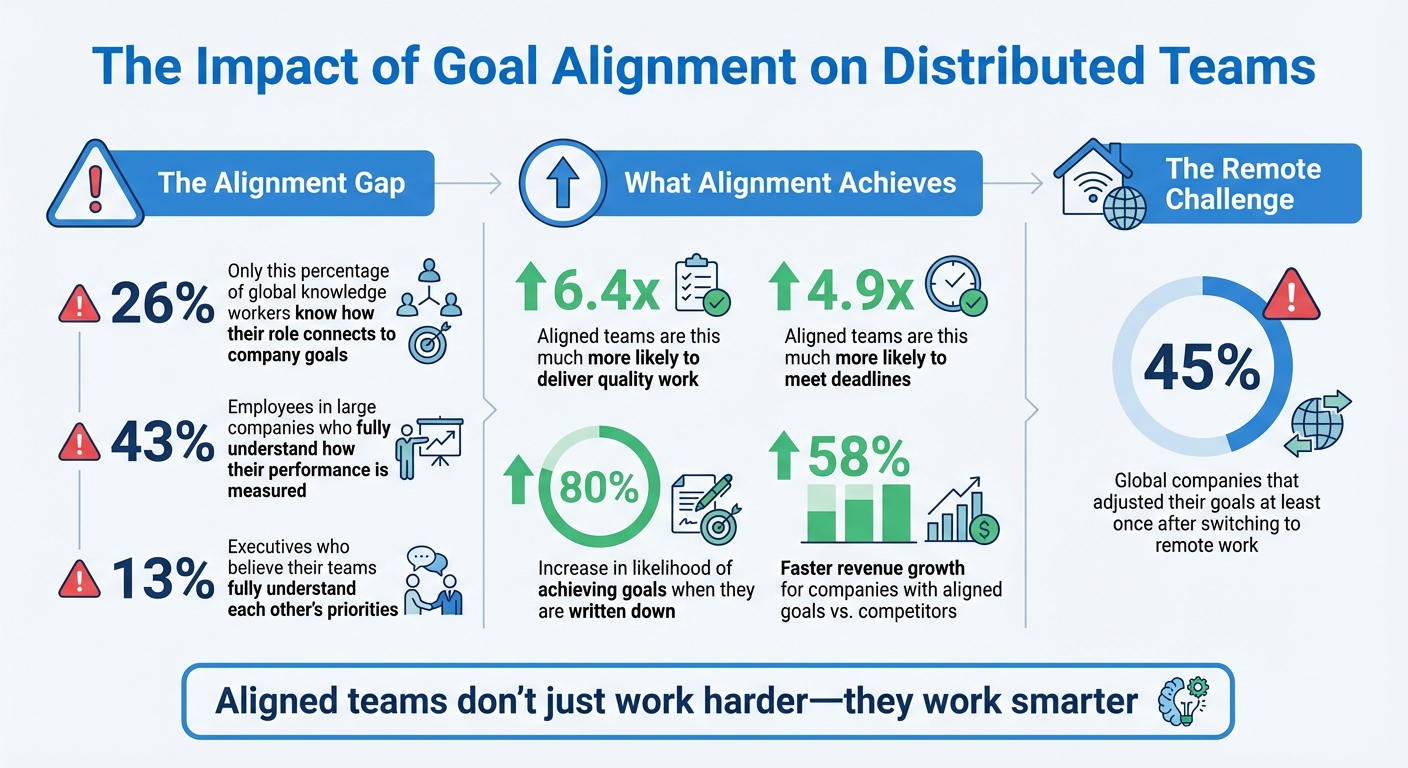
Distributed teams can thrive - if they’re aligned. But here’s the kicker: most teams aren’t. Only 26% of global knowledge workers know how their role connects to company goals. That’s a huge problem when misalignment leads to wasted time, missed deadlines, and confusion. This is where strategic alignment becomes critical for leadership.
The fix? Clear goals, visible progress, and better communication. Here’s what works:
- Set SMART Goals: Specific, measurable, realistic, and time-bound goals keep everyone on the same page.
- Use OKRs: Objectives and Key Results help tie individual tasks to the company’s mission.
- Work Asynchronously: Tools like dashboards and Loom videos cut down on endless meetings.
- Create Working Agreements: Define how your team communicates, makes decisions, and tracks progress.
- Leverage Technology: Use tools like Asana, Slack, and Trello to keep goals visible and track performance.
The result? Aligned teams are 6.4x more likely to deliver quality work and nearly 5x more likely to meet deadlines. Keep reading for practical tips, tools, and frameworks to make this happen.
Distributed Team Goal Alignment Statistics and Impact
The Simplest Exercise to Instantly Align Any Team on a Goal
sbb-itb-fe42743
Setting Clear and Measurable Goals
For remote teams, success isn't about clocking hours or being visibly busy - it’s about delivering results. Managers in distributed settings need to shift their focus from activities they can observe to the outcomes being achieved. Considering that only 43% of employees in large companies fully understand how their performance is measured [9], it’s clear how critical clarity and precision are in goal-setting.
When it comes to setting goals for remote teams, two popular frameworks stand out: SMART goals and OKRs (Objectives and Key Results). SMART goals ensure clarity by making every goal Specific, Measurable, Achievable, Relevant, and Time-bound. On the other hand, OKRs connect individual tasks to the organisation’s broader mission, creating a sense of direction and purpose.
Getting this right can make a huge difference. Studies show that writing down goals increases the likelihood of achieving them by 80% [2]. Plus, employees are more than twice as motivated when they understand how their work contributes to the company’s larger objectives [9]. However, just documenting goals isn’t enough - they need to be stored in a centralised, easily accessible system, whether that’s a knowledge base or project management tool. This ensures everyone, no matter their time zone, stays aligned. Let’s dive into how these frameworks work, starting with SMART goals.
Using SMART Goals for Remote Teams
The SMART framework is a natural fit for remote teams because it replaces vague targets with clear, actionable objectives. Here’s how each element of SMART translates to a distributed work environment:
- Specific: Clearly define who’s responsible and what the goal entails, so there’s no confusion when team members are working independently.
- Measurable: Use digital tools like dashboards to track progress with real numbers or metrics.
- Achievable: Be realistic about what can be done, factoring in resources, time zones, and workload.
- Relevant: Tie each goal to the company’s overall strategy, ensuring individual efforts align with the bigger picture.
- Time-bound: Set deadlines that respect varying working hours across different locations.
For remote teams, a few tweaks to the usual SMART process are essential. Break large goals into smaller milestones that are easier to track and manage. Adjust deadlines and check-ins to accommodate time zone differences, and assign each goal to a specific person to avoid confusion or overlap. Adopting a “default to on track” mindset, where progress is assumed unless flagged otherwise, can also help streamline communication.
When it comes to meetings, keep synchronous planning sessions short - no more than two hours - and consider asynchronous "kick-offs" where team members review materials on their own before coming together. This approach respects everyone’s work styles while keeping things focused.
"The goal-setting conversation can be a powerful unlock to bring purpose into work and connect the individual to something larger than themselves" [8].
McKinsey’s insight here highlights how SMART goals don’t just clarify tasks - they create a sense of purpose. While SMART goals provide tactical precision, OKRs take it a step further by aligning everyone with the company’s strategic vision. Let’s take a closer look at how OKRs work.
Using OKRs for Team Alignment
OKRs are all about results, not hours worked - perfect for remote teams where physical supervision isn’t an option. The framework is simple: Objectives define what you want to achieve, while Key Results outline the measurable how. By focusing on outcomes, OKRs make it easier for remote employees to see how their work fits into the company’s larger mission, breaking down the silos that often form in digital workplaces.
One of the biggest advantages of OKRs is their flexibility, which is especially useful for distributed teams. They’re typically set and reviewed quarterly, allowing teams to adapt quickly to changes - a necessity given that 45% of global companies reported adjusting their goals at least once after switching to remote work [1]. To keep things manageable, limit each cycle to three to five Objectives, with three to five Key Results per Objective [10][11][12].
It’s also a good idea to use leading indicators - metrics that can be tracked weekly or monthly - to monitor progress in real-time, rather than relying solely on lagging indicators that only show results at the end of the year [12].
Interestingly, in the OKR framework, achieving 70% of a goal (a score of 0.7) is considered successful. This encourages teams to aim high without worrying about failure [12][13]. It’s a mindset shift that promotes ambition while keeping stress levels manageable.
"If you can get people intrinsically motivated, you don't have to worry much about accountability" [13].
Brett Huff, Engineering Manager at Atlassian, captures the essence of OKRs here. When people are driven by intrinsic motivation, they naturally stay accountable. OKRs give remote teams the clarity and focus they need to stay aligned and prioritise what truly matters.
Building a Framework for Collaboration
Setting goals is just the starting point; the real challenge lies in ensuring those goals are met effectively. For remote teams, this means having a clear framework for collaboration. Without the casual conversations and visual cues of an office, teams need to rely on explicit agreements to keep things running smoothly. As Juan Pablo Buriticá, VP of Engineering at Splice, aptly puts it:
"Goal alignment and autonomy thrive in a trusting environment supported by explicit working agreements that eliminate assumptions about how to work at a distance" [3].
Interestingly, only 13% of executives believe their teams fully understand each other's priorities [7]. Throw in time zones and asynchronous communication, and things can get messy fast. The solution isn’t to pile on more meetings - it’s about having clear, documented frameworks that anyone can reference, no matter where they are or when they’re working.
Creating Working Agreements
Working agreements are like a team’s playbook - they outline how everyone will work together. These agreements cover everything from communication norms to decision-making processes. Without them, teams risk wasting time on avoidable misunderstandings about response times, meeting etiquette, or individual roles.
Start with solid communication rules. Define which channels are used for what purpose. For instance, use #announce for company-wide updates and #team for daily coordination. At the same time, discourage work-related direct messages, which can lead to silos. Set response time expectations, like replying within four business hours on team channels and within one business day for cross-team queries. This kind of clarity can ease the "always-on" pressure that remote workers often feel.
Here’s how you can tailor key elements for remote work:
| Agreement Element | Remote Tailoring Strategy | Purpose |
|---|---|---|
| Status Reporting | Default to "On Track" | Cuts down on unnecessary sync meetings |
| Meetings | 25/50-minute defaults | Allows buffer time between sessions |
| Decision Making | Written Decision Records (ADRs) | Prevents rehashing decisions across time zones |
| Availability | Define Core Hours | Ensures fair overlap for global teams |
| Feedback | Written-first approach | Gives remote workers time to process feedback |
One simple yet effective rule is the "Two-tap rule": cancel any meeting that doesn’t have an agenda and a pre-read shared at least 24 hours in advance. This small change can significantly reduce unnecessary synchronous time. For asynchronous handoffs - especially in a "follow-the-sun" setup - use standardised templates with sections like "since last handoff", "open questions", "blockers", and "decision deadlines." This ensures everyone stays on the same page.
Documentation is another biggie. Beancount.io has a great take on this:
"Treat writing as the company's API. Default to public docs, async by default, and clear owners" [6].
Every decision, plan, or process should have an owner, a dedicated page, and a clear timestamp. This approach not only keeps historical records accessible but also helps new team members get up to speed without relying on word of mouth. It’s a lifesaver for distributed teams.
Lastly, set predictable rhythms for planning and execution. For instance, you might do strategic planning quarterly and sprint reviews bi-weekly. Teams that operate across time zones and follow these rhythms often report 18% higher goal clarity [7]. It’s all about being intentional with your frameworks.
With these working agreements in place, teams are far better equipped to tackle challenges, even when they span departments.
Enabling Cross-Functional Collaboration
Once your team has nailed its internal processes, it’s time to extend those practices to cross-departmental collaboration. This is where things can get tricky. Different departments - like Marketing, Product, and Engineering - often need to work together, and without clear processes, complexity can spiral out of control. The solution? Structural clarity.
Assign a Directly Responsible Individual (DRI) to every major project. For startups or scaling firms, a fractional CTO can provide the necessary leadership to define these roles and oversee technical execution. This eliminates confusion about who’s accountable. Pair this with a Plan of Record (POR), which acts as a single source of truth for the project. A POR should outline the goals, scope, milestones, and dependencies, making it easier for everyone to stay aligned.
For major decisions, use Architecture Decision Records (ADRs). These records capture the context, options considered, and the reasoning behind the final choice. ADRs are especially helpful when new team members join or when teams across time zones revisit past decisions.
Shared metrics can also work wonders for alignment. For example, both Marketing and Product could share a customer satisfaction score, or Sales and Customer Success could jointly own retention rates. These shared goals naturally encourage collaboration and reduce siloed thinking.
To streamline communication, establish an escalation ladder:
- Start with a document
- Move to a thread
- Add comments
- Schedule a quick huddle (≤15 minutes)
- Only then, hold a meeting
This ensures asynchronous methods are fully utilised before jumping to synchronous ones, which saves time and respects everyone’s schedule. When synchronous collaboration is needed, set narrow "core hours" - two to three hours a day where everyone is available.
"Clarity is kindness. Every material decision, plan, and process has an owner, a page, and a date."
- Beancount.io [6]
This clarity is especially critical in cross-functional work, where unclear roles can derail projects. Teams that align their efforts with shared goals are 6.4 times more likely to produce high-quality work and 4.9 times more likely to hit deadlines [5]. By establishing clear collaboration protocols and measurable ownership, distributed teams can stay aligned across departments and time zones.
Using Technology to Support Goal Alignment
Once you've got clear frameworks in place, the next step is making them work seamlessly - and that's where technology steps in. The right tools can make remote work more transparent, accountable, and efficient. But here's the catch: 45% of global companies have seen their goals shift at least once since moving to remote work [1]. Without the right tech stack, those changes can leave teams scrambling to keep up.
The real magic of technology isn't about using more tools - it's about using the right tools that actually work together. If your project management software syncs with your communication platform, and your dashboards show real-time updates, your team can stay informed without drowning in endless status meetings.
The key is to pick tools that integrate smoothly and reduce unnecessary friction. Regularly audit your tech stack to ensure it's helping, not just adding noise [15]. Let’s dive into how specific tools can make goal alignment easier.
Shared Dashboards for Performance Tracking
Dashboards are a lifesaver for remote teams, cutting through the endless "where are we on this?" emails. They provide a single source of truth, pulling everything from scattered spreadsheets and slide decks into one central hub that anyone can access [1]. And this is crucial - only 26% of global knowledge workers say they clearly understand how their work connects to company goals [1].
A great dashboard does three things really well:
- It links daily tasks to big-picture goals - what Asana calls the "pyramid of clarity" [1].
- It shows real-time progress, so teams can spot issues and adjust quickly [16].
- It publicly documents responsibilities, deadlines, and ownership, driving accountability [14][1].
The impact? Companies with aligned goals grow revenue 58% faster than their competitors [17]. Plus, writing down goals and making them visible increases the likelihood of achieving them by 80% [2].
Here’s a quick look at how some popular tools support this:
| Tool | Role in Goal Alignment | Key Features |
|---|---|---|
| Asana | Goal Management | Links tasks to strategic goals; "Pyramid of Clarity" framework; portfolio tracking [1] |
| Slack | Communication | @-mentions for goals in updates; asynchronous status channels; real-time messaging [14][1] |
| Spider Impact | Performance Tracking | Automated dashboards; links strategy to metrics; real-time decision support [16] |
| Trello / Jira | Project Management | Visual task boards; clear assignees and deadlines; team-wide workflow visibility [14][15] |
One handy tip: set dashboards to default to "On Track" unless there's a blocker. This eliminates unnecessary check-ins and empowers teams to work autonomously. If something does go off track, it’s immediately visible to everyone who needs to act on it.
Another smart move? Keep goals front and centre by @-mentioning them in task comments or Slack updates [1]. This way, priorities stay where the work happens, not buried in some quarterly planning doc. Teams that align their daily work with goals are 6.4 times more likely to deliver high-quality results and 4.9 times more likely to hit deadlines [5].
This kind of centralised, real-time data flow also supports asynchronous communication, making it easier for remote teams to stay aligned.
Using Asynchronous Tools for Communication
Let’s face it: meetings can be a nightmare, especially when you’re juggling time zones. Asynchronous tools allow distributed teams to stay in sync without everyone needing to be online at the same time. This isn’t about dodging collaboration - it’s about making it sustainable and inclusive for global teams.
Take video updates, for example. Atlassian’s sales leaders swapped goal-setting meetings for short Loom videos hosted in Confluence. This allowed global teams to focus on priorities without scheduling headaches. Managers shared weekly updates via Loom, and teammates could watch at 2× speed and leave comments on specific parts [5]. The result? Less meeting fatigue and better retention of information.
Platforms like Notion and Confluence act as centralised knowledge bases for technical specs, architecture decisions, and team playbooks [19]. This ensures that everyone stays aligned, even if they missed a meeting. GitLab took this a step further: by 2025, they managed 95% of their technical specs with automated templates and version-controlled docs. This boosted adoption rates to 92% and saved managers about 8 hours a week [19].
And the benefits don’t stop there. Netflix Engineering used custom workflow automation to integrate CI/CD notifications, cutting average code review times from 36 hours to just 8 - a 78% improvement. They also ramped up deployment frequency from twice weekly to eight times a week [19].
Asynchronous tools also tackle the productivity killer that is context switching, which costs developers an average of 23.5 minutes every time they switch tasks [19]. By letting people process information on their own schedule, these tools reduce interruptions and keep workflows smooth. Pair this with clear ownership in your dashboards - every goal should have an owner and a deadline [1] - and you’ve got a system that respects both autonomy and accountability.
The trick is finding tools that work well together. Use Slack for quick coordination and peer recognition, Notion for documentation and tracking technical debt, and Asana for linking tasks to high-level objectives [20][19][1]. When these tools are in sync, they create a seamless flow of information that keeps everyone aligned, no matter where - or when - they’re working.
Measuring and Adjusting Goals Over Time
With solid frameworks and the right tools in place, the next step is ensuring your goals stay aligned with your evolving business needs.
Setting goals is the easy part. The real challenge? Keeping them relevant as things change. Here's a stat to chew on: 45% of global companies have had to adjust their goals at least once since transitioning to remote work [1]. Without proper systems to track and tweak those goals, teams can quickly find themselves out of sync.
To avoid this, create feedback loops that catch issues early and focus on meaningful metrics. Remote teams can't depend on the casual chats that happen in an office. Instead, they need intentional processes to identify problems before they snowball.
Setting Up Feedback Loops
Once you've laid the groundwork for collaboration, regular feedback becomes essential to stay on the same page.
The good news? Feedback loops don’t have to mean endless meetings. You can weave them into your team’s day-to-day flow. For example:
- Daily async standups: Quick updates on progress.
- Weekly team reviews: Space to demo work and tackle blockers.
- Quarterly planning sessions: Time to recalibrate priorities [6].
A smart approach is the "Default to On Track" method. Basically, everything is assumed to be going smoothly unless flagged otherwise [2]. This approach slashes the need for constant check-in emails and meetings. If someone does raise a flag, treat it as a top priority and offer support, not blame.
"Anything less than perfect clarity around performance in a remote setting essentially sabotages a remote worker's chances of turning a situation around."
- The Holloway Guide to Remote Work [4]
Some companies have nailed this rhythm. Basecamp, for instance, runs on six-week cycles, which gives teams a steady flow for planning and execution [3]. GitLab takes it further, mapping out strategies that scale from 30-year plans down to daily tasks [3]. The trick? Find a rhythm that works for your team and stick to it.
When priorities shift, update dashboards and communicate the changes clearly and immediately. In a remote setup, there’s no overhearing someone’s conversation in the hallway - clear communication is non-negotiable.
Defining Metrics for Success
Focus on metrics that show real outcomes - like the quality and timing of work - rather than hours worked or how "busy" someone looks [7]. Key metrics can be split into two categories:
- Strategic metrics: These include things like Annual Recurring Revenue (ARR), subscriber growth, or market share. They tell you if you're hitting big-picture goals [18].
- Operational metrics: These measure how well your team is functioning, like customer satisfaction scores, system reliability, or feature delivery timelines [3][18].
How often you review these metrics is just as important as the metrics themselves. For strategic goals, aim for an annual review with quarterly check-ins. For execution, track progress weekly, with daily updates for individual tasks using the "on track" default [2][3][5].
Here’s a worrying stat: only 13% of executives say their teams have full visibility into each other's priorities and progress [7]. A simple fix? Limit your team to 3–5 major goals per year to avoid spreading focus too thin [5]. Use frameworks like "Goals, Signals, Measures" to stay organised - define what you’re trying to achieve (Goals), how to track progress (Signals), and how to measure success (Measures) [18].
Juan Pablo Buriticá, Splice’s VP of Engineering, learned this lesson the hard way. It took his team six quarters of trial and error with OKRs to go from over-ambitious brainstorming to setting achievable, capacity-driven goals [2]. His takeaway? Start small, measure obsessively, and adjust as you learn what’s realistic for your team.
"Stubbornly sticking to outdated goals isn't discipline - it's spinning your wheels while your competitors pull ahead."
- Erin Mosbaugh, Content Strategist, Atlassian [5]
Assigning a Directly Responsible Individual (DRI) to each project ensures someone is accountable for hitting success metrics and making decisions [6]. And don’t just call something "done" when the code’s written - make sure documentation is updated, and metrics are in place. That’s your "Definition of Done" [6].
Lastly, don’t forget to celebrate wins. Use Slack channels like "#high-five" or "#shipped" to spotlight achievements [6]. In a remote setting, these moments of public recognition can do wonders for morale, especially when the pace of change feels relentless.
Conclusion
After diving into frameworks, collaboration methods, and tech tools, it’s clear how these pieces come together to fuel success for distributed teams.
The key isn’t about replicating office dynamics - it’s about creating a system that works better. Moving from valuing physical presence to focusing on measurable outcomes means relying on goal-setting frameworks, deliberate collaboration, and technology that connects teams across time zones without adding barriers.
Here’s a staggering stat: only 26% of global knowledge workers actually know how their tasks tie into broader company goals [1]. That’s a lot of wasted energy and misplaced priorities. The fix? It’s not about endless meetings or stricter management. Instead, it’s about writing goals down (which, by the way, boosts success rates by 80% [2]), defaulting to an "on track" status to cut back on constant status updates [2][3], and treating documentation as the backbone of your organisation - like an API for your team [6].
"In a remote team, this level of clarity is not just preferred, but essential - it's much more difficult to fall back onto micro-managing to fill communication and expectation gaps."
- The Holloway Guide to Remote Work [4]
FAQs
How can remote teams use OKRs to align with company goals effectively?
OKRs (Objectives and Key Results) can be a game-changer when it comes to keeping remote teams on the same page with company goals. The trick is to make sure the objectives are crystal clear, measurable, and tied directly to what the organisation is prioritising. When everyone understands how their efforts contribute to the bigger picture, it creates a real sense of purpose and direction.
Communication is absolutely essential here. Regular check-ins are a must - use these sessions to go over progress, share feedback, and tweak goals if things aren’t quite on track. Collaborative tools like shared dashboards or project management software can help keep everything visible and ensure accountability. This way, no one’s left in the dark, and the whole team stays aligned.
On top of that, trust and clear expectations are non-negotiable. When everyone knows what’s expected of them and feels trusted to deliver, you avoid those frustrating misunderstandings and keep the team focused on shared outcomes.
By weaving OKRs into your team’s regular routines and keeping everything open and transparent, remote teams can stay motivated, in sync, and fully aligned with the organisation’s goals.
How can remote teams effectively set and align SMART goals?
When it comes to remote teams, clarity, documentation, and alignment with your organisation's overall priorities are key. Goals need to be crystal clear so everyone understands not just what they’re doing, but why it matters. When you write goals down, you’re not just jotting notes - you’re boosting accountability and making success much more likely.
SMART goals - specific, measurable, achievable, relevant, and time-bound - are like a compass for remote teams, keeping everyone focused and results-oriented. To stay on track, regular check-ins and updates are a must. This ensures everyone’s on the same page, even if they’re in different time zones. Tools that let everyone track goals in one place? They’re a game-changer for transparency and teamwork in distributed teams.
How can technology help distributed teams align their goals effectively?
Technology plays a key role in keeping distributed teams on the same page by encouraging clear communication, openness, and a shared sense of purpose. Think of tools like project management platforms, collaboration software, or goal-tracking apps - they act as a virtual hub where teams can document, update, and track progress in real time. This cuts down on confusion and ensures everyone knows what’s happening, even if they’re miles apart.
Take communication tools like Slack or Microsoft Teams, for example. These platforms make it easy to keep the conversation flowing, whether the team is scattered across different time zones or working remotely. Using these tools for regular check-ins or quick updates helps build accountability and keeps motivation high.
When teams use the right tech, they can stay focused, adjust to shifting priorities, and hit their goals without missing a beat. It’s like having a digital glue that holds everything together, no matter where everyone is working from.