
Building a Tech Team Across Time Zones: 9 Lessons from Managing UK-Ukraine-Poland-Israel Teams

Building a Tech Team Across Time Zones: 9 Lessons from Managing UK-Ukraine-Poland-Israel Teams
A distributed engineering team is a group of software developers, designers, and technical leads working together on the same product from different countries and time zones - typically spanning 2-8 hours of offset - using structured async and sync communication to maintain delivery velocity without co-location. At Metamindz, we've been running teams across the UK, Ukraine, Poland, and Israel for years. Not as a theory exercise. As the actual way we build and ship software for clients every day.
So.. everyone talks about distributed teams like it's a logistics problem. "How do you do standups?" "What tools do you use?" Those are the wrong questions. The real challenge is context preservation - making sure the person picking up work in Kyiv at 9am has exactly the same understanding as the person who put it down in London at 6pm. Get that wrong and you're paying for two teams that operate like strangers sharing a codebase.
I've made most of the mistakes you can make with distributed teams. Tried the "just use Slack and figure it out" approach. Tried over-engineering processes until everyone drowned in documentation nobody read. What I've landed on - after years of iteration across dozens of client engagements - is a set of practices that actually work. Here are the 9 lessons I keep coming back to.
1. Protect Your Overlap Hours Like They're Revenue
London to Kyiv is a 2-hour offset. London to Tel Aviv is 3 hours in summer, 2 in winter. London to Warsaw is 1 hour. That gives us a solid 4-5 hour daily overlap window across all four locations, typically 10am-3pm London time.
Those hours are sacred. All synchronous work - sprint planning, architecture discussions, code review walkthroughs, client demos - happens in that window. Everything outside it is async. No exceptions. Research from N-iX shows that high-performing distributed teams maintain 3-4 hours of overlap and avoid "always-on" expectations. We've found 4 hours is the sweet spot for our setup.
The mistake most teams make: they don't enforce the boundary. Someone schedules a "quick call" at 5pm London time, which is 8pm in Israel. Do that three times and your best engineer in Tel Aviv starts looking for local jobs. Respect the boundary or lose the people.
2. Structured Handoffs Beat Status Updates
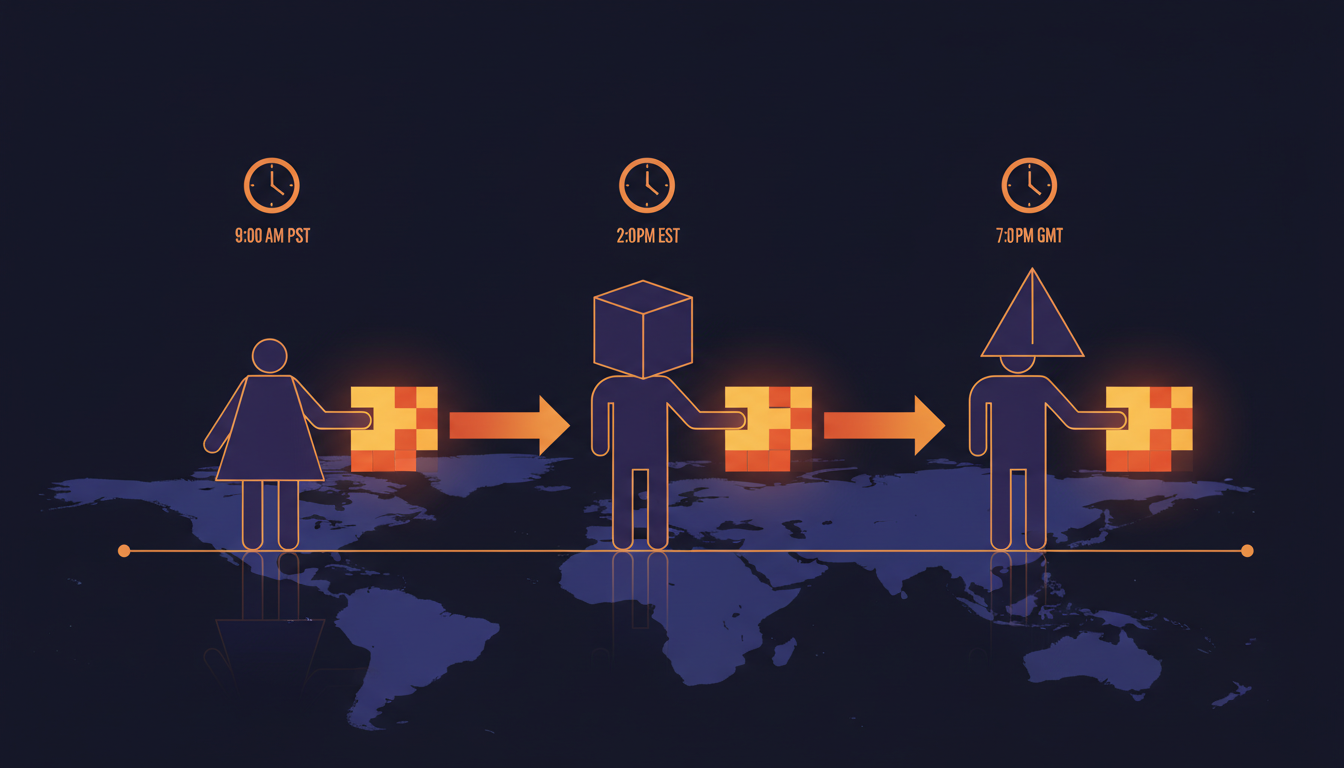
Daily standups are fine when everyone's in the same room. When you're spanning time zones, they become a performance ritual that adds latency without adding information. We replaced standups with structured end-of-day handoffs.
Every engineer posts a handoff at the end of their working day in a dedicated Slack channel. Not a free-text "here's what I did" message. A structured format:
- Completed: what shipped or merged, with PR links
- In Progress: what's partially done, where it's at, what the next step is
- Blocked: what can't move forward and who/what is needed to unblock it
- Context: anything the next person picking this up needs to know that isn't in the ticket
That last field - Context - is the one that makes the difference. "I refactored the auth middleware but the tests are still using the old mock pattern, don't be alarmed by the failures" saves someone 2 hours of confusion the next morning. StandIn's 2026 research calls this "state declaration" - and teams that do it properly report 40% fewer blocked tickets.
3. Default to Async, Earn Your Way to Sync

We run an explicit communication hierarchy. Before scheduling a meeting, you need to demonstrate that async didn't work. The rule is:
- Written message (Slack): progress reports, non-urgent questions, end-of-day handoffs
- Recorded video (Loom): walkthroughs, demos, anything visual or complex to type
- Scheduled meeting (Google Meet): architecture decisions, conflict resolution, client-facing work, onboarding
This isn't about being anti-meeting. It's about respecting that every synchronous meeting costs 3-4x what you think when you factor in time zone coordination, context switching, and the prep tax for people joining outside their core hours. Research shows remote workers achieve 6.2 hours of deep focus daily - meetings chew through that fast.
4. Build a Documentation Culture or Fail Slowly
I used to think good documentation was a nice-to-have. After running distributed teams for years, I know it's the single biggest predictor of whether a cross-timezone team will ship well or descend into chaos.
We use Notion as our single source of truth. Every significant technical decision gets an Architecture Decision Record (ADR) with context, options considered, and rationale. Not because we enjoy writing documents - because six months from now, when someone in Warsaw needs to understand why we chose PostgreSQL over MongoDB for a particular service, "ask Dave, he was there" doesn't work when Dave left two months ago.
The specific things we document that most teams don't: deployment procedures for each environment, the "why" behind non-obvious code patterns (not just what the code does), client-specific quirks and preferences, and escalation paths when something breaks at 2am. BETSOL's research confirms this: documentation is the backbone of effective distributed collaboration because unlike co-located teams, you can't rely on the person sitting next to you to explain things.
5. CTO-Led Oversight, Not PM-Led Telephone
This is where most outsourcing arrangements fall apart. The typical setup: a non-technical project manager sits between the client and the dev team, translating requirements they don't fully understand and filtering technical concerns they can't properly evaluate. Information degrades at every handoff.
At Metamindz, every distributed engagement has a CTO or senior technical lead who works directly with the client AND directly with the dev team. No translation layer. The same person who understands the business context reviews the pull requests. The same person who spots an architecture concern can explain the trade-off to the founder in business terms.
| Aspect | Typical Outsourcing Model | CTO-Led Model (Metamindz) |
|---|---|---|
| Client communication | Through non-technical PM | Direct with CTO/tech lead |
| Technical decisions | Made by devs, PM relays outcome | Made collaboratively with CTO oversight |
| Code quality | Reviewed internally (if at all) | CTO-reviewed with documented standards |
| Architecture changes | Discovered in retrospect | Discussed and documented before implementation |
| Vendor lock-in | Common - poor docs, proprietary patterns | No lock-in - full documentation, handover-ready |
| Daily updates | Summary email from PM | Shared Slack workspace, real-time visibility |
| Problem escalation | Hours to days through PM chain | Minutes - CTO identifies and acts directly |
This isn't just a Metamindz pitch - it's the lesson I've learnt from seeing dozens of client relationships where the non-technical middleman was the bottleneck. If you're running a distributed team and your technical lead doesn't talk to the client directly, you're paying for a game of telephone.
6. Hire for Async Competence, Not Just Technical Skill
Not every brilliant engineer works well in a distributed setup. Some people need the energy of a room. Some can't write a clear ticket description to save their life. Some will Slack you "hey, got a minute?" at midnight your time instead of writing down the actual question.
When we recruit for distributed roles, we screen specifically for async communication skills. Can they write a clear problem description? Do they proactively document their work? Can they unblock themselves for 4 hours before escalating? These aren't personality quirks - they're core competencies for distributed work.
82% of companies now use remote work as their default hiring model, which means the talent pool is enormous. But "can work remotely" and "thrives in a multi-timezone async-first team" are very different things. We've learnt to test for the second one explicitly.
7. Consolidate Your Tools or Drown in Tabs
In 2026, the trend is clear: distributed teams that perform well use fewer tools, not more. We've consolidated to a core stack:
- Slack - all day-to-day communication, structured channels per project, handoff channels
- Notion - documentation, ADRs, project wikis, onboarding guides
- Linear - issue tracking, sprint management, roadmap
- GitHub - code, PRs, CI/CD, code review
- Google Meet - sync meetings during overlap hours
- Loom - async video walkthroughs and demos
That's it. Six tools. Every new tool suggestion has to pass the "does this replace something or does it add another tab?" test. 2026 research from Guideflow shows that teams are consolidating to 2-3 core platforms because context-switching between tools kills productivity just as much as time zone gaps do.
8. Rotate the Inconvenience
Here's something most distributed team guides skip. When you have teams in multiple time zones, someone always gets the short end on meeting times. The Monday planning call at 10am London is noon in Israel and 11am in Poland. Fine. But the Friday retrospective at 4pm London is 7pm in Israel.
We rotate meeting times quarterly so the same team doesn't always get the 7pm slot. It sounds trivial. It's not. N-iX's distributed teams research found that teams with strong distributed culture - which includes fairness in scheduling - report 35% higher retention rates. When your senior backend dev in Kyiv feels like the schedule always favours London, they'll leave. Not because of the inconvenience itself, but because of what it signals about whose time the company values.
9. Weekly Demo Calls Are Non-Negotiable
With all the async communication, structured handoffs, and documentation, you still need one ritual that brings everyone together synchronously. For us, that's the weekly demo call.
Every Friday during overlap hours, each engineer shows what they shipped that week. Not a presentation. Not slides. Actual working software. Screen share, click through it, explain the decisions. Takes 30-45 minutes for a team of 5-6.
Why it matters: it's the one moment each week where the entire distributed team sees the product moving forward together. It builds shared context that no amount of Slack messages can replace. It also catches misalignments early - when the Ukraine team demos a feature that doesn't match what the London team expected, you find out on Friday, not three weeks later in QA.
The Real Numbers: Why UK-Eastern Europe Works
I'm often asked why we specifically run teams across the UK, Ukraine, Poland, and Israel rather than going fully offshore to India or the Philippines. The answer is practical, not ideological:
| Factor | UK + Eastern Europe/Israel | UK + South/Southeast Asia |
|---|---|---|
| Time zone offset | 1-3 hours | 5-8 hours |
| Overlap hours (with London) | 4-6 hours daily | 1-3 hours daily |
| Travel time | 2-4 hour flights | 8-12 hour flights |
| Cost savings vs UK rates | 30-50% | 50-70% |
| English proficiency | 55%+ upper-intermediate or above | Varies widely |
| Cultural alignment with UK work style | High - European work culture | Moderate - different norms |
| Real-time collaboration feasibility | Daily, natural | Limited, requires scheduling |
Yes, you save more money going to South Asia. But 67% of organisations now prioritise business outcomes over cost savings in vendor relationships. When your overlap window shrinks to 1-2 hours, you're not running a distributed team - you're running two separate teams that occasionally sync. The coordination cost eats the salary savings.
The 2026 nearshore market data backs this up: UK companies are increasingly choosing Eastern European partners specifically because the 1-3 hour offset enables genuine real-time collaboration rather than fire-and-forget task delegation.
When Distributed Is the Wrong Choice
I'd be dishonest if I didn't say this: distributed teams aren't always the right answer. If you're a 2-person founding team figuring out product-market fit and you need to pivot weekly, co-location (or at minimum the same time zone) is probably better. The overhead of structured handoffs and documentation doesn't justify itself when the entire product direction changes every fortnight.
Distributed works when you have clarity on what you're building and need to scale execution. It works when you've defined your architecture and processes well enough that async communication carries enough context. It works when you have a technical leader who can bridge the gaps and maintain quality across locations.
If you're unsure whether your setup is ready for distributed, that's a conversation worth having before you hire across borders. We've told clients "you're not ready for this yet" more times than I can count - and that honesty saves them six months and a lot of money.
Frequently Asked Questions
How many hours of time zone overlap do you need for a distributed engineering team?
A minimum of 3-4 hours of daily overlap is the sweet spot for distributed engineering teams. This provides enough time for synchronous activities like sprint planning, architecture discussions, and code review walkthroughs, while leaving the remaining hours for deep async work. Teams spanning more than 5 hours of offset struggle to maintain this minimum and should consider a follow-the-sun model with structured handoff protocols instead.
What is the biggest mistake companies make with distributed development teams?
The single biggest mistake is treating distributed teams as a cost-saving exercise rather than an engineering discipline. Companies that go distributed purely for cheaper rates without investing in structured handoffs, documentation culture, async-first communication norms, and CTO-level technical oversight end up spending more on coordination overhead than they save on salaries. The second biggest mistake is putting a non-technical project manager as the translation layer between client and dev team.
Is nearshore development better than offshore for UK companies?
For most UK companies, nearshore (Eastern Europe, specifically Ukraine, Poland, Romania) outperforms offshore (India, Philippines) because of the 1-3 hour time zone offset versus 5-8 hours. This enables 4-6 hours of daily real-time collaboration, which is enough for genuine team cohesion. You save 30-50% versus UK rates with nearshore compared to 50-70% with offshore, but the coordination savings and quality of collaboration typically make nearshore the better overall value.
What tools do distributed engineering teams need in 2026?
The best distributed teams in 2026 use fewer tools, not more. A core stack of Slack (communication), Notion (documentation and decision records), Linear or Jira (issue tracking), GitHub (code and CI/CD), Google Meet or Zoom (sync meetings), and Loom (async video) covers everything. The trend is toward consolidation to 2-3 core platforms to reduce context-switching, which kills productivity just as much as time zone gaps.
How does Metamindz manage distributed development teams differently?
Every Metamindz distributed engagement is led by a CTO or senior technical lead who works directly with both the client and the dev team - no non-technical project manager translating in the middle. We run shared Slack workspaces with structured daily handoffs, weekly demo calls, and documented architecture decisions. Our teams across the UK, Ukraine, Poland, and Israel operate with 4-5 hours of daily overlap, async-first communication norms, and no vendor lock-in through comprehensive documentation. Learn more at metamindz.co.uk/services/software-app-development.