
How to Choose Between Local, Nearshore, Offshore Hiring
How to Choose Between Local, Nearshore, Offshore Hiring
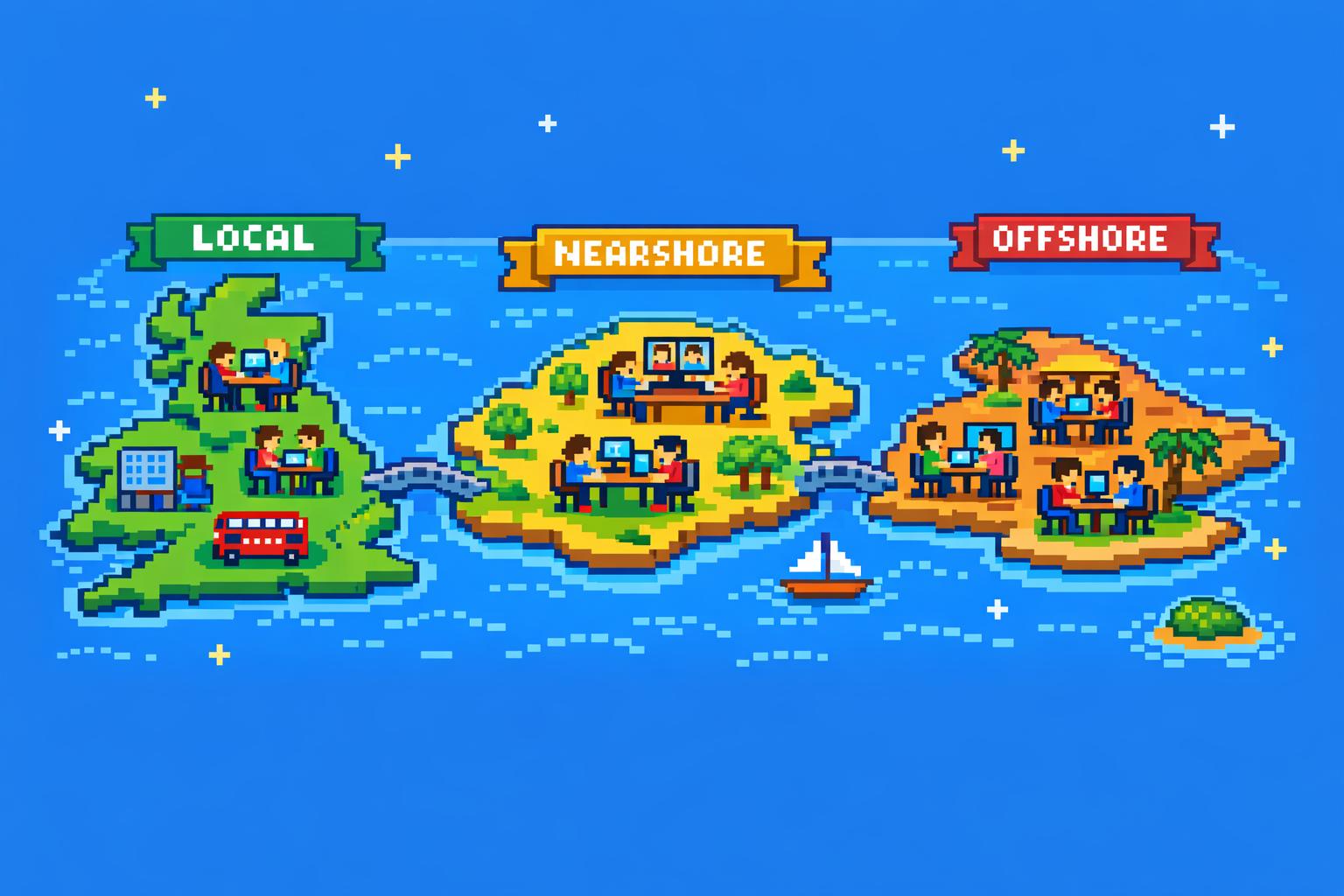
When deciding how to hire for your tech project, you’ve got three main options: local, nearshore, and offshore. Each has its pros and cons, and the right choice depends on your budget, collaboration needs, and project goals. Here’s the gist:
- Local (UK-based): Offers the best communication and alignment with your team but comes with the highest costs. Ideal for leadership roles, sensitive projects, or when in-person collaboration is vital.
- Nearshore (Europe): Strikes a balance between cost and collaboration. Nearby countries like Poland or Romania offer skilled talent, lower rates, and minimal time zone differences. Great for Agile projects needing real-time teamwork.
- Offshore (Asia): The cheapest option with access to large talent pools in countries like India or Vietnam. Best for scaling quickly or structured tasks but can face delays due to time zones and cultural gaps.
Quick Comparison
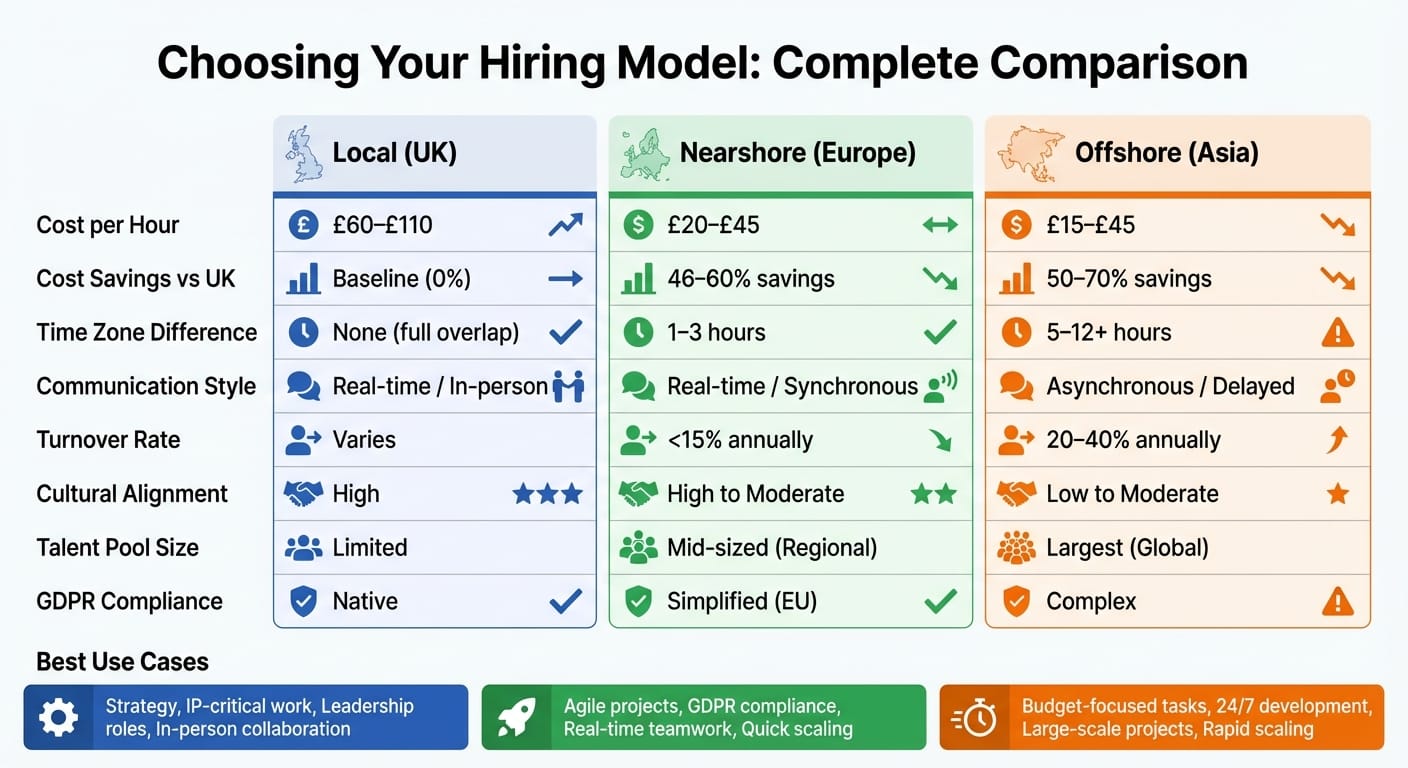
| Hiring Model | Cost (£/hour) | Time Zone Overlap | Turnover Rate | Best Use Case |
|---|---|---|---|---|
| Local (UK) | £60-£110 | Full overlap | Varies | Leadership, sensitive projects |
| Nearshore (EU) | £20-£45 | 1-3 hours | <15% | Agile projects, GDPR-compliant work |
| Offshore (Asia) | £15-£45 | 5-12+ hours | 20-40% | Scaling, budget-focused tasks |
Key takeaway: If budget is tight, offshore hiring is tempting but may slow you down. For most UK teams, nearshore hiring offers the best mix of affordability and collaboration. Want a deeper dive? Keep reading for practical tips on choosing the right model for your needs.
Local vs Nearshore vs Offshore Hiring: Cost, Time Zones & Best Use Cases Comparison
What to Consider When Choosing a Hiring Model
Budget and Cost Structure
Budget is the foundation for every hiring decision - not just in terms of hourly rates but the overall costs involved. For instance, a mid-level developer in the UK or Western Europe might charge between £60-£110 per hour. Compare that to Eastern European nearshore developers, who typically cost £20-£45 per hour, or offshore teams in Asia, where rates range from £15-£45 per hour [7][9]. But don’t forget, hiring locally comes with additional expenses - around 20-30% more - due to things like healthcare, pensions, office space, and recruitment fees.
Nearshore hiring can save you 46-60% compared to UK rates while keeping management overheads low. Offshore teams, on the other hand, might cut costs by 50-70%, but you’ll likely need to factor in an extra 30-50% for coordination, management, and quality assurance [9].
"The cheapest talent isn't the one with the lowest hourly rate. It's the talent that slots into your workflow seamlessly, demands the least management overhead, and delivers quality work on time - cutting down on expensive delays and do-overs."
Here’s something to think about: a nearshore developer with a higher hourly rate might save you money overall because they can resolve issues faster thanks to real-time communication. In contrast, a cheaper offshore option could lead to delays, with problems taking up to 48 hours to fix. Long-term projects also need to consider turnover rates - nearshore teams typically see less than 15% annual attrition, while offshore hubs like India face 20-40% [7].
These cost factors tie directly into how you plan schedules and manage communication, which we’ll dive into next.
Time Zones and Working Hours
Time zones can make or break daily collaboration. Local teams obviously work within the same hours, making real-time communication easy. Nearshore teams - think Poland, Romania, or Portugal - operate just 1-3 hours ahead of UK time, which works brilliantly for Agile projects that need quick iterations, daily stand-ups, and immediate debugging [7].
Offshore teams in Asia, however, often deal with a 5-12+ hour time difference [7][3]. While the "follow-the-sun" model might sound appealing for keeping work moving 24/7, it can also create frustrating delays. For example, if a bug is found at 4pm in London, it might not be addressed until the next morning, unlike the near-instant fixes possible with nearshore teams [7].
"The proximity in time zones allows for real-time communication, immediate problem-solving, and seamless integration with in-house teams."
Offshore teams can still be a great fit for structured, well-defined tasks like maintenance, handling support tickets, or managing back-office functions - areas where continuous coverage really shines [3][5].
Language and Cultural Alignment
Language and cultural differences are often the silent killers of software projects [1]. It’s not just about speaking English - it’s about understanding context, tone, and communication styles. According to the Education First English Proficiency Index, only 31 out of 112 countries rank highly for English proficiency [1].
Poland, ranked 15th globally for English skills, is a standout nearshore option [12]. Meanwhile, UK-based teams naturally avoid these barriers altogether. Eastern Europe also tends to align well culturally, offering minimal friction in day-to-day interactions.
Consider Boeing’s move in early 2022 to nearshore operations to Mexico. After years of offshore outsourcing led to quality issues, they aimed to reduce cultural disconnects and rebuild trust [8]. Similarly, IBM’s DemandTec division grew its annual revenue from $5 million to $65 million by leveraging nearshore developers in Latin America, benefiting from shared cultural and time zone alignment [2].
To mitigate potential issues, test English proficiency during recruitment, establish direct communication channels with engineers, and consider cross-cultural training for both local and remote teams [12][6].
Access to Skills and Expertise
Your hiring model directly impacts the skills you can tap into. Sticking to local hiring limits you to UK-based developers, which might not cover niche areas like AI, fintech, or cybersecurity. Nearshore hiring opens up access to Europe’s tech talent, with countries like Poland, Romania, and Portugal offering strong ecosystems and expertise in modern technologies.
Going offshore expands your reach even further. India, for example, is home to millions of developers, while Vietnam and the Philippines are emerging as tech hubs. Companies are increasingly prioritising specialised skills over geographical proximity.
"The talent Near provided is incredibly high quality. I worked at Google for 10 years... and I would say the people I placed through Near are comparable to the people I worked with at Google."
- Ashley Black, Founder, Candid Consulting [4]
Take FairMoney as an example. In 2025, they partnered with Netguru to strengthen their engineering team, optimising KYC processes and improving app stability, which cut their time-to-market by 30% [11]. Similarly, BigCommerce scaled its developer team to over 30 members in just six months by leveraging nearshore and offshore talent in Eastern Europe [11].
A hybrid approach often works best: keep local technical leaders to drive culture and decisions, while scaling development work with nearshore or offshore teams [4]. The talent pool you choose will have a direct impact on costs, time management, and how well teams integrate culturally.
Offshore vs. Nearshore Hiring: Which One Is Better?
Comparing the Three Hiring Models
Now that we've gone over what drives each hiring decision, let’s take a closer look at how local, nearshore, and offshore hiring models compare in practice. Each comes with its own set of strengths and trade-offs. Below, we’ll break down the benefits and limitations of each to help you figure out which approach best suits your project’s needs.
Local Hiring: Benefits, Drawbacks, and When to Use It
Local hiring - keeping your team based in the UK - offers the highest level of control and alignment in terms of culture, language, and working hours. This setup allows for seamless real-time communication, making it a great choice for tasks like core strategic planning, architectural decisions, and projects involving sensitive information. However, this model comes at a premium. UK-based developers typically charge between £60 and £110 per hour, and additional expenses like recruitment costs, office space, pensions, and healthcare push the overall price even higher. Another challenge? The local talent pool is relatively small compared to global options.
When to use local hiring: This model shines when you're building a technical leadership team, working with sensitive intellectual property, or need in-person mentoring and frequent face-to-face collaboration.
| Feature | Local (UK) | Nearshore (Europe) | Offshore (Asia) |
|---|---|---|---|
| Time Zone Difference | None | 1-3 hours | 5-12+ hours |
| Hourly Rate | £60-£110 | £20-£45 | £15-£45 |
| Cultural Alignment | High | High to Moderate | Low to Moderate |
| Talent Pool | Limited | Mid-sized (Regional) | Largest (Global) |
| Best For | Strategy, IP-critical work | Agile projects, GDPR compliance | Scaling, 24/7 development |
Next, let’s see how nearshore hiring offers a middle ground between cost and collaboration.
Nearshore Hiring: Benefits, Drawbacks, and When to Use It
Nearshore hiring - working with teams from countries like Poland, Romania, or Portugal - strikes a balance between cost savings and collaboration. You can typically save 46-60% compared to UK rates, while still being in similar time zones (1-3 hours difference). This makes daily stand-ups, Agile sprints, and real-time debugging much more manageable. Another plus? Nearshore teams often have lower attrition rates - frequently under 15% annually - compared to offshore hubs. Plus, working with EU-based partners simplifies compliance with data regulations like GDPR.
Of course, there can be minor cultural differences or occasional communication quirks, but these are usually easy to navigate. Nearshore hiring is an excellent option for those who want to maintain effective collaboration without the higher costs of local hiring.
When to use nearshore hiring: Ideal for Agile projects that need real-time teamwork, quick scaling, and straightforward compliance with data protection laws like GDPR.
| Feature | Nearshore (Europe) | Local (UK) | Offshore (Asia) |
|---|---|---|---|
| Cost Savings | 46-60% vs. UK | Baseline | 50-70% vs. UK |
| Time Zone Overlap | 1-3 hours | None | 5-12+ hours |
| Communication | Real-time / Synchronous | Real-time / In-person | Asynchronous / Delayed |
| Attrition Rate | <15% annually | Varies | 20-40% annually |
| GDPR Compliance | Simplified (EU) | Native | Complex |
Offshore Hiring: Benefits, Drawbacks, and When to Use It
Offshore hiring - typically involving teams in countries like India, Vietnam, or the Philippines - offers the lowest costs and access to the largest global talent pool. Rates are 50-70% lower than UK equivalents, meaning even a small offshore team can lead to significant annual savings. In fact, the global offshore software development market is expected to reach £88.5 billion by 2030 [6].
That said, the time zone differences (5-12+ hours) can slow things down, as communication often has to be asynchronous, delaying issue resolution. Language barriers and cultural differences can also require more structured processes and detailed documentation. Additionally, offshore teams tend to have higher attrition rates, ranging from 20% to 40%, which can be a concern for long-term projects.
Despite these challenges, offshore teams are fantastic for large-scale projects with clear requirements, especially when cost efficiency is a priority. They’re also a great fit for "follow-the-sun" development models, where tasks are handed off across time zones for continuous progress.
When to use offshore hiring: Go offshore when you need to scale quickly while keeping costs low, access specialised skills that may not be available locally, or implement round-the-clock development cycles.
| Feature | Offshore (Asia) | Local (UK) | Nearshore (Europe) |
|---|---|---|---|
| Hourly Rate | £15-£45 | £60-£110 | £20-£45 |
| Talent Pool | Largest (Global) | Limited | Mid-sized (Regional) |
| Time Zone Difference | 5-12+ hours | None | 1-3 hours |
| Best For | Scaling, 24/7 development, budget-focused projects | Strategy, IP-critical work | Agile projects, GDPR compliance |
Many companies now opt for a hybrid model - keeping strategic leadership and sensitive tasks local, while relying on nearshore or offshore teams for bulk development. This approach allows you to strike a balance between control and cost efficiency, making the most of each model’s strengths.
How to Choose the Right Hiring Model: A Step-by-Step Process
Finding the right hiring model can feel like navigating a maze. But with this framework, you can align your hiring approach with your project’s specific needs. It’s all about balancing trade-offs, considering costs, and understanding team dynamics.
Define Your Project Requirements
Start by nailing down what your project actually needs. Is it a straightforward app, or are you diving into something more complex, like an AI-driven system? The answer will dictate whether you need highly specialised skills or a broader range of talent [3].
Think about how much real-time collaboration your project demands. If you’re running Agile sprints, minimal time zone differences are a big deal [7]. Calculate the number of weekly "sync hours" you’ll need - this can help you decide whether a nearshore or offshore team makes sense.
Don’t forget compliance. For example, if GDPR or intellectual property regulations are non-negotiable, you might need local or EU-based teams [7]. And ask yourself: is this a one-off project, or are you building long-term internal expertise? The answer will shape your hiring approach [7].
Calculate the Full Cost
Hourly rates only tell part of the story. To get a true picture, calculate the Total Cost of Ownership (TCO). This means adding up not just base rates, but also recruitment fees (which can range from £2,000 to £40,000, depending on location [15]), management overhead (typically 15-30% [15]), and infrastructure costs (around £1,200-£3,600 per developer annually) [15].
Keep in mind that offshore teams may come with hidden costs. For instance, productivity often drops by 15-20% due to time zone gaps and communication barriers [15]. Worse, poor communication can lead to rework, consuming a staggering 40-70% of your project’s budget [14].
"While nearshore hourly rates are higher, factors like improved communication, reduced management overhead, higher productivity, lower attrition, and easier compliance can lead to a lower TCO over the lifespan of a project." - SmartChoice International [7]
Test Time Zone and Cultural Compatibility
Before you commit to a hiring model, put it to the test. Start by mapping out how many hours of real-time collaboration you genuinely need each day. Nearshore teams usually offer 4-6 hours of overlap, while offshore teams might only manage 1-3 hours [15].
When interviewing candidates, don’t just focus on English fluency. Make sure they understand your business context and can explain technical concepts clearly [13]. A decision matrix can help here - score candidates on factors like time zone overlap, cultural fit, and language skills [3].
Trial periods or pilot projects are another great way to test the waters. Use this time to see how well the remote team integrates into your workflows and how they respond to real-time feedback. And don’t underestimate the importance of "cultural onboarding" - it’s worth investing time to align the team with your company’s values and communication style [7].
Work with CTO-Led Recruitment Services
Hiring technical talent is hard. The difference between a developer who can bring your vision to life and one who can’t often comes down to the hiring process itself. That’s where CTO-led recruitment can make all the difference.
Take Metamindz, for example. They have active CTOs and experienced developers leading the hiring process. It starts with a fractional CTO session to pinpoint your needs, followed by in-depth technical and cultural assessments. This hands-on approach ensures that UK and Europe-based teams integrate seamlessly into your workflows - whether that’s through Slack channels, weekly check-ins, or daily updates.
For UK companies, this model offers a major advantage: CTO-level oversight from the start. Whether you’re scaling quickly with nearshore developers or building a long-term technical team, having technical leadership involved from day one helps avoid costly hiring mistakes.
Conclusion
Main Points to Remember
When choosing a hiring model, it’s all about matching the approach to your project’s specific needs. Local hiring is ideal for roles like strategic leadership, core architecture, or projects where control and alignment with local work culture are non-negotiable [4]. Nearshore teams offer a sweet spot - minimal time zone differences, enabling real-time collaboration, while still providing noticeable cost advantages [7]. Offshore teams, on the other hand, give you access to the largest talent pool at the lowest rates, making them perfect for round-the-clock operations or scaling non-critical work [7][3].
But let’s be real - hourly rates don’t tell the whole story. To make an informed choice, calculate your Total Cost of Ownership (TCO). This means factoring in everything: management overhead, potential productivity drops due to time zone gaps, and even costs related to staff turnover [7]. For Agile projects with daily stand-ups or sprints, overlapping work hours can be the difference between a smooth workflow and constant delays.
Many companies find success with a hybrid model. This approach keeps technical leadership local while leveraging nearshore or offshore teams for execution [4][3]. It’s a way to combine strategic control where it’s most needed with cost-effective scaling for everything else.
Your Next Steps
So, what’s next? Use these insights to guide your hiring decisions. Start by getting clear on your project’s requirements. Do you need strategic leadership, fast scaling, or niche expertise? Take a hard look at all the costs involved, including recruitment fees, management overhead, and any potential productivity challenges. Don’t forget about compliance - especially with regulations like GDPR - and think honestly about how much real-time collaboration your team will need.
If you’re still unsure, Metamindz can help. Founded by Lev Perlman, they specialise in CTO-led recruitment services, making hiring decisions far less daunting [16]. Every engagement kicks off with a fractional CTO session to understand your unique context and tech stack. From there, their team conducts thorough technical and cultural assessments - done by actual developers, not just recruiters skimming CVs.
"We built Metamindz because we know what founders actually need. Technical things done by technical people, with hands-on oversight. No fluff, just results." - Metamindz [16]
Whether you’re looking to hire nearshore developers in Europe or need guidance on technical strategy, starting with CTO-level advice can save you from costly missteps. Book a free consultation to discuss your hiring challenges and explore tailored solutions that align with your budget, project goals, and team dynamics [16].
FAQs
What should I consider when deciding between local, nearshore, and offshore hiring?
When deciding between local, nearshore, or offshore hiring, there are a few key aspects to weigh up. Start with your budget - how much can you realistically allocate? Then, think about the level of expertise your project demands and whether your team can handle potential challenges with remote communication.
Ask yourself: Is overlapping time zones a must for smooth collaboration? How important is it that your team aligns in terms of language and cultural understanding? And don’t forget to consider whether in-person meetings or hands-on collaboration will be necessary to get things done effectively.
You’ll also need to factor in regulatory compliance - for instance, meeting GDPR requirements if you're handling personal data. Consider the complexity of the project too. A highly intricate project might require more seamless communication and oversight. Finally, assess whether your team has the tools and skills to manage remote workers efficiently. By keeping all these elements in mind, you’ll be in a better position to choose the hiring model that fits your needs.
How can I communicate effectively with offshore teams despite time zone differences?
Effective communication with offshore teams doesn’t have to be a headache. In fact, those time zone differences can actually work in your favour if you approach them the right way. Start by setting up a core overlap window of two to three hours each day. This shared time is perfect for real-time collaboration - think daily stand-ups, quick clarifications, or making decisions on the spot. If your overlap is minimal, try rotating meeting times now and then so the early mornings or late evenings aren’t always falling on the same people. Fairness goes a long way in building team morale.
Outside of live meetings, asynchronous communication is your best friend. Make sure you’ve got a shared, well-organised space for documentation - tools like Confluence or Google Drive work a treat for this. Use platforms like Slack or Microsoft Teams for discussions, and don’t forget to tag the right person so they can jump in when they’re online. Sharing recorded demos or review sessions is another great way to keep everyone on the same page without needing everyone to be in the same (virtual) room at the same time.
Lastly, set up clear communication protocols. For example, agree on response times - urgent issues might need a reply within two hours, while non-urgent ones can wait up to 24 hours. A shared calendar showing everyone’s local times can also help avoid scheduling mishaps. Tools like Jira or Trello, updated daily, are brilliant for tracking progress and cutting down on misunderstandings. By combining a bit of structured overlap, disciplined async habits, and clear expectations, you’ll find that working across time zones can be smooth sailing.
What hidden costs should I consider when hiring offshore?
Offshore hiring can sometimes bring along some unexpected costs that might throw off your budget or timeline. For instance, you might find yourself dealing with longer onboarding and training periods, which can eat into your schedule. Then there’s the added management effort, especially if the team needs closer supervision. Let’s not forget communication delays - those time-zone differences can make even quick updates feel like a waiting game.
You might also encounter higher staff turnover rates, which means spending more time and money on recruitment. There are compliance and legal risks to navigate, particularly if you’re unfamiliar with local regulations. And, of course, there’s the frustrating possibility of needing rework due to quality issues, which can cost both time and resources.
On top of that, there are often hidden travel costs if face-to-face meetings become necessary, infrastructure investments to support remote work, and the time it takes to integrate offshore teams into your organisation’s workflow. By weighing these factors carefully, you’ll be better prepared to manage these challenges and avoid unwelcome surprises later on.