
How to Get Your Codebase DD-Ready: A 30-Day Pre-Raise Sprint
How to Get Your Codebase DD-Ready: A 30-Day Pre-Raise Sprint
A 30-day codebase preparation sprint for technical due diligence covers four areas in sequence: IP and legal audit, security and vulnerability triage, architecture documentation, and CI/CD and test coverage. Most founders skip this entirely and find out on the call with an investor's technical reviewer. Starting this sprint before a term sheet lands puts you in the room with leverage, not a list of problems you didn't know about.
I've done a lot of fractional CTO work and technical due diligence engagements. One pattern I keep seeing: founders who are brilliant at fundraising, sharp on product, good on numbers - and then completely blindsided when a technical reviewer opens the hood. Not because their product is bad. Because they never thought about what the codebase looks like to an outsider.
According to Sphere, nearly 60% of investment deals fall through due to problems uncovered during technical review, and tech issues discovered during due diligence can reduce valuation by up to 20%. Variant Systems puts the AI-generated codebase penalty even higher - 15-30% valuation reduction where there's high model dependency and a weak documentation trail.
If you're 6 months from a raise, you have time to fix all of this properly. If you're 30 days out, you have time to fix the things that actually kill deals. This post is about the second scenario.
Why Most Startups Fail Technical Due Diligence
It's rarely the technology itself. I've seen solid codebases fail DD because of paperwork. I've seen messy codebases pass because the team had a credible remediation plan documented and ready. What investors' technical reviewers are actually looking for is evidence that the team understands what they have, what's wrong with it, and what they'd do about it.
According to Peony's 2026 data room analysis, the two most common deal-breakers are missing IP assignment agreements and undocumented architecture. Both are fixable. Neither requires rewriting code. They require a sprint of organised, deliberate work - which most founders simply haven't done.
Forrester estimates that 75% of tech decision-makers are dealing with moderate-to-severe technical debt in 2026. So you're not being judged against perfection. You're being judged against whether you can articulate what you know, what you've deferred, and why. That's a very different bar - and a much more achievable one if you prepare.
The other thing worth saying: 70% of private investors now require technical due diligence before committing capital, up from around 40% five years ago. It's not an edge case anymore. If you're raising a Series A, or entering any acquisition conversation, a technical reviewer is coming. The question is whether they find a story you've told, or one they have to piece together themselves.
The 30-Day Sprint Plan
This isn't a cleaning exercise. It's a structured audit and documentation sprint. The goal is a codebase and data room that can survive 2-4 weeks of external technical scrutiny without producing surprises. Here's how to run it.
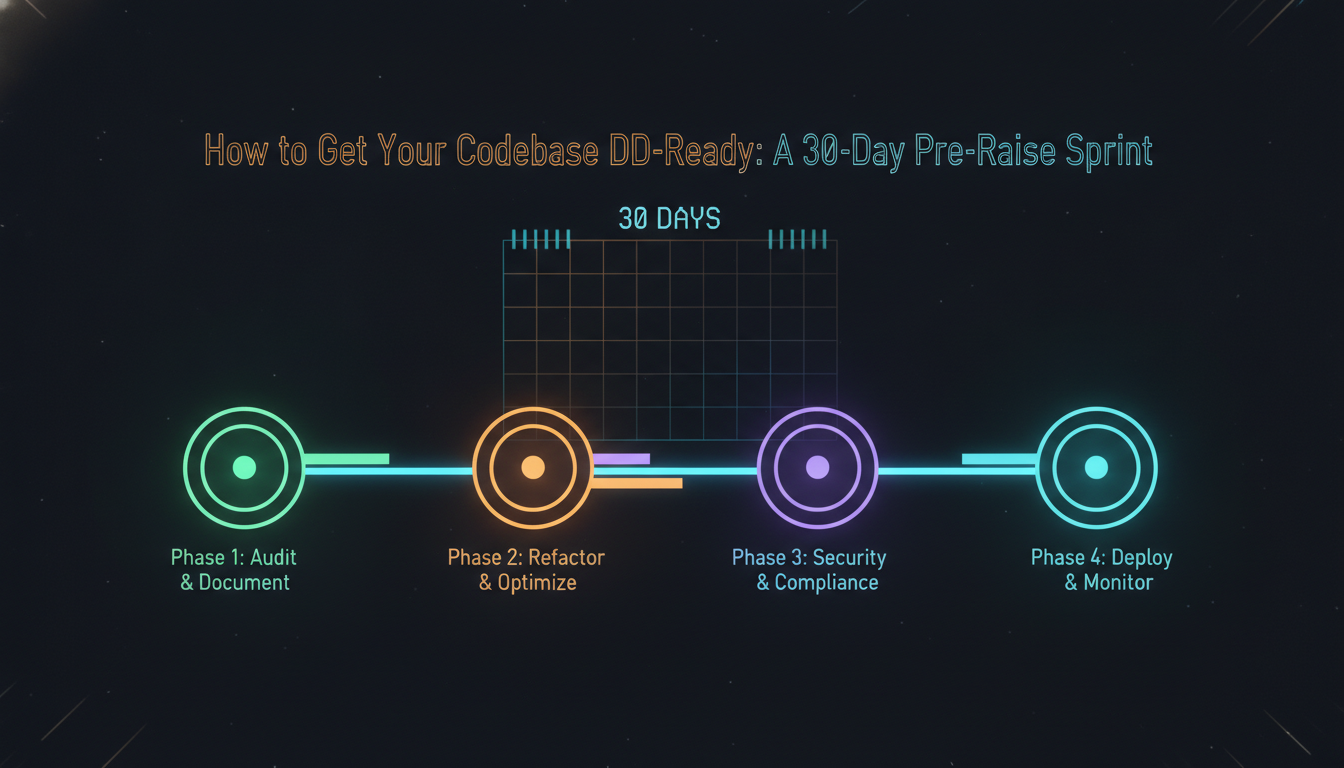
Week 1 - IP and Legal Audit
Start here. This is the area where most deals stall, and it's the one that takes the longest to remediate if you leave it late.
Go through every person who has ever written code for your company. Employees, contractors, freelancers, co-founders. For each one: do you have a signed IP assignment agreement? Does it explicitly assign all code they wrote to the company? Not "work for hire" language, not a vague NDA - a specific IP assignment. If the answer is no for anyone who contributed meaningfully to the codebase, fix it before DD starts.
OmniLegal Group's 2026 analysis is blunt about this: if a contractor from three years ago never signed a formal IP assignment, they - not your company - legally own part of what you're selling. Investors will find this. Their legal team will flag it. And in the worst case, that contractor uses the leverage to renegotiate, or the deal simply stalls while you scramble to get a signature from someone you haven't spoken to in two years.
Also check your open-source dependencies. If you're using GPL-licensed libraries in a commercial product without understanding what that means, you need to know that before a reviewer tells your investor. Run a Snyk or SonarQube scan. Log every dependency with a restrictive licence. Either replace them or document why the licence doesn't apply to your use case.
For AI-generated code specifically: if your team uses Cursor, Claude Code, or GitHub Copilot, document that. Log your review process. Document what AI cannot touch (auth, payments, data handling). Investors in 2026 expect to see this as part of the technical documentation. AI code without documented review is treated the same as unreviewed contractor code - with scepticism.
Week 2 - Security and Vulnerability Triage
You're not trying to achieve perfect security posture in a week. You're trying to ensure that a security scan during DD doesn't produce a list of critical vulnerabilities that look like you've never thought about security at all.
Run an automated scan first. Snyk on dependencies is the minimum. OWASP ZAP or Burp Suite on the application layer if you have time. Prioritise and fix every CVSS critical (9.0+) and high (7.0+) before DD starts. Anything below 7.0, document it, triage it, and put a remediation timeline against it. Reviewers understand that startups carry debt. They want evidence that you're managing it consciously, not discovering it alongside them.
Check your authentication and authorisation logic specifically. This is where AI-generated code most commonly fails - not on the obvious things, but on authorisation gaps (BOLA-type vulnerabilities where user A can access user B's data). Nearly half of AI-generated code contains OWASP Top-10 vulnerabilities according to Master of Code's 2026 analysis. If your codebase is heavily AI-generated, budget time specifically for an authorisation review.
Check your secrets management. Hardcoded credentials in the repository - even in git history - are an immediate red flag. Run a tool like Gitleaks or TruffleHog against your git history. If you find secrets, rotate them and clean the history with git-filter-repo. Don't leave this for the reviewer to find.
Week 3 - Documentation, Architecture, and Technical Debt
By week three, you should be producing the artifacts that tell the story of your system. A technical reviewer who can understand your architecture in the first hour is going to ask better questions - and give you more opportunity to explain context - than one who spends two days reverse-engineering it.
Write a system architecture document. It doesn't have to be beautiful. It needs to cover: the main components, how they talk to each other, where data lives, what external services you depend on, and what the main scalability constraints are. If you have a data model diagram, include it. If you've made deliberate architectural choices (going monolith-first, using a specific queue pattern for background jobs), explain them.
Create a technical debt register. This is the document most startups don't have - and it's one of the most powerful trust signals you can present. List the known areas of debt, their severity, why they exist, the business reason you deferred them, and your planned remediation timeline. A startup that walks into DD with a debt register is saying: "We know what we have. We've thought about it. Here's the plan." That's a fundamentally different conversation than a reviewer discovering debt and asking why you didn't know about it.
Write environment documentation. How do you deploy? What environments exist (dev, staging, production)? What's the promotion path? Who has production access and why? Where are the configuration secrets stored? This sounds basic, but technical reviewers routinely find that the answer to "how do you deploy" is "one of the founders SSH's in". That is a red flag - not because it's catastrophic, but because it signals a lack of process maturity.
Week 4 - CI/CD, Test Coverage, and Final Review
By week four you should have the legal, security, and documentation layers sorted. This week is about the operational confidence layer - CI/CD and test coverage - and the final data room assembly.
If you don't have a CI/CD pipeline, you need one. Not for the code quality reasons (though those matter) but because the absence of CI/CD is a process maturity signal that investors read badly. A basic GitHub Actions setup that runs tests on every PR and auto-deploys to staging is sufficient. The point is that you have automated gates in place, not that you've built a sophisticated deployment platform.
On test coverage: target 80%+, but be honest about it. AI-generated tests that hit 90%+ coverage metrics but verify nothing meaningful are worse than a lower honest number with good unit tests on your critical paths. Reviewers know how to read test quality, not just coverage metrics. Focus on testing your core business logic - the thing that makes your product work - rather than chasing a coverage number.
Assemble your data room in this final week. The standard technical components are: architecture document, system dependencies map, tech stack summary, infrastructure overview, security assessment results with remediation status, IP ownership documentation, third-party licences summary, CI/CD pipeline documentation, test coverage report, performance benchmarks if relevant, and your technical debt register. According to URLaunched's 2026 guide, a well-organised data room can cut the DD timeline by 25-35%. That's time your deal spends in progress rather than stalled waiting for documentation.
The AI-Generated Code Problem in 2026
If your team has been using AI coding tools heavily, you have an additional layer of preparation to do. This isn't about whether AI tools are good or bad. It's about what a technical reviewer will find and how they'll interpret it.
Variant Systems' 2026 analysis found that AI-generated codebases typically need 30-60% more restructuring than traditional codebases of similar size and age, and FE International's 2026 analysis found that regulatory, privacy, and technical risks can reduce AI business valuation multiples by 15-30% where there's high model dependency and a weak data moat.
The practical preparation steps for an AI-heavy codebase are:
Document your AI usage policy. Write down what AI tools your team uses, what review process applies to AI-generated code, and what areas of the codebase AI cannot touch without senior engineer review. Auth, payments, data access control - these need manual review documented. Not because investors are anti-AI, but because a codebase with no documented AI governance is treated like one with no review process at all.
Run duplication analysis. AI-generated code tends to produce significantly more duplication than hand-written code. GitClear's analysis of 211M lines of code found 8x more duplication in AI-assisted codebases compared to pre-AI baselines. A duplication report that shows you know about this and have a plan for it is better than a reviewer discovering it on their own.
Check the IP chain for AI-generated code specifically. The provenance of AI-generated code - especially for tools that trained on open-source code - is an emerging DD question. Document which tools you use, what the licencing implications are, and what your policy is on code generated from those tools. If you're unsure, IP counsel's guidance on AI code provenance is worth the few hundred pounds before a raise, not after.
Unmanaged vs CTO-Led DD Preparation
| Area | Left Until DD Starts (Most Founders) | CTO-Led Pre-Raise Sprint (Metamindz) |
|---|---|---|
| IP ownership | Unknown gaps discovered by investor's legal team; deal stalls | Full IP chain audited, gaps remediated before reviewer opens the file |
| Security vulnerabilities | Critical CVEs discovered during DD; valuation discussion restarts | Scan run, criticals fixed, everything else triaged and documented |
| Architecture documentation | Reviewer spends 2-3 days reverse-engineering; bad questions follow | Architecture doc ready; reviewer asks better questions, faster |
| Technical debt | Discovered and framed by reviewer - you're on the back foot | Debt register presented upfront; founder controls the narrative |
| AI-generated code | No documented review process; 15-30% valuation discount risk | AI usage policy, review protocols, and IP provenance documented |
| CI/CD and deployment | "We SSH in" - process maturity signal fails | Automated pipeline in place, promotion path documented |
| Test coverage | Unknown or auto-generated tests with no real coverage | 80%+ on core paths, quality over metric, report ready |
| DD timeline | 4-8 weeks, often longer due to missing docs and back-and-forth | 25-35% shorter with organised data room; deal moves faster |
What DD-Ready Actually Looks Like
There's a version of this where you spend 30 days frantically trying to make everything perfect and still get hit with findings. That's not the goal. DD-ready means: when a technical reviewer opens your data room, they can understand your system, see that you understand its risks, and have a conversation with you about trade-offs rather than chasing down basic documentation.
I've sat on both sides of this - as the fractional CTO helping a founder prepare, and as the technical reviewer for investors. The founders who do well in DD are almost never the ones with the cleanest codebases. They're the ones who can answer "yes, we know about that, here's why it is the way it is, here's what we'd do about it." That's a posture you build through preparation, not by accident.
If you want external eyes on your codebase before the process starts, that's exactly what our fractional CTO service does. We run the same review an investor's technical team would run, and we tell you what we find before they do. That's the most useful 30 days you'll spend before a raise.
Not sure where your codebase sits? Get in touch - we'll tell you honestly what we see.
Frequently Asked Questions
How long does technical due diligence take for a startup?
For a seed-stage startup, a technical reviewer typically needs 2-4 weeks. For a Series A or acquisition target with a larger, more complex codebase, expect 4-8 weeks. A well-organised data room with clear documentation can cut that timeline by 25-35%, according to multiple 2026 due diligence guides. Disorganised documentation can double it.
What is the most common reason technical due diligence fails?
Missing IP assignment agreements are consistently the top deal-killer in technical due diligence. If contractors, freelancers, or co-founders wrote code without a signed IP assignment, your company may not legally own parts of its own product. The second most common issue is undocumented architecture - a reviewer who can't understand the system has no choice but to assume the worst.
Does using AI coding tools hurt technical due diligence?
Not inherently, but an AI-heavy codebase without documented review processes, governance policies, and IP provenance documentation is treated with the same scepticism as any unreviewed code. FE International's 2026 analysis found 15-30% valuation reduction risk for AI-heavy codebases with weak data moats. The fix is documentation, not removing the tools.
Do I need a fractional CTO to prepare for technical due diligence?
You can do much of the preparation yourself - especially the IP audit and documentation. But an experienced technical reviewer running a pre-DD audit on your own codebase is the closest thing you can get to the real process before it happens. They'll flag the things that a founder who built the product is too close to see, and they'll tell you what to prioritise in the time you have.
What technical documentation should be in my data room?
At minimum: system architecture document, third-party dependencies and licences, IP ownership and contractor agreements, security assessment results, CI/CD pipeline documentation, test coverage report, infrastructure overview, and a technical debt register. In 2026, AI usage policy and code review protocols for AI-generated code are increasingly expected as part of the technical documentation package.