
Customizing Agile for Enterprise Processes
- Enterprise Agile Strategy: A Beginner's Guide to Organization-Wide Agility
- Assessing Enterprise Needs Before Implementation
- Customising Agile Frameworks for Enterprise Processes
- Implementing Agile Customisations Across the Organisation
- Measuring Success and Refining Agile Practices
- Conclusion
- FAQs
- How can enterprises identify and resolve bottlenecks when adapting Agile frameworks to their processes?
- What factors should be considered when selecting an Agile framework for a large organisation?
- How can enterprises foster effective collaboration across teams and manage dependencies when adapting Agile to their unique workflows?
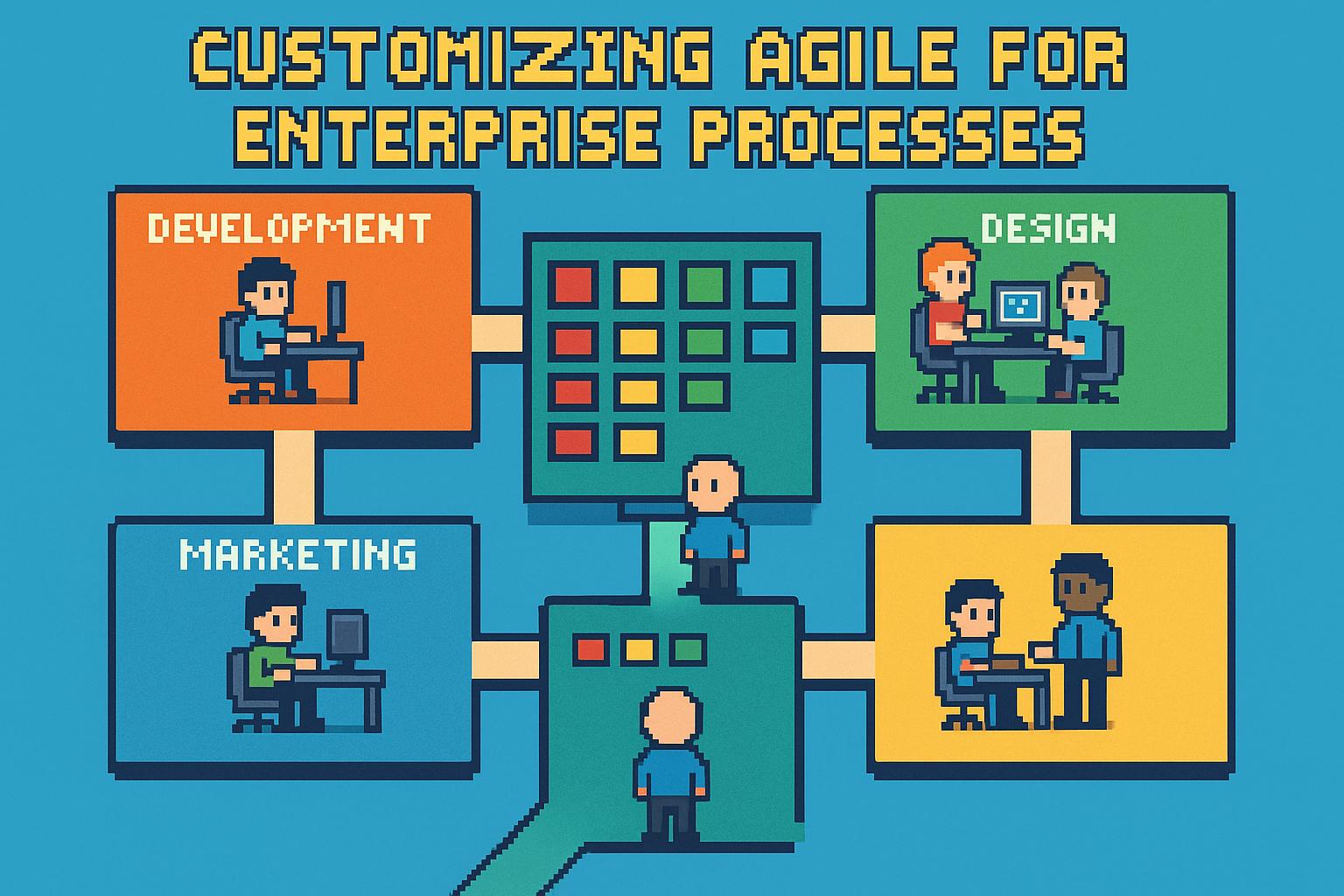
Customizing Agile for Enterprise Processes
Adopting Agile in large organisations isn’t as straightforward as it might seem. While Agile thrives on flexibility and collaboration, enterprises often face unique challenges like departmental silos, legacy systems, and juggling multiple stakeholder priorities. The key takeaway? You can’t just copy-paste a standard Agile framework. It needs to be tailored to fit your organisation’s specific needs.
Here’s the gist of how to make Agile work for enterprises:
- Understand your organisation's bottlenecks: Map workflows, identify delays, and involve teams in spotting challenges - whether it’s unclear priorities or outdated systems.
- Choose the right framework: Options like Scrum, Kanban, SAFe, or even hybrid models can work, depending on your team structure, goals, and compliance needs.
- Customise roles and practices: Adjust roles like Product Owners for scale, use tools like Scrum of Scrums for cross-team coordination, and tweak ceremonies like sprint planning to align with enterprise goals.
- Pilot before scaling: Start small with a few teams, test your approach, and refine it before rolling out company-wide.
- Measure success: Use metrics like delivery speed, defect rates, and team engagement to track progress and make data-driven improvements.
- Focus on learning and feedback: Regular retrospectives, knowledge sharing, and leadership support are essential to keep improving.
Agile isn’t a one-size-fits-all solution, especially for enterprises. It’s about building a flexible system that respects your organisation’s constraints while delivering value consistently. Start small, stay open to feedback, and tweak as you go. Done right, Agile can help your teams deliver faster, collaborate better, and navigate complexity with ease.
Enterprise Agile Strategy: A Beginner's Guide to Organization-Wide Agility
Assessing Enterprise Needs Before Implementation
Before diving into Agile customisation, it’s essential for enterprises to take a hard look at their current state. A thorough evaluation helps pinpoint where the organisation stands, highlights areas that need attention, and identifies which aspects of Agile will bring the most value. Think of it as laying the groundwork for a smoother, more effective Agile journey.
Finding Pain Points and Bottlenecks
The first step in tailoring Agile is understanding where the organisation struggles. Start by mapping out workflows - from the moment a task is initiated to its final delivery. This makes it easier to spot delays, miscommunications, or bottlenecks. Pay special attention to handoff points, as that’s often where things slow down or fall through the cracks.
You’ll need input from the people in the trenches. Interview team leads, product owners, and other stakeholders to get a well-rounded view of the challenges. Different groups often face unique issues. For example, development teams might complain about unclear priorities causing constant context-switching, while compliance teams could be worried about documentation gaps that make audits a nightmare.
Don’t forget the tech side of things. Many enterprises rely on legacy systems that just aren’t cut out for the rapid pace of Agile. A technical audit can reveal whether your current tools and systems support practices like continuous integration and deployment. Understanding these limitations upfront will help you set realistic goals and create a plan that works within your organisation’s constraints.
A data-driven approach can also be helpful here. For example, you might create a heat map to assess Agile readiness across teams, highlighting those with the most significant challenges. Prioritise issues based on their impact and how feasible they are to address. Focus on bottlenecks that directly affect revenue, customer satisfaction, or strategic goals, and decide whether Agile adjustments alone can solve them - or if broader changes are needed.
Understanding Stakeholder and Team Requirements
To get Agile customisation right, you need input from everyone involved - from top executives to team members on the ground. Each group has its own priorities, constraints, and goals that need to be factored in.
Executives typically focus on the big picture: business objectives, expected outcomes from Agile adoption, available resources, and timelines. Meanwhile, product owners and business analysts can provide insights into customer demands and market pressures. Development teams are your go-to for feedback on current Agile practices, technical limitations, and any training they might need.
Don’t overlook operations and compliance teams - they’ll have critical input on regulatory requirements and documentation standards. HR and organisational development teams can offer valuable perspectives on change management, training capabilities, and how ready the organisation is for a cultural shift.
To keep all this input organised, consider using a stakeholder requirements matrix. This tool can help you visualise each group’s priorities and ensure nothing gets overlooked. Regular check-ins, shared digital workspaces, and open communication channels are key to keeping everyone aligned as the process evolves.
"His ability to assess technical challenges and architect solutions whilst considering the broader business context has been invaluable. One of Lev's standout qualities is how he meets you exactly where you are - whether discussing early-stage challenges or complex architectural decisions, he tailors his guidance to your specific business stage and needs."
- Tanya Mulesa, Founder, Aeva Health
These insights are the foundation for building a strong assessment framework.
Creating an Assessment Framework
An assessment framework helps you capture the key requirements, constraints, and goals that will guide your Agile customisation. Here are some areas to focus on:
- Compliance: Identify essential regulatory and audit requirements (e.g., GDPR, FCA).
- Scalability: Consider team sizes, anticipated growth, and how to support distributed or remote teams.
- Collaboration: Review current communication tools, geographical distribution, and teamwork patterns.
- Technical: Evaluate your infrastructure, target deployment frequencies, and how well legacy systems integrate with newer ones.
- Organisational: Look at governance structures, decision-making processes, and reporting hierarchies.
Ask practical questions like: How many teams will use Agile? What compliance certifications are necessary? How many locations are involved? What metrics do leaders need to see? Establishing baseline metrics at this stage is crucial for measuring progress later.
Some useful baseline metrics include:
- Delivery: Cycle time, deployment frequency, and lead time for changes.
- Quality: Defect rates, customer satisfaction scores, and rework percentages.
- Team: Velocity, utilisation rates, and engagement levels.
- Process: Meeting effectiveness and decision-making speed.
- Financial: Cost per feature delivered and budget variances.
For instance, if a team currently deploys quarterly with a six-month cycle time and a 15% defect rate, those figures become your starting point. After customisation, you can measure improvements against these benchmarks.
If analysing all this feels overwhelming, a fractional CTO can step in to assess your business context and tech stack, pinpoint bottlenecks, and recommend tailored solutions. Services like CTO-as-a-Service from Metamindz offer expert evaluations and strategic guidance to help you navigate this process with confidence.
Customising Agile Frameworks for Enterprise Processes
Once you've figured out what your enterprise needs, the next step is tweaking Agile frameworks to fit your organisation's unique setup. This isn’t about blindly following Agile textbooks - it’s about bridging the gap between standard practices and the often messy realities of enterprise operations. The aim? To create a customised approach that works for your teams and aligns with your business goals.
Choosing the Right Agile Framework
Based on your earlier analysis, you’ll want to pick a framework that tackles your specific challenges. Each framework has its strengths, and knowing these will help you make a choice that suits your organisation.
- Scrum: Ideal for teams that thrive on structure and accountability. It uses short sprints (two to four weeks) and clearly defined roles like Product Owner, Scrum Master, and Development Team. This is a good fit if you value regular delivery and predictable planning cycles.
- Kanban: A more flexible option that focuses on continuous work rather than fixed sprints. With its visual boards and Work in Progress (WIP) limits, it’s great for teams needing clear visibility and a steady workflow. If your team prefers a smooth, manageable pace over the intensity of sprints, Kanban might be the way to go.
- SAFe (Scaled Agile Framework): Designed for scaling Agile across multiple teams, SAFe helps with cross-team planning, role clarity, and regular reviews. It uses Agile Release Trains (ARTs) to synchronise efforts across the organisation.
- LeSS (Large-Scale Scrum): A simpler alternative to SAFe, LeSS focuses on self-organisation with fewer roles and ceremonies, making it less overwhelming for teams.
- Extreme Programming (XP): This one’s all about improving code quality through practices like test-driven development, pair programming, and continuous integration.
- Hybrid Approaches: Sometimes, blending Agile and Waterfall works best - especially for projects combining hardware and software. This mix lets you use structure for certain phases and flexibility for others.
When deciding, think about factors like project complexity, team distribution, regulatory requirements, and how fast you need to deliver. For instance, distributed teams might lean towards frameworks with strong visual tools, while heavily regulated industries may need frameworks that handle compliance and documentation well.
Adapting Roles, Ceremonies, and Artefacts
Once you’ve picked a framework, it’s time to adjust roles and ceremonies to suit the scale of your enterprise. Agile roles and rituals often need tweaking to maintain coordination across multiple teams while staying true to Agile principles.
- Roles: At the team level, roles like Scrum Master and Product Owner remain vital. However, in larger setups, Product Owners might need extra support from business analysts or product managers to manage stakeholders and prioritise backlogs effectively.
- Multi-Team Coordination: For organisations with multiple teams, tools like Scrum of Scrums or scaled daily stand-ups can help. These sessions bring together representatives from each team to discuss progress, dependencies, and blockers. Instead of involving everyone, each team sends a delegate who can coordinate with others.
- Daily Stand-Ups: Keep these short - 15 minutes is enough to cover progress and blockers. For distributed teams, stagger timings or use digital tools to track updates asynchronously.
- Sprint Planning: At the enterprise level, sprint planning needs to align goals across teams. Joint planning sessions are crucial for identifying dependencies and ensuring that delivery schedules work smoothly.
- Retrospectives and Reviews: These are even more important in bigger organisations. Regular retrospectives help teams reflect on what’s working and what isn’t. For larger setups, consider both team-level and cross-team retrospectives to tackle broader issues. Reviews should include representatives from all teams to maintain alignment and catch potential integration challenges early.
Visual tools like shared boards and communication platforms are your best friends here. They make it easier to track progress and spot bottlenecks, especially for distributed teams.
Creating a Hybrid Model from Multiple Frameworks
Sometimes, no single framework fits all your needs. That’s when a hybrid approach - mixing elements from different frameworks - can be a smart move.
For example, you could use SAFe’s structured coordination for cross-team efforts while adopting Kanban’s visual workflow for teams handling ongoing tasks. Or you might stick with Scrum’s sprint cycles for development teams and use Kanban for support teams managing continuous incoming work.
To build a hybrid model:
- Identify which aspects of various frameworks align with your goals and challenges. For example, if coordination is an issue, SAFe’s Planning Iterations might help. If teams are overwhelmed, Kanban’s WIP limits could ease the pressure.
- Document your approach in an Agile playbook. This should outline workflows, ceremonies, and standards, serving as a guide for all teams. However, keep it flexible - allow teams to adapt practices as long as they stick to the core principles.
Your playbook might specify that teams must hold sprint planning and retrospectives but leave it up to them whether to use story points or time estimates. Similarly, you could standardise tools for collaboration but let teams decide how often they update their boards.
Before rolling out a hybrid model across your organisation, start with pilot projects. Choose a mix of teams - like one product team, one operations team, and one legacy systems team. This lets you test the approach in a controlled environment and make adjustments based on feedback.
An Agile Centre of Excellence can also be invaluable. This group can oversee adherence to standard practices, support teams in adapting processes, and mediate between the need for consistency and the flexibility Agile thrives on.
Hybrid models aren’t static. As your organisation evolves, so should your approach. Regularly review your framework to ensure it still meets your needs. If something isn’t working, be ready to tweak it.
For expert support, consider services like CTO-as-a-Service from Metamindz. They can help you navigate complex Agile transformations, combining technical and business insights to create a customised framework that works for your organisation.
sbb-itb-fe42743
Implementing Agile Customisations Across the Organisation
Once you've tailored your Agile framework, the next step is rolling it out across the organisation. But this isn't a quick "flip the switch" process. It requires a well-thought-out approach that balances structure with flexibility, gradually brings teams on board, and ensures everything stays on track with proper oversight.
Building a Flexible Implementation Roadmap
A rigid, cookie-cutter rollout plan just won't cut it for an Agile transformation, especially in a complex enterprise setting. Instead, you need a roadmap that can adapt to feedback and shifting priorities while still offering clear guidance.
Start small with a pilot programme. Pick a mix of teams - maybe product development, operations, and legacy systems - to test your customised framework in a real-world setting. This phase, ideally lasting two to three months, gives you the chance to iron out kinks, identify gaps, and create early wins that can build momentum. Think of it as your testing ground before scaling up.
Once the pilot wraps up, roll out Agile practices gradually. Begin with the basics - daily stand-ups, shorter sprints (two to four weeks), and clear sprint goals. These foundational practices help teams ease into the process. Once they're comfortable, you can layer on more advanced practices like retrospectives, sprint reviews, and more complex backlog management.
To keep everyone aligned, tie your goals to measurable OKRs. For instance, if your objective is "Improve cross-team delivery predictability", your key results might include "Reduce sprint commitment variance to under 10%" or "Achieve 90% on-time delivery for inter-team dependencies." These metrics provide focus without being overly prescriptive, letting teams figure out the best way to meet their targets.
Instead of rigid deadlines, use theme-based goals. For example, rather than saying, "All teams must complete Scrum Master training by 30th June 2026", you could aim for "Q2 2026: Build foundational Agile capabilities across teams." This approach acknowledges that different teams will progress at their own pace and allows for iterative adjustments.
Resource allocation is another critical piece of the puzzle. Teams need the right tools, people, and - most importantly - time to adopt Agile effectively. This might mean temporarily easing delivery expectations while teams adapt. Trying to maintain full speed during a transformation is a surefire way to burn everyone out.
If you're feeling overwhelmed, consider bringing in expert help. Services like CTO-as-a-Service from Metamindz can provide valuable guidance. As Metamindz puts it:
"It always starts with a fractional CTO session, in order to fully dive into the context of your business and existing tech stack. It continues to a proper, lean, and scalable software architecture (if needed), and we then assign the right developers from our team, guided by our technical project manager and CTO, to work with you directly. We will be in the same Slack workspace, have weekly catch-ups, and send you preview links and daily updates. We are hungry for feedback, and will always work together, as a team, to deliver results."
This kind of support can make all the difference, especially when you're navigating the complexities of a large-scale transformation.
Managing Dependencies and Cross-Team Collaboration
Once your roadmap is in place, the next hurdle is managing inter-team dependencies. In large organisations, no team operates in isolation, so effective coordination is key.
Frameworks like SAFe, LeSS, or DAD can help structure cross-team collaboration. For instance, SAFe uses Agile Release Trains (ARTs) to synchronise teams with shared planning cadences and delivery schedules.
For day-to-day coordination, try Scrum of Scrums or scaled daily stand-ups. Instead of massive all-hands meetings, have each team send a representative to discuss progress, upcoming work, and any blockers. Regular synchronisation during sprint planning and reviews can also help identify integration issues early.
Visual management tools are a game-changer here. Shared boards can highlight bottlenecks, while portfolio management tools show how individual teams' work ties into broader organisational goals.
If your teams are spread across different locations, invest in real-time communication tools. Platforms like Slack and video conferencing can bridge the distance and keep everyone on the same page.
Setting Up Governance and Feedback Mechanisms
Governance in Agile isn't about rigid rules - it's about creating structures that support flexibility and continuous improvement.
An Agile playbook can act as a go-to guide during implementation. It should outline the tools you'll use, the format for ceremonies, and the standards expected across the organisation. Think of it as a baseline that teams can adapt to their unique needs.
Set up an Agile Centre of Excellence to oversee the transformation. This group shouldn't act as enforcers but as coaches and facilitators, helping teams tackle challenges and share best practices. They can also strike a balance between the need for standardisation and teams' autonomy.
Executive sponsorship is another must-have. Leaders need to do more than just sign off on the transformation - they should actively participate by attending key ceremonies, removing roadblocks, and championing the cultural changes Agile demands.
Regular retrospectives and cross-team feedback sessions are critical for spotting what's working and what isn't. These sessions should create a safe space for teams to voice concerns and identify areas for improvement. Cross-team retrospectives can also uncover systemic issues that individual teams might not be able to resolve on their own.
Finally, track progress with clear metrics and KPIs - like sprint velocity, cycle time, defect rates, or customer satisfaction. These metrics can guide improvements, but don't go overboard or use them as a stick to beat teams with. Agile is about enabling teams, not micromanaging them.
Don't overlook risk identification either. Build it into regular ceremonies like sprint planning and retrospectives. Spotting risks early makes them much easier to manage. You can also strengthen cross-departmental relationships with team-building exercises and quarterly reviews to refine your governance structures as your Agile maturity grows.
Measuring Success and Refining Agile Practices
Once you've rolled out your tailored Agile framework, the next crucial step is figuring out if it's actually working. Without keeping an eye on results and making adjustments, even the best Agile transformations can lose their way. This is where metrics, regular reviews, and an ongoing commitment to learning come into play.
Key Metrics for Enterprise Agile Success
Tracking success in Agile isn't about drowning in endless data; it's about focusing on the metrics that genuinely show whether you're delivering value. A good mix of delivery, quality, and organisational health indicators can give you a clear picture.
Start with velocity, which measures how much work gets done in a sprint. It’s a handy way to gauge capacity and plan for future work. But don’t rely on it too much - velocity alone can be misleading. A team might seem productive on paper but could be racking up technical debt or cutting corners on quality.
That’s why you also need lead time and cycle time. Lead time tracks how long it takes from when a task is requested to when it’s delivered, while cycle time measures the duration from when the work begins to when it’s completed. These metrics help you spot bottlenecks. For instance, if lead time is creeping up but cycle time stays steady, it could mean your backlog needs better prioritisation. If both are increasing, you might have capacity issues or process inefficiencies.
Quality is another big one. Keep an eye on defect rates - how many bugs make it into production? Pair this with customer satisfaction scores to see if you're delivering work that users actually value. A team that’s quick but ships buggy software isn’t Agile - they’re just fast at creating headaches.
Don’t overlook team morale and stakeholder alignment. Are your teams engaged and clear on how their efforts tie into broader goals? Regular employee surveys and feedback from Agile ceremonies can highlight burnout or disengagement before they become major issues. At the enterprise level, check if all teams are aligned with the organisation’s strategic objectives. If individual teams are hitting their targets but the business isn’t meeting its goals, you’ve got a misalignment problem.
The key is to use these metrics as tools for learning, not as sticks to beat teams with. For example, if velocity drops, don’t jump to conclusions about team performance. Instead, dig deeper - are unclear requirements, dependencies, or technical debt slowing things down?
Metrics should guide your regular reviews and help refine your processes.
Regular Review and Iterative Improvements
Metrics are only useful if you act on them, and that’s where regular reviews and retrospectives come in. These aren’t just routine check-ins - they’re your chance to figure out what’s working, what’s not, and what needs tweaking.
At the team level, hold sprint retrospectives at the end of each iteration. These sessions are a space for teams to reflect on what went well, what didn’t, and what they’d like to try differently. The most important ingredient here is psychological safety. If team members don’t feel safe sharing honest feedback, you won’t uncover the real issues.
Take the insights from retrospectives and turn them into actionable steps for the next sprint. Keep it focused - limit changes to one or two key improvements that can have a big impact.
Beyond individual teams, you’ll need programme-level reviews to assess how well teams are collaborating, managing dependencies, and staying aligned with business goals. These reviews might happen monthly or quarterly, depending on your organisation’s rhythm. Use them to uncover systemic issues that could be holding back progress.
The feedback from these reviews should directly inform adjustments to your Agile processes. For example, you might discover that two-week sprints aren’t enough time for teams tackling complex legacy systems, so you shift to three-week cycles. Or you might realise that your definition of "done" needs tightening to prevent quality issues.
Agile isn’t static. What worked during the pilot phase might not work six months later. Stay flexible and open to change.
Building a Culture of Continuous Learning
To keep your Agile transformation thriving, you need a culture where continuous learning is the norm. This doesn’t just happen - it requires deliberate effort and investment.
An Agile Centre of Excellence can play a big role here. Think of them as coaches and facilitators. They can help teams implement Agile practices, run training sessions, and provide guidance when challenges arise. They can also lead workshops and certification programmes to ensure everyone understands the principles and knows how to work within your framework.
Formalise knowledge sharing across teams. Set up communities of practice where team members can exchange ideas, tackle challenges together, and share solutions. For instance, if one team cracks a tricky problem, that insight should benefit the entire organisation - not stay siloed.
Create a living Agile playbook - a resource that documents workflows, standards, and best practices. Make it accessible to everyone, but don’t let it become a rulebook that stifles creativity. It should guide teams, not dictate every detail.
Leadership has a huge role to play in fostering continuous learning. When executives participate in training, support improvement efforts, and encourage experimentation, it sends a clear message that learning matters. Teams need the freedom to try new approaches, even if some experiments fail. Viewing setbacks as learning opportunities rather than reasons for blame creates the trust needed for innovation.
Celebrate wins, but don’t shy away from failures. When things go wrong, conduct blameless post-mortems to understand what happened and how to avoid similar issues. This approach builds trust and encourages transparency.
Regular team-building activities and quarterly reviews can also help strengthen collaboration across departments. These efforts break down silos and reinforce the cross-functional teamwork that’s essential for Agile success.
Continuous learning isn’t just about formal training or reading books - it’s about creating an environment where everyone is motivated to improve, feedback is welcomed, and growth is a shared responsibility. When this culture takes root, your Agile transformation becomes self-sustaining, no longer reliant on constant top-down intervention to keep it alive.
Conclusion
Key Takeaways
Shaping Agile to fit enterprise processes is about building a framework that aligns with your organisation's specific needs while staying rooted in Agile principles. This isn’t a one-and-done effort - it requires careful planning, ongoing adjustments, and a commitment to continuous improvement.
Leadership must lead from the front. Senior management has to visibly back the transformation, allocate the right resources, and encourage a mindset that welcomes change. Without this top-level support, Agile initiatives can lose steam before they even get going.
Take it one step at a time. Rolling out Agile practices incrementally - starting with pilot programmes - helps you test the waters, troubleshoot early issues, and gradually build trust in the new approach.
Strike a balance between consistency and adaptability. Create an Agile playbook to document workflows, ceremonies, and standards for consistency across teams. But don’t let it get too rigid - teams should have room to tweak practices based on their unique challenges. An Agile Centre of Excellence can be instrumental here, ensuring teams stick to core principles while allowing room for creativity and context-specific adaptations.
Measure what really counts. Establish meaningful metrics like velocity, lead time, cycle time, defect rates, and customer satisfaction. These aren’t just numbers - they’re tools to pinpoint areas for improvement and celebrate progress.
Prioritise feedback and learning. Build strong feedback loops through sprint retrospectives, quarterly reviews, and cross-team collaboration. Invest in ongoing training and foster communities of practice where knowledge is shared openly. Celebrate wins, but also treat setbacks as learning opportunities. When teams feel safe to voice their challenges and experiment, Agile transformation becomes a living, breathing process.
Final Thoughts on Agile at Scale
Tailoring Agile for your enterprise is an ongoing journey that balances structure with adaptability. Success comes from embracing Agile values - iterative development, collaboration, and continuous feedback - while being flexible enough to address the realities of your organisation.
Start with a clear vision of why Agile matters to your business. Secure executive buy-in and launch pilot initiatives that show real, tangible results. Frameworks like SAFe or LeSS can offer a starting point, but they should be adjusted to fit your unique situation.
The true strength of Agile at scale lies in fostering a culture where continuous improvement feels natural. When teams are empowered to make decisions, experiment within clear boundaries, and learn from both wins and missteps, your Agile framework becomes more than just a set of rules - it becomes the way your organisation works.
And remember, Agile transformation is never static. What works today might need tweaking tomorrow. Stay curious, be open to change, and trust the process. Over time, this investment will lead to faster delivery, better quality, and happier customers. That’s the real payoff of customising Agile for your enterprise.
FAQs
How can enterprises identify and resolve bottlenecks when adapting Agile frameworks to their processes?
To tackle bottlenecks during Agile customisation, the first step is to map out your current workflows. This gives you a clear view of where processes are stalling or not aligning with Agile principles. Bringing together teams from different departments at this stage is key - it ensures everyone understands the challenges and opens the door to collaborative problem-solving.
Once you've pinpointed the trouble spots, it's time to make targeted tweaks. This could mean adjusting sprint cycles to better suit your team, redefining roles to avoid overlap or confusion, or automating those repetitive tasks that eat up valuable time. Regular retrospectives and feedback sessions are essential here - they help you track progress and make sure your Agile framework keeps pace with your organisation's changing needs.
If you’re looking for extra guidance, Metamindz offers services like CTO-as-a-Service and technical evaluations. They can help you design scalable, efficient solutions tailored to the specific challenges your organisation faces.
What factors should be considered when selecting an Agile framework for a large organisation?
When deciding on an Agile framework for a large organisation, you’ll want to think about the scale and complexity of your operations. It’s not just about picking something popular like SAFe or LeSS - it’s about finding a framework that fits how your teams work, how they’re structured, and what your business is aiming to achieve. For example, if your organisation already has a lot of cross-functional teams in place, a framework that emphasises collaboration might be a better fit.
You’ll also need to gauge your teams’ readiness for Agile. Are they familiar with Agile principles? Will they need extensive training to make the shift? These are critical questions because a smooth transition often hinges on how prepared and supported your teams feel. And don’t overlook the importance of the framework’s ability to scale - especially if you’re dealing with multiple departments. A good framework should encourage collaboration across the board, ensuring everyone is aligned and delivering consistent results.
How can enterprises foster effective collaboration across teams and manage dependencies when adapting Agile to their unique workflows?
To keep collaboration smooth and manage dependencies in a tailored Agile setup, it’s all about getting the basics right: clear communication, aligned objectives, and shared accountability. Regular cross-team meetings, like the classic scrum of scrums, can work wonders for keeping everyone on the same page and spotting potential hiccups before they snowball.
On top of that, having the right tools in place is a game-changer. Think Agile project management software or customised dashboards that offer a bird’s-eye view of workflows and dependencies. These tools can help teams stay coordinated without stepping on each other’s toes.
Lastly, building a culture where transparency and continuous improvement are second nature can make all the difference. When teams are open about challenges and committed to evolving, they can stay in sync - even in the trickiest enterprise environments.