6 Engineering Intelligence Platforms That Measure AI's Impact in 2026
6 Engineering Intelligence Platforms That Measure AI's Real Impact in 2026
An engineering intelligence platform (also called a software engineering intelligence, or SEI, platform) pulls data from your Git, CI/CD, ticketing and IDE tools to show how your team actually delivers software. In 2026 the good ones do one extra job: they tell you whether the AI coding tools you're paying for are making you faster, or just busier. The six worth knowing are DX, LinearB, Jellyfish, Swarmia, Sleuth and Faros AI.
So, look, I do fractional CTO work, and this exact question comes up in nearly every engagement now: "We've rolled out Cursor and Claude Code to the whole team. Are we getting anything back?" Most founders can't answer it. Neither can most VPs of Engineering. That's not a failure of effort. It's a measurement gap, and it's gotten wide.
Harness surveyed engineering leaders in 2026 and the numbers are uncomfortable. Only 46% of organisations actively track AI-specific metrics like adoption, acceptance rate or model usage. A full 60% say the lack of clear metrics is their single biggest challenge in AI adoption. And here's the kicker: 89% say their current metrics accurately reflect AI's impact, yet 94% admit those same metrics miss things like tech debt, validation time and developer burnout, with only 6% believing their current framework can fix it (Harness, 2026).
Translation: most teams are flying on instruments they already know are broken. This post is a straight, honest roundup of the six platforms that fix that, what each is actually good at, roughly what they cost, and who should ignore all of them.
Why you can't measure AI with your old metrics
AI now writes roughly 41% of all code, and about 27.4% of code reaching production in Q1 2026 was AI-generated (Zylos, 2026; DX research, 2026). That breaks the old story completely. Lines of code, commits, story points, "velocity" - all of it gets easier to inflate the moment an agent is doing the typing.
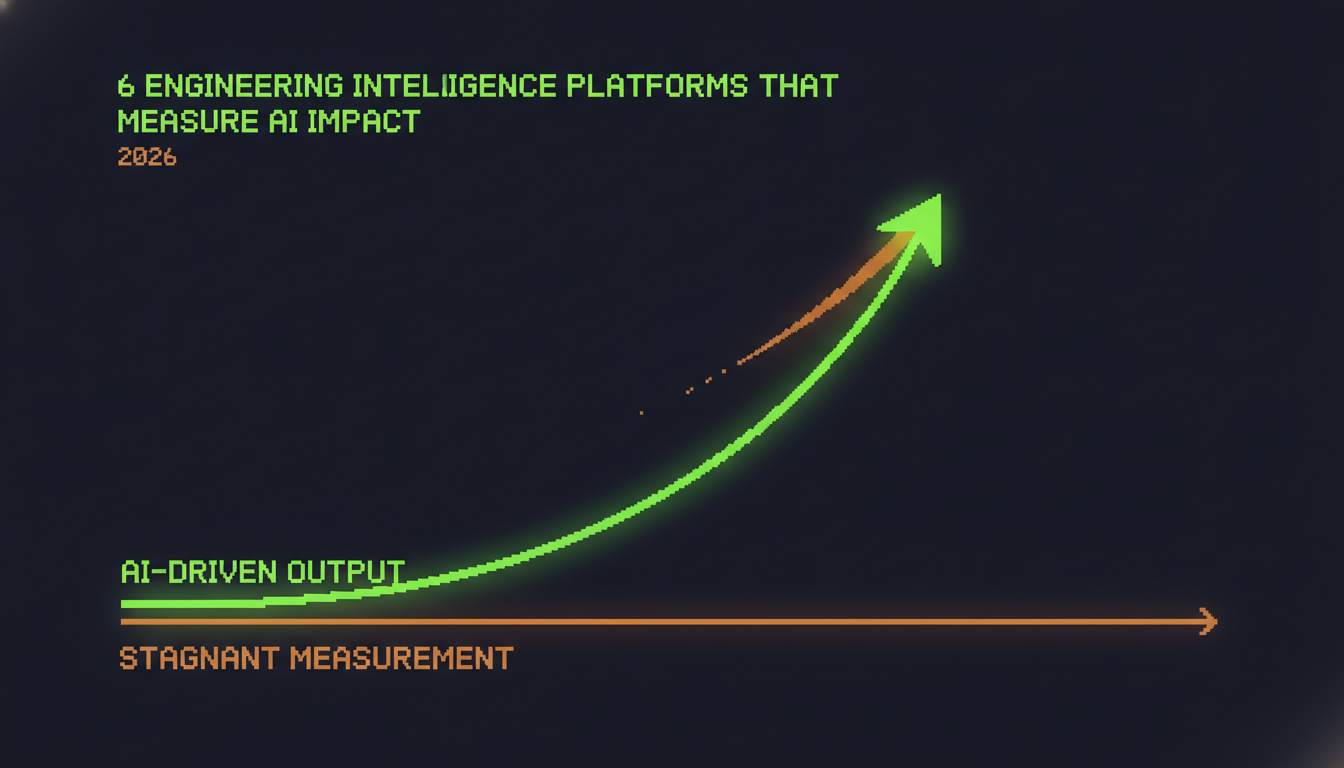
There's a 1975 idea that explains the trap perfectly. Goodhart's Law: "When a measure becomes a target, it ceases to be a good measure" (Teksidia). Reward lines of code and people write bloated, copy-pasted rubbish. Reward PR count and someone floods the review queue, boosting their own number while dragging the whole team's throughput down. AI makes every one of these games trivially easy to play. You can now generate 400 lines of plausible-looking nonsense in 90 seconds.
The platforms below are attempts to build what actually works: a SYSTEM of counter-metrics that balance speed against quality, effectiveness and business impact, so no single number can be gamed in isolation. The framework most of them have converged on is the DX Core 4 - speed, effectiveness, quality, impact - which folds the older DORA, SPACE and DevEx models into one (Swarmia; LinearB).
The six platforms, and who each one is really for
1. DX (getDX) - the one built by the researchers. DX is the platform behind the Core 4 framework and the separate DX AI Measurement Framework, which tracks AI along three axes that map to how adoption actually unfolds: utilisation, impact and cost (getDX). Its edge is combining hard system data with structured developer surveys, so you see both what the tools do and how engineers feel about them. Booking.com used this approach to roll AI out to over 3,500 engineers and posted a 16% throughput increase within months. If you're serious about AI ROI specifically, this is the most credible option. Pricing is enterprise and quote-based, so it's aimed at larger orgs.
2. LinearB - the engineering manager's cockpit. LinearB gives you the most granular cycle-time breakdown of the lot: coding, pickup, review and deploy, each with trends and targets. It's also the only one with real workflow automation baked in, through gitStream, which auto-routes and labels PRs. Best for teams of roughly 30-200 engineers with strong Jira usage who want to fix bottlenecks, not just watch them. The free tier is gone; expect around $39 per developer per month (CodePulse comparison, 2026).
3. Jellyfish - the boardroom platform. Jellyfish is built for VPs and CTOs who have to answer "where did the engineering money go?" It maps effort to business initiatives, does capacity forecasting and investment allocation, and produces the kind of report a CFO will actually read. If your problem is reporting engineering investment upward, this is your tool. Pricing isn't public - it's custom quotes after a demo, which tells you it's aimed at scale-ups and enterprises, not five-person teams.
4. Swarmia - the one developers don't hate. This matters more than it sounds. Swarmia defaults to team-level metrics, keeps individual data private to the individual, and leans on collaborative "working agreements" rather than top-down surveillance. That design choice is why it survives contact with actual engineers instead of triggering a quiet revolt. Best for GitHub-centric teams of 20-100 who care about developer experience. Roughly $15-25 per developer per month.
5. Sleuth - deployment intelligence, done deep. Sleuth is narrower on purpose. It specialises in tracking releases, connecting each code change to incidents, and measuring the real impact of every deployment. If you ship many times a day and your main question is "which release broke things and what did it cost us", Sleuth goes deeper than the generalists. Around $20 per developer per month.
6. Faros AI - the enterprise toolchain connector. Faros pulls signals across your entire engineering stack and has leaned hard into AI-impact analytics at scale - it's the platform behind some of the most-cited 2026 datasets on AI's effect on large developer populations. It's a heavier, enterprise-grade implementation, so it fits organisations with dozens of teams and a messy tool sprawl to unify. Custom pricing.
Engineering intelligence platforms compared
| Platform | Really for | AI-impact measurement | Rough price (per dev/month) | Watch-out |
|---|---|---|---|---|
| DX | Orgs serious about AI ROI + DevEx | Best in class (utilisation, impact, cost) | Enterprise / custom | Overkill for small teams |
| LinearB | Eng managers fixing bottlenecks | Good; strong on flow, add-on for AI | ~$39 | Needs solid Jira hygiene |
| Jellyfish | VPs/CTOs reporting to the board | Framed around investment, not code | Custom quote | Not for hands-on team tuning |
| Swarmia | Dev-experience-led teams (20-100) | Good; team-level, privacy-first | ~$15-25 | Lighter on exec/finance reporting |
| Sleuth | High-deploy-frequency teams | Deployment/incident focus | ~$20 | Narrow; not a full SEI suite |
| Faros AI | Large orgs with tool sprawl | Strong AI analytics at scale | Enterprise / custom | Heavy to implement |
For a 50-person engineering org, per-seat platforms land somewhere between $12,000 and $30,000 a year (CodePulse, 2026). That's real money, and it buys you a dashboard, not an answer.
The honest bit: most small teams shouldn't buy any of these yet
I'll say the thing the vendors won't. If you have fewer than about 15-20 engineers, buying one of these platforms is usually premature. You can get 80% of the value from free DORA tooling and a monthly 20-minute conversation with your team (getDX on DORA tooling). The bottleneck at that size is rarely "we lack a dashboard". It's that nobody senior has decided what "good" looks like for your specific product and stage.
That's the trap with all engineering intelligence platforms: they measure brilliantly and interpret nothing. A tool will happily tell you cycle time went up 18% last month. It will not tell you whether that's because your AI-generated PRs are now 4x larger and drowning your reviewers, or because you took on a genuinely hard migration, or because two senior people left. The number is identical. The response is completely different. Getting that wrong is how leaders end up weaponising metrics against individuals, which is the fastest way to make your best engineers start gaming them (Jellyfish, 2026).
This is exactly where a good fractional CTO earns their retainer. Not by picking your dashboard. By deciding what to measure, reading the numbers in context, and turning "review time is climbing" into "cap PR size at 400 lines, split the payments service, and stop counting story points". At Metamindz our AI adoption work starts with an AI maturity assessment precisely because tooling without interpretation is just expensive noise.
Buying a dashboard vs measuring properly
| Aspect | Typical approach (buy a tool) | CTO-led approach (Metamindz) |
|---|---|---|
| Starting point | Pick a platform, roll it out to everyone | Decide what "good" means for your stage first |
| Metrics used | Whatever the dashboard defaults to | A balanced system of counter-metrics, no single target |
| AI ROI question | "Adoption is 80%" (usage, not value) | Throughput, quality and cost tracked together |
| Interpretation | Left to whoever opens the tab | Read in context by someone who's shipped software |
| Risk to team morale | Metrics get weaponised against individuals | Team-level focus, individuals coached not ranked |
| When you don't need it | Vendor always says you do | We'll tell you to use free DORA tooling instead |
If you've already got a platform and you're not sure the numbers mean anything, that's a one-call fix. A discovery call is free, and half the time the honest answer is "your setup is fine, here are the three metrics to actually watch".
Frequently Asked Questions
What is an engineering intelligence platform?
An engineering intelligence platform (or software engineering intelligence, SEI, platform) aggregates data from Git, CI/CD, ticketing and IDE tools to measure how a software team delivers. It surfaces cycle time, deployment frequency, quality and, increasingly, the measurable impact of AI coding tools on output and cost.
Which engineering metrics platform is best for measuring AI's impact?
DX (getDX) is currently the strongest for AI specifically, because its AI Measurement Framework tracks utilisation, impact and cost together, backed by developer surveys. LinearB and Faros AI are solid alternatives. The best choice depends on team size, existing tooling and whether you need board-level or team-level reporting.
How much do these platforms cost?
Per-seat platforms typically run $15-40 per developer per month. Swarmia sits around $15-25, Sleuth near $20, LinearB about $39. DX, Jellyfish and Faros AI use custom enterprise pricing. For a 50-engineer org, expect roughly $12,000-$30,000 per year depending on platform and tier.
Do small startups need an engineering intelligence platform?
Usually not below 15-20 engineers. Free DORA tooling plus a short monthly team conversation covers most of the value. The real constraint at that size is deciding what "good" looks like for your product and stage, which is a leadership job, not a tooling one. Buy the platform when interpretation, not data, becomes the bottleneck.
Why aren't lines of code or story points good AI productivity metrics?
Because of Goodhart's Law: once a measure becomes a target, it gets gamed. AI makes it trivial to inflate lines of code, commits or PR counts without adding real value. Effective measurement uses a balanced system, speed, effectiveness, quality and business impact together, so no single number can be manipulated in isolation.
Last updated: 10 July 2026. Written by Lev Perlman, Co-Founder & CTO at Metamindz, fractional CTO and Advisor at Google for Startups and Loyal VC.