
The Entry-Level Developer Hiring Collapse: Why Cutting Juniors Today Creates a Senior Shortage Tomorrow

The Entry-Level Developer Hiring Collapse: Why Cutting Juniors Today Creates a Senior Shortage Tomorrow
The entry-level developer hiring collapse is the systematic elimination of junior developer roles across the tech industry, driven by AI tool adoption and economic pressure, which has reduced junior hires from 32% of Big Tech new hires in 2019 to just 7% in 2026 - a shift that will create a severe mid-level and senior talent crisis within 3-5 years.
So.. the tech industry has collectively decided that junior developers are too expensive. I've been watching this unfold for the last 18 months across every startup and scaleup I work with as a fractional CTO, and the numbers are genuinely alarming.
Entry-level tech roles in the UK fell by 46% in 2024, with projections hitting a 53% decline by end of 2026. In the US, the picture is worse - a 73% drop in actual entry-level hiring in the past year alone. The share of juniors and graduates in IT employment has dropped from roughly 15% to 7% over three years.
Everyone's celebrating the short-term efficiency gains. Nobody's talking about what happens in 2029 when there are no mid-level developers to promote.
The numbers behind the collapse
I want to be specific here because vague hand-waving about "tough markets" doesn't capture what's actually happening.
In 2019, new graduates represented 32% of Big Tech hires. By 2026, that's cratered to 7%. That's a 78% reduction in the share of junior hires. The "Magnificent Seven" - Alphabet, Amazon, Apple, Meta, Microsoft, NVIDIA, Tesla - have sharply cut campus hiring. When industry leaders do this, everyone else follows.
There's a particularly cynical twist. Job postings labelled "entry-level software engineer" grew 47% between October 2023 and November 2024. But actual hiring into those levels dropped 73% during the same period. Companies are advertising junior roles, then quietly filling them with experienced engineers. It's a bait-and-switch at scale.
CS graduate unemployment now sits at 6-7%, up from historical lows. The average tech job search takes 5-6 months and requires 200+ applications. For graduates in 2026, getting a first developer job is harder than it's been in over a decade.
Why it's happening - and why "AI did it" is only half the story
The easy narrative is that AI coding tools replaced junior developers. Managers compare the $20-30/month cost of GitHub Copilot or Cursor against the expense of hiring a junior who needs 6-12 months of ramp-up before contributing meaningfully. One senior developer with Claude Code or Cursor now ships what used to require a senior plus a junior. AI won the spreadsheet argument.
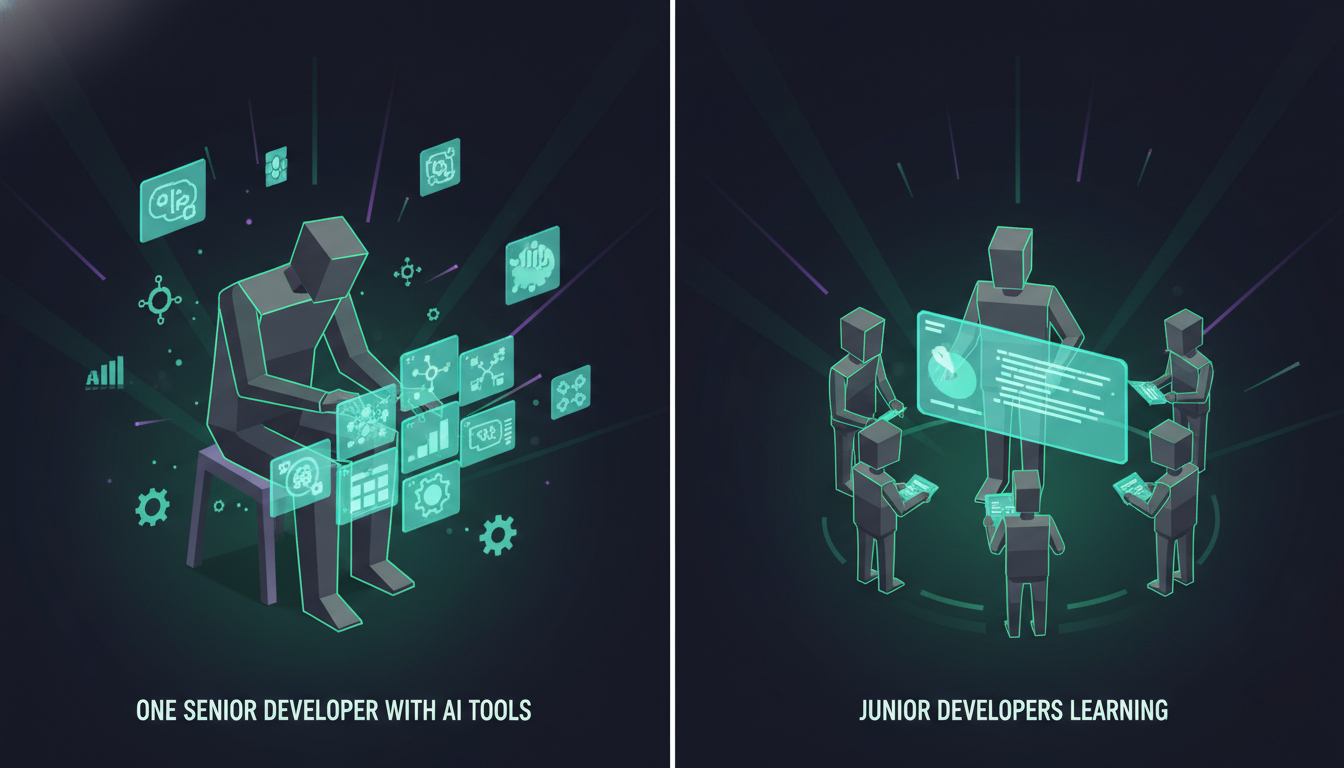
But timing tells a different story. If AI truly made juniors obsolete, the collapse would have started in late 2022 when ChatGPT launched. Instead, it accelerated in 2023-2024 when interest rates spiked. Sixty-six percent of global enterprises say they're cutting entry-level hiring "due to AI" - but AI is the excuse and economics is the driver.
High interest rates demand Day 1 ROI. Training budgets with 12-18 month payback periods got slashed first. "Precision hiring" replaced volume hiring - instead of 30 candidates and 4 interviews yielding one hire, it's 4 candidates with 3 interviews and 3 moving forward. Companies aren't looking for potential anymore. They want specific, high-demand skills in candidates who can contribute immediately.
That's great for experienced specialists. It's a disaster for everyone starting out.
The offshore factor nobody wants to discuss
There's an uncomfortable economic reality underneath this. Offshore developers cost 40-70% less than onshore talent, saving $50K-$100K annually per developer. A UK junior costs roughly £40-50K in salary plus benefits, needs 6-12 months of training, and might leave after 18 months. An experienced developer in Poland or Ukraine costs a similar amount but contributes from day one.
I run distributed teams across UK, Ukraine, Poland, and Israel at Metamindz. I'm not against nearshore or offshore hiring - we do it, and we do it well with CTO-led oversight. But when companies use offshore mid-level hires as a wholesale replacement for investing in domestic junior talent, they're not solving a problem. They're deferring it.
The 2029 reckoning: where will your mid-level engineers come from?
This is the part that keeps me up at night. The talent pipeline works like this:
Junior developer (year 0-2) becomes mid-level developer (year 3-5) becomes senior engineer (year 6-10) becomes tech lead or architect (year 10+). Skip a generation, and the pipeline breaks.

If the industry meaningfully reduces junior hiring for 3 consecutive years - 2024, 2025, 2026, which is exactly what's happening - the effects hit in waves. By 2029-2031, the pool of mid-level engineers thins dramatically. By 2032-2036, the senior engineer pipeline narrows. And this coincides with mass retirements of the current senior cohort.
The BLS still projects 327,900 new software developer jobs by 2033 - a 17% increase, well above the 4% average. Both things are true simultaneously: the industry needs more developers AND is refusing to train them. Short-term ROI thinking has won. The long-term consequences will take years to materialise, and by then, the shortage will be far worse.
What I see in tech DD and recruitment engagements
In every fractional CTO engagement and recruitment project I run at Metamindz, I'm already seeing early symptoms:
Startups at Series A asking for mid-level React developers with 3-5 years of experience - and getting 110+ applicants per role, but fewer than 5% have genuine hands-on experience (the rest padded their CVs with AI). Companies that laid off juniors in 2023 now can't find mid-level replacements in 2026 because - surprise - those juniors went to other industries. Hiring managers who can't distinguish between an AI-polished CV and genuine competence because they've never been trained to screen technically.
The companies that will win the next 5 years are the ones investing in junior talent NOW, while their competitors treat it as an unnecessary cost.
The CTO-led approach to junior hiring that actually works
I'm not arguing that every company should blindly hire juniors. The old model - hire 10 graduates, throw them at a codebase, hope 3 stick - was wasteful. But the current model of hiring zero juniors is worse.
What works is structured, CTO-led junior development. At Metamindz, when we help companies build their engineering teams through our CTO-led recruitment service, we design junior hiring programmes that look nothing like the graduate schemes of 2019:
| Aspect | Traditional Graduate Scheme | CTO-Led Junior Programme (Metamindz Approach) |
|---|---|---|
| Screening | CV keywords, university name | Live coding exercises, architecture discussions, AI tool proficiency tests |
| Team ratio | 1 senior to 4-5 juniors | 1 senior to 1-2 juniors maximum |
| AI tools | Not part of training | AI-augmented from day one with structured oversight protocols |
| Ramp-up time | 6-12 months to productive | 8-12 weeks with AI acceleration and CTO-led mentoring |
| Code review | Ad-hoc, inconsistent | Daily reviews by senior engineers with documented feedback loops |
| Retention | ~40% leave within 18 months | Higher retention through genuine career path design and skill ownership |
| Cost per productive hire | £80-120K (salary + training overhead + low output period) | £45-65K (structured programme, faster ramp, AI-augmented productivity) |
The key difference: a CTO or senior technical leader designs the programme, runs the screening, and oversees the development path. Not a non-technical recruiter. Not an HR department running a generic "graduate scheme". Someone who has actually built and shipped software and can tell the difference between a junior who will grow into a strong mid-level engineer in 2 years and one who won't.
Five things CTOs should do right now
1. Audit your talent pipeline. Map out your team by seniority. If you have zero developers under 3 years of experience, you have a ticking time bomb. Your mid-level and senior engineers will eventually leave, retire, or burn out - and you'll have nobody to replace them.
2. Hire 1-2 juniors per team of 5-6 seniors. Not a graduate army. Small, deliberate investments in early-career talent with proper mentoring structures. The maths works: one junior at £35-45K with 8-12 weeks of structured ramp-up is cheaper than recruiting a mid-level at £65-85K in a market where there aren't enough of them.
3. Build AI-native junior programmes. Train juniors WITH AI tools from day one, not as a crutch but as a productivity multiplier. This is exactly what our AI adoption service helps engineering teams design - structured workflows where AI augments human oversight, not replaces it.
4. Screen for learning velocity, not knowledge. The best junior hire isn't the one who knows React today. It's the one who can learn your entire stack in 6 weeks because they understand fundamentals and know how to use AI tools to accelerate their learning. CTO-led technical screening catches this. Keyword-matching CV scanning does not.
5. Partner with technical recruiters, not generalist ones. When hiring managers and interviewers are the biggest bottleneck in tech hiring (ranked the #1 internal challenge for 2026), the last thing you need is a non-technical recruiter adding noise to the process. CTOs and senior engineers should be running the screening, the interviews, and the assessment.
The counter-argument (and why it doesn't hold)
I hear this a lot: "But AI will keep getting better. Eventually we won't need as many developers at all, so why invest in juniors?"
Maybe. In 10 years. But the BLS projects 327,900 new developer jobs by 2033. AI-related job postings grew 74% year-over-year. The demand for developers isn't shrinking - it's shifting. You need people who understand systems, who can architect solutions, who can review AI-generated code (which, as I've written about before, has a 2.74x higher vulnerability rate than human-written code).
You can't hire those people externally in 2029 if nobody trained them in 2026. The companies investing in structured junior development today are building a competitive advantage that compounds over time. Everyone else is playing musical chairs with an ever-shrinking pool of experienced engineers.
Frequently Asked Questions
Why are companies not hiring junior developers in 2026?
Companies have reduced junior hiring due to a combination of AI coding tool adoption (which lets senior developers do more with less support), high interest rates demanding immediate ROI from new hires, and a shift to "precision hiring" that favours experienced specialists over candidates who need training. Entry-level tech hiring has dropped 73% in the past year alone.
Will the junior developer hiring collapse cause a senior shortage?
Yes. If the industry reduces junior hiring for three consecutive years (2024-2026), the mid-level talent pool thins by 2029-2031, and the senior pipeline narrows by 2032-2036. This coincides with retirements of the current senior cohort, creating a compounding shortage that will be far more expensive to address than investing in junior talent today.
How can startups afford to hire junior developers in 2026?
Structured, CTO-led junior programmes with AI-augmented training can reduce ramp-up time from 6-12 months to 8-12 weeks, cutting the total cost per productive hire to £45-65K compared to £80-120K under traditional graduate schemes. The key is small ratios (1-2 juniors per 5-6 seniors) with deliberate mentoring and daily code reviews.
What skills should entry-level developers focus on in 2026?
AI tool proficiency (Cursor, Claude Code, Copilot) is now table stakes for entry-level roles. Beyond that, strong fundamentals matter more than framework knowledge - understanding data structures, system design basics, and security principles. Learning velocity and the ability to use AI tools for accelerated skill acquisition are what CTO-led technical screening looks for.
How does CTO-led recruitment help with junior developer hiring?
CTO-led recruitment replaces keyword-matching CV screening with live coding exercises, architecture discussions, and AI proficiency tests run by people who have actually built software. This identifies high-potential juniors that generalist recruiters miss, and designs structured development programmes that turn new hires productive faster with proper technical oversight.