
How to Design a SaaS Data Model That Won't Cost You 6 Months
How to Design a SaaS Data Model That Won't Cost You 6 Months
A SaaS data model is the structure of your tables, relationships and tenant boundaries - the layer everything else is built on top of. Get it right and you scale quietly. Get it wrong and you're staring down a 6 to 12 month re-architecture instead of shipping features. This is how I design one that survives contact with real customers, based on years of building and auditing them.
So, look, most of the tech debt I find when I do a fractional CTO engagement or a technical due diligence doesn't come from bad code. Bad code is cheap to fix. You refactor a function, you delete a file, you move on. The stuff that actually hurts is baked into the data model - the decisions someone made in week two, before there was a single paying customer, that now can't be undone without touching every query, every migration and every integration in the product.
I've seen a founder spend £40,000 unwinding a data model that stored everything in one giant "users" table with a nullable column for every possible role. I've seen a Series A raise wobble because the schema couldn't answer "how much revenue came from this customer segment last quarter" without a week of manual SQL. The pattern is always the same: nobody thought about the data model as a decision. They just started typing.
Why the data model is the one thing you can't cheaply change later
Everything else in your stack is replaceable. You can swap React for Svelte. You can move off Heroku onto AWS. You can rewrite your API. Painful, but doable in a sprint or two. The data model is different because your data outlives your code. Once you have a million rows shaped a certain way, changing the shape means migrating all of them, usually while the product is live and customers are writing new rows the whole time.
The numbers back this up. Poor data quality costs the average organisation $12.9 million a year, according to Gartner, and MIT Sloan research puts the revenue lost to bad data at 15 to 25%. A lot of that "bad data" isn't dirty input - it's structural. It's a model that was never designed to answer the questions the business now needs answered.
And when you do have to change it, unplanned downtime during a migration can cost large operations over $9,000 per minute. That's not a typo. Every minute your database is locked while you re-shape a table is money walking out the door. This is exactly the sort of thing that turns up in a tech due diligence and makes an investor nervous, because a single database with no clear path to horizontal scaling is a well-known red flag for anyone assessing technical risk before a deal.
Decide your tenant isolation before anything else
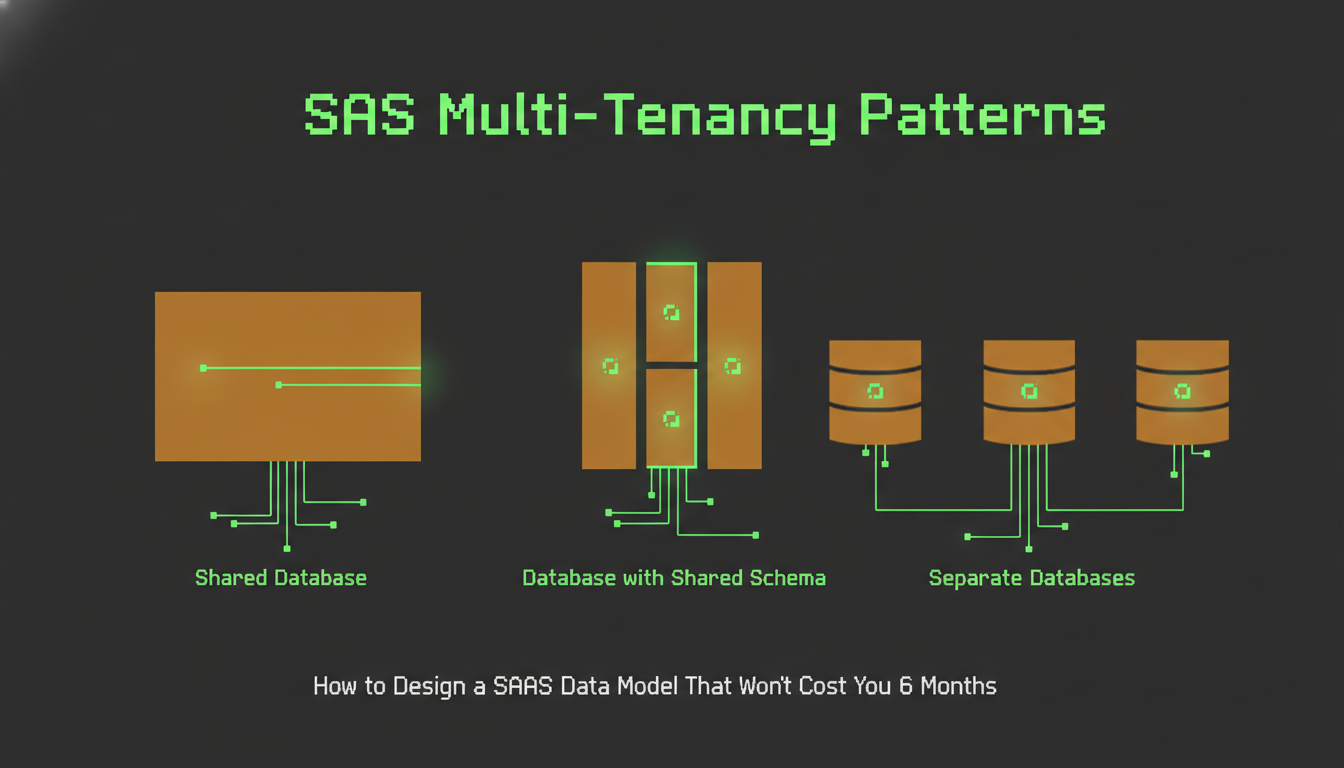
If you're building B2B SaaS, the single biggest data model decision is how you separate one customer's data from another's. This is multi-tenancy, and there are three patterns. Pick the wrong one and you will pay for it, either in security incidents or in migration bills.
| Pattern | How it works | Best for | The catch |
|---|---|---|---|
| Shared schema (one tenant_id column) | Every tenant lives in the same tables, separated by a tenant_id column | Early-stage products, 100 to 10,000 tenants, no isolation demands beyond SOC 2 | One query that forgets the tenant_id filter leaks everyone's data. Highest risk, cheapest to run. |
| Schema-per-tenant | One database, each tenant gets its own schema inside it | Growth-stage products that need stronger isolation and per-tenant migrations | More operational overhead. The de facto 2026 default for growing SaaS. |
| Database-per-tenant | Each tenant gets a dedicated database or cluster | Enterprise, healthtech, anything under HIPAA or FedRAMP | Most expensive, hardest to operate. Overkill until a contract forces it. |
The rule I give every founder: pick your isolation based on who signs the contract, not on what feels technically elegant. A healthcare buyer asking about HIPAA will push you toward database-per-tenant long before your infrastructure feels ready. A self-serve SMB product with 5,000 accounts on a free trial does not need a dedicated Aurora cluster each. Most sensible teams end up on a hybrid: small accounts share, top-tier enterprise logos get dedicated resources. That keeps your margins healthy AND lets you win the big deals.
The expensive mistake is migrating between patterns after the fact. Moving from shared schema to database-per-tenant once you already have 500 customers is a 6 to 12 month re-architecture project, and doing that migration at scale runs £80,000 to £250,000 in engineering time alone. That is a whole product roadmap you don't get to build because you're busy moving data sideways.
The five rules I apply to every new SaaS data model
These aren't theoretical. This is the checklist I actually run through in the first architecture session before anyone writes a migration.
1. Model the questions, not just the things. Don't just ask "what objects exist" (users, orders, projects). Ask "what will the business need to know in 18 months". If you'll need revenue by cohort, by plan, by region, then those dimensions need to exist as proper columns and relationships from day one, not as strings you'll regret parsing later. A data model that can't answer your board's questions without a heroic SQL session is a broken data model.
2. Put the tenant boundary in from the very first table. Even if you launch with shared schema, every table gets a tenant_id, every query gets filtered by it, and you enforce it at the framework level, not by hoping developers remember. In Postgres, Row Level Security (RLS) does this for you so a forgotten WHERE clause can't leak data across tenants. Adding tenant awareness later means touching every single query you've ever written.
3. Normalise first, denormalise on purpose. Start normalised - it keeps your data honest and prevents the update anomalies that corrupt reports. Denormalise only when you have a measured performance problem and you know exactly which read you're optimising. Denormalising early "for speed" before you have traffic is how you end up with three copies of the same customer name that slowly drift out of sync.
4. Never store money, time or state as loose strings. Money is integer minor units (pence, cents) plus a currency code, never a float. Timestamps are stored in UTC with timezone awareness. State machines (order status, subscription status) are explicit enums with defined transitions, not free-text fields where "cancelled", "Cancelled" and "canceled" all appear. These three get botched constantly and every one of them causes a data cleanup project down the line.
5. Design for migration from day one. You WILL change the schema. The question is whether it hurts. Use the expand-and-contract pattern: add the new column, backfill it, move the code across, then drop the old one - so you never need a big locking change on a live table. Version your migrations, keep them reversible, and test them against a production-sized copy before they go anywhere near real customers. The teams that skip this are the ones paying $9,000 a minute later.
The re-architecture wall - and how to see it coming
Products built on a weak data foundation hit a scaling ceiling that costs £150,000 to £400,000 to correct after the fact. The frustrating part is that the wall is always visible in advance if you know what to look for. The single database that's fine at 10,000 rows and starts timing out at 10 million. The report that took 200 milliseconds and now takes 40 seconds. The feature request that gets estimated at "two weeks" and comes back as "we can't do that without changing the schema".
When AI-generated code is involved, this gets worse, not better. A lot of vibe-coded MVPs I audit have a data model that an AI produced to make one screen work, with no thought for tenancy, indexing or how it'll behave at volume. It runs beautifully in the demo and falls over the moment real usage arrives. That's a big part of why our software development and vibe-code fix work almost always starts with the schema, not the UI.
The honest answer for most seed-stage founders is that you don't need a perfect data model. You need a defensible one - one that's normalised, tenant-aware, and designed with the next 18 months of business questions in mind. That's a few hours of thinking with someone who's seen the failure modes, versus months of unwinding later.
Metamindz vs the typical approach to your data model
| Aspect | The typical way | CTO-led approach (Metamindz) |
|---|---|---|
| Who designs it | A junior dev, an offshore team, or an AI prompt, with no business context | A hands-on CTO who's mapped it against your actual contracts and roadmap |
| Tenancy decision | Whatever the tutorial used, decided implicitly | Chosen deliberately based on who signs your contracts and your compliance needs |
| When problems surface | At Series A tech DD, or when the database starts timing out | In the first architecture session, before a line of code is written |
| Migration readiness | Big locking changes, downtime, fingers crossed | Expand-and-contract, reversible, tested against production-sized data |
| Lock-in | Undocumented model only the original dev understands | Documented schema, handover-ready, your team can own it |
I'll say the same thing I always do: if your data model is already sound, we'll tell you and point you at what actually matters instead. But if you're pre-launch or heading into a raise, an hour spent on the schema now is the cheapest insurance you'll ever buy. If you want a second pair of eyes on it, a free CTO discovery call is the right place to start.
Frequently Asked Questions
What is a SaaS data model?
A SaaS data model is the structure of your database - the tables, the relationships between them, and how one customer's data is separated from another's. It defines what your product can store, query and report on. It's the foundation everything else is built on, and the hardest layer to change once you have real data in it.
How much does it cost to re-architect a SaaS data model?
Migrating between multi-tenancy patterns at scale runs £80,000 to £250,000 in engineering time, and correcting a weak foundation after hitting a scaling ceiling costs £150,000 to £400,000. On top of that, unplanned downtime during migration can exceed $9,000 per minute for larger operations. Designing it right upfront costs a few hours.
Which multi-tenancy pattern should a startup use?
Most early-stage SaaS should start with a shared schema and a tenant_id column, enforced with Row Level Security. Move to schema-per-tenant as you grow, and database-per-tenant only when an enterprise or compliance contract (HIPAA, FedRAMP) forces it. Choose based on who signs your contracts, not on what feels technically elegant.
When should I bring in a fractional CTO for data modelling?
Before you write your first migration, and again before any fundraise or acquisition. A fractional CTO can design a defensible model in a few hours and catch the mistakes that turn into six-month re-architectures. It's far cheaper than fixing a broken schema once you have thousands of customers writing to it.
Do AI-generated data models cause problems?
Often, yes. AI tools tend to produce a schema that makes one screen work in a demo, with no thought for tenancy, indexing or behaviour at volume. It looks fine until real usage arrives, then falls over. AI-generated data models should always be reviewed by someone who understands how they'll perform in production before you ship.