
Bots Are Applying, Bots Are Screening: How to Hire Developers in 2026
Bots Are Applying, Bots Are Screening: How to Hire Developers in 2026
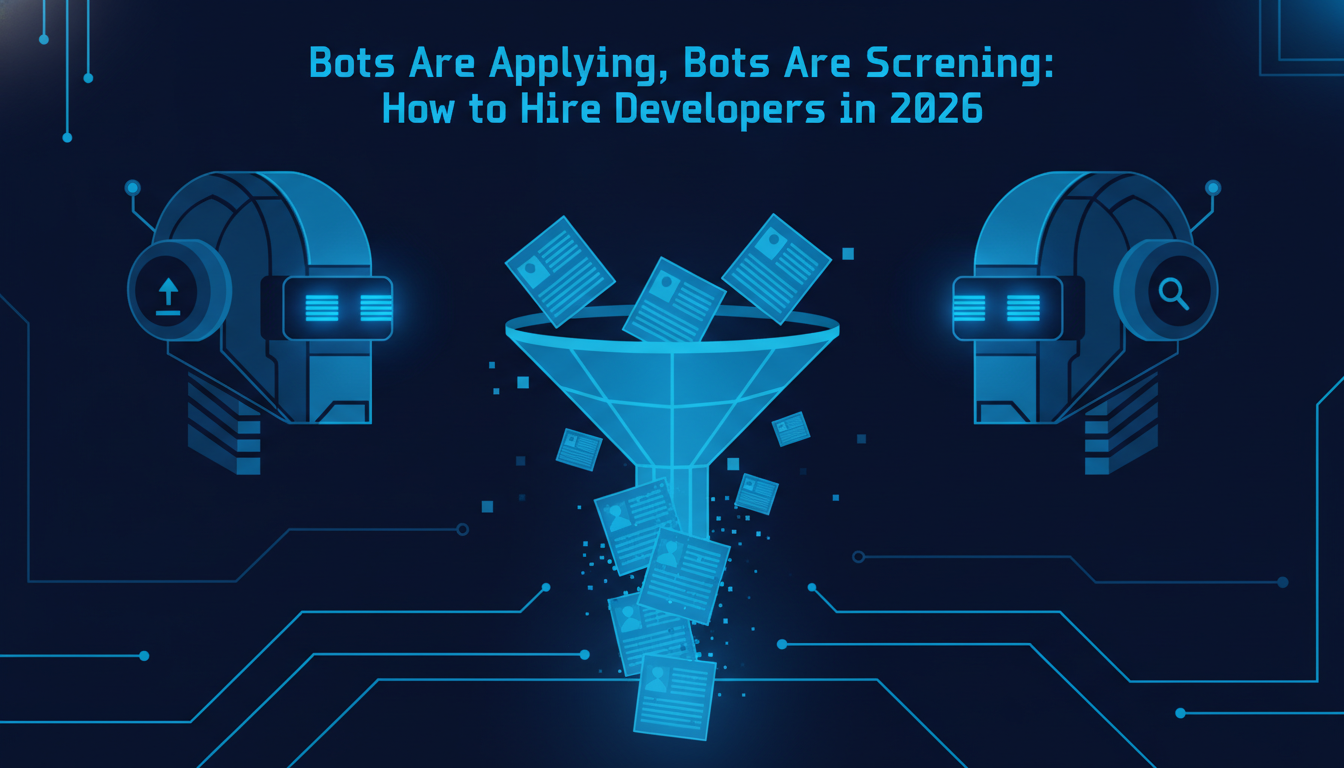
Tech hiring broke in 2026. Candidates use AI to write CVs and auto-apply at scale. Employers use AI to screen them. The screening models now prefer AI-written CVs by up to 82%, so the funnel rewards whoever games the machine best, not whoever can build. The only reliable signal left is a real engineer judging real work.
So.. I had a call last month with a founder who had 1,400 applications on a single backend role inside four days. He was thrilled. "Look at the demand," he said. I asked him how many he'd actually spoken to. Zero. His ATS had auto-rejected most of them, shortlisted eleven, and three of the eleven turned out to be the same person applying under different names.
That's not a demand signal. That's noise dressed up as a pipeline.
I've spent years running CTO-led technical recruitment and sitting on the hiring side as a fractional CTO. The machinery that used to filter candidates - job board, ATS, keyword match, phone screen - has stopped working. Not "needs tuning". Stopped. Below is what actually happened to the funnel this year, with the data, and what I now tell every founder who asks me how to hire developers without drowning.
How AI broke the top of the hiring funnel
The top of the funnel is flooded, and the flood is automated. LinkedIn is now processing around 11,000 job applications every minute, a 45% jump year on year, and a big chunk of that is driven by personal AI agents that apply on a candidate's behalf while they sleep. New graduates alone submitted roughly 64% more applications per job in 2024 than the class before them.
This is not "more good candidates found you". It's the same people firing at everything. A candidate using an auto-apply tool can hit a thousand roles in a weekend, most of which they don't remember applying to and couldn't describe back to you. Recruiters report being able to keep up with a fresh posting for a few hours before it becomes unmanageable.
So volume tells you nothing now. A role with 1,400 applicants and a role with 90 might contain the same number of people who can actually do the job. The flood just makes the good ones harder to find, because they're buried under perfectly formatted, keyword-stuffed, AI-generated submissions that look exactly like the real thing on paper.
The doom loop: AI writes the CVs, and AI prefers them
Here's where it gets properly daft. The same AI that writes the CVs is increasingly the AI that screens them - and it has a favourite. It likes its own output.
Greenhouse's CEO Daniel Chait calls it a "doom loop": candidates use AI to apply to more roles, so employers use AI to filter more aggressively, so candidates use MORE AI to beat the filter, and the whole thing accelerates with no human gaining anything. Both sides are spending money to fight an arms race that produces worse outcomes for everyone.
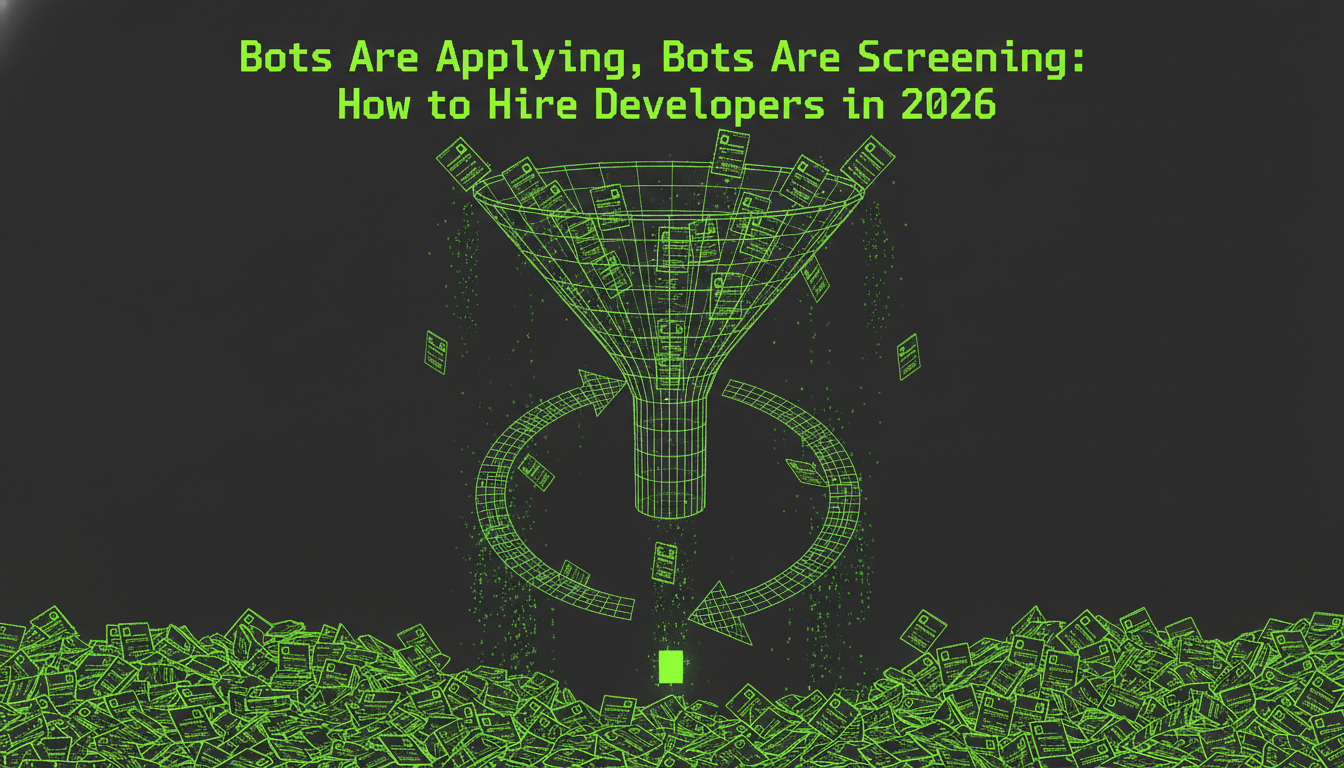
The numbers behind the filter are the part that should worry you. Around 98% of Fortune 500 companies run an ATS, and up to 75% of CVs are rejected before a human ever reads them. None of the major systems - Workday, Greenhouse, iCIMS, Lever, Ashby - reliably detect whether a CV was written by a human or a model.
And then there's the bias. A 2026 study by researchers at the University of Maryland, the National University of Singapore and Ohio State ("AI Self-preferencing in Algorithmic Hiring") found that large language models prefer AI-written CVs over human-written ones by 67% to 82%, boosting shortlisting odds by 23% to 60% across two dozen jobs. The effect is strongest when the same model that wrote the CV is also doing the screening. Separate vendor data puts the preference for AI-polished CVs at up to 82%.
Read that back. Your screening AI is not selecting for the best engineer. It's selecting for the candidate who used the slickest AI to write their CV. The brilliant developer who wrote their own honest, slightly clunky CV gets binned. The one who let ChatGPT inflate a thin background sails through. You've automated your way into optimising for the exact opposite of what you want.
Why your ATS can't save you
Modern systems have moved from crude keyword matching to semantic matching, which sounds like progress until you remember the inputs are now synthetic. Most tools became "operationally necessary" precisely because teams are handling 250-plus applications per role. They're a coping mechanism for volume, not a quality filter. Feeding more AI-generated text into a smarter parser doesn't get you signal, it gets you a more confident wrong answer. The ATS is solving the wrong problem - it's trying to rank a pile of documents when the documents themselves stopped being trustworthy.
Then the interview stage broke too
Say you survive the funnel and get someone on a call. That used to be where the truth came out. Not anymore.
Fabric analysed over 50,000 candidates and found AI-assisted interview cheating more than doubled, from 15% in June 2025 to 35% by December 2025. In a separate sample of 19,368 interviews, 38.5% of tech candidates showed signs of AI cheating, rising to 48% in purely technical roles. Worse: 61% of the candidates who cheated still cleared the pass threshold. The tools doing this - Cluely, Interview Coder and the rest - sit invisibly on screen, feed answers in real time, and are explicitly built to be undetectable on a standard video call.
This is the bit people get wrong: a live coding test is NOT enough on its own anymore. If the candidate is alone with a shared editor and an overlay tool whispering answers, your "live" assessment is just a typing test for an AI. Juniors with 0-5 years of experience cheat the most, because they feel they need every edge just to get a foot in the door, which means the exact pool you most need to assess carefully is the pool most likely to be faking it.
What this actually costs you
None of this is academic. Getting a developer hire wrong is one of the most expensive mistakes a startup makes. The average bad hire costs at least $15,000, and often more than $240,000 for senior technical roles. The US Department of Labor pegs it at 30% of the employee's first-year wages; SHRM puts replacement at half to twice annual salary. And 74% of employers admit they've hired the wrong person.
The time cost is just as brutal. Filling a senior software engineer role takes somewhere between 47 and 90 days for most teams, and roughly 17 days when you're working from a pre-vetted senior pool. Meanwhile 76% of recruiters say they're struggling to attract quality talent, and 30-50% of candidates drop out mid-process because of slow, messy funnels. So you spend two months, burn a fortune in engineering interview time, and frequently end up with the wrong person or no one.
For an early-stage team, a single bad senior hire can eat six months of runway and demoralise the three good engineers who have to clean up after them. This is the real reason the broken funnel matters. It's not an HR inconvenience. It's a direct hit to your burn rate and your roadmap.
How to actually hire developers in 2026
The fix is not a better filter. It's a different question. Stop asking "does this CV match the keywords" and start asking "can this person do the work, judged by someone who can do the work themselves". That single shift - from document screening to assessment-first, human-led evaluation - is what cuts through the noise.
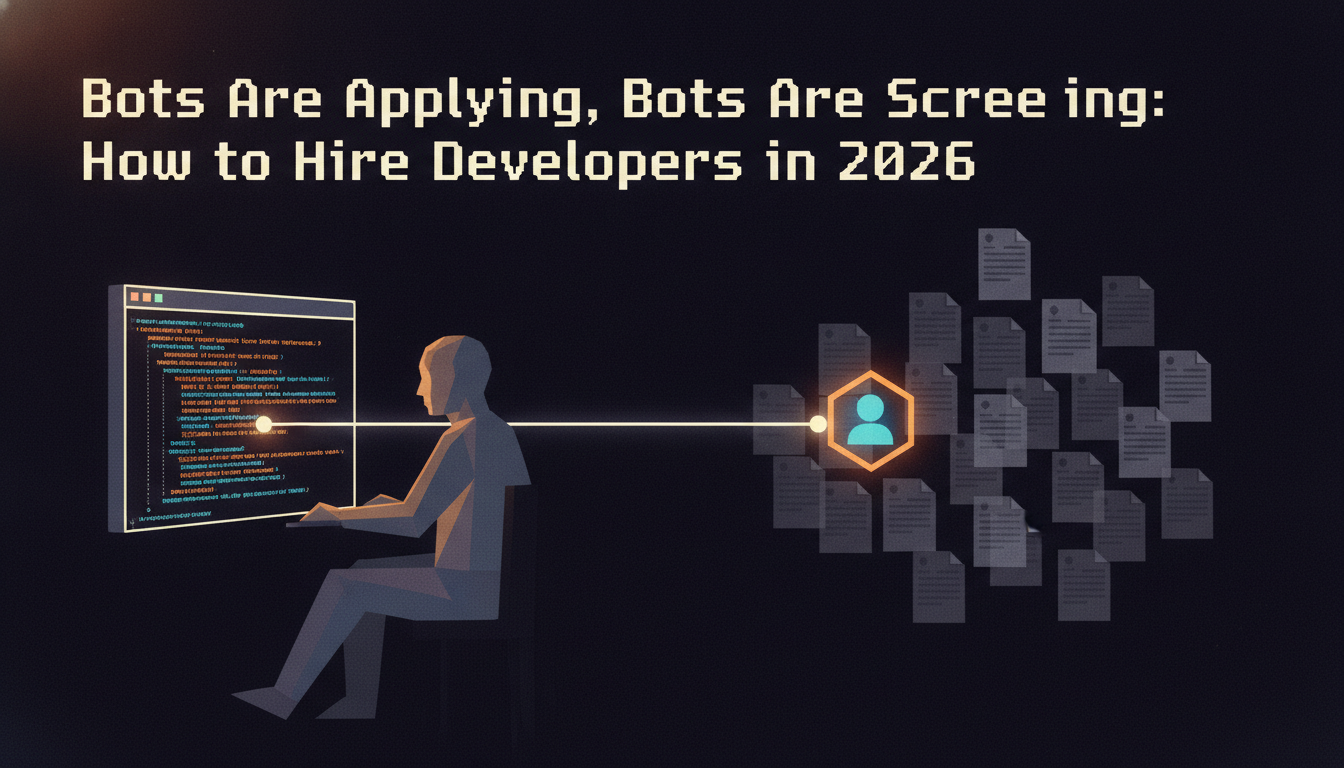
This is exactly why everything we do at Metamindz is led by people who write code. A non-technical recruiter cannot tell the difference between a candidate who understands distributed systems and one who memorised the right phrases. An AI screener actively prefers the latter. A senior engineer who has built the thing can spot it in ten minutes. That's the whole game now.
Here's the practical version of what works, and how it compares to the automated funnel most companies are still trusting:
| Stage | Keyword / AI-led funnel (typical) | CTO-led technical screening (Metamindz) |
|---|---|---|
| First filter | ATS keyword and semantic match on a CV that AI probably wrote | Short async work-sample on a real, scoped problem - judged on the code, not the CV |
| Who screens | Software, then a generalist recruiter who's never shipped code | A senior developer or CTO who has built and scaled the same kind of system |
| Technical assessment | Solo "live" coding test an overlay tool can quietly solve | 1.5-2 hour live pairing session - collaborative, watched, discussed in real time |
| Depth check | Standardised question bank, easy to pre-answer with AI | Architecture grilling with curveballs - "why did you do it that way, what breaks at 10x" |
| Cheating resistance | Low - 38-48% of technical candidates show AI cheating signs | High - real-time dialogue, screen and ID checks, follow-ups no overlay can fake |
| What you optimise for | Whoever games the machine best | Whoever can actually build and reason about the work |
| Time to a real shortlist | 47-90 days, lots of noise | Quality profiles typically within a week, pre-vetted |
The mechanics that make this resistant to the doom loop are specific, so let me name them:
1. Work-sample before CV. A small, paid-or-timeboxed task that mirrors your real codebase tells you more than any CV. Decades of hiring research say work-sample tests are among the most predictive things you can do, and crucially, AI helping someone do real work well is fine - that's the job now. AI faking experience they don't have is what you're filtering out.
2. Pair, don't quiz. Replace the solo algorithm test with a 90-120 minute live pairing session on a realistic problem. When you're building alongside someone, talking through trade-offs, an overlay tool feeding canned answers falls apart fast. You see how they think, not just what they type.
3. Grill the architecture. Ask them to walk through something they actually built. Then push - what would you change, where does it fall over, what did you get wrong. Real builders light up here. People who memorised buzzwords or leaned on AI for the whole thing run out of road in about three questions.
4. Verify the human. Screen-share, camera on, a quick ID check, and watch for the response latency and linguistic tells of someone reading off a second screen. This is table stakes now, not paranoia - especially with proxy and deepfake interviews rising alongside the cheating tools.
5. Use AI fluency as a signal, not a disqualifier. The strongest 2026 developers use AI well. You want to see HOW they use it - do they review what it generates, do they know where it's dangerous (auth, payments, data models), can they tell good output from confident rubbish. That's a competence test in itself, and it's exactly the kind of structured judgement we teach teams in our AI adoption work.
What I tell founders drowning in applications
Three things, usually.
First, stop celebrating application volume. It's a vanity metric now. A flooded posting is a sign your top of funnel is being scraped by bots, not that the market loves your role. Judge your pipeline on the number of genuinely qualified people you've actually assessed, not the count in your ATS.
Second, get a technical person in front of candidates as early as you can afford to. Every stage you let the machine run unsupervised is a stage optimising for the wrong thing. If you don't have a senior engineer to spare - and most seed-stage teams don't - that's precisely the gap a fractional CTO fills. You borrow the judgement for the handful of hours hiring actually needs it.
Third, be honest in your own process. If you're using AI to mass-reject humans while expecting humans not to use AI to apply, you've already lost the plot. Design a process that rewards demonstrable skill, tell candidates exactly what it involves, and let AI be a tool on both sides rather than a weapon. The companies winning at hiring right now aren't the ones with the cleverest filter. They're the ones who put real evaluation back in the loop.
We do this for clients across SaaS, healthtech, e-commerce and consumer apps every week - and one of the things I'm proudest of is that we'll happily tell you when you don't actually need us, or when one of your own engineers should run the loop instead. The point is to hire the right person, not to sell you a service. If you want a look at how we run CTO-led recruitment, or you just want a second technical opinion on a candidate you're unsure about, that's a free conversation.
The founder with 1,400 applications? We binned the CV pile, sent eight people a two-hour scoped task, paired with the three who did it well, and he hired one of them. Total elapsed time, eleven days. The funnel didn't need fixing. It needed a human who could read code standing in the right place.
Frequently Asked Questions
Why are there so many applicants per tech role in 2026?
AI auto-apply agents and CV-writing tools let candidates apply to hundreds or thousands of roles with almost no effort. LinkedIn now sees around 11,000 applications a minute, up 45% year on year. The volume reflects automation, not genuine demand, so a flooded posting tells you very little about candidate quality.
Can an ATS detect AI-written CVs?
No. None of the major applicant tracking systems reliably detect AI authorship in 2026. Worse, studies show AI screeners actively prefer AI-written CVs by 67-82%. So your ATS isn't filtering out fakery - it's often rewarding the candidate who used the best AI tool, not the best engineer.
How do you stop AI cheating in technical interviews?
Solo coding tests no longer work, since overlay tools like Cluely feed answers in real time. The reliable defence is live pairing with a senior engineer, architecture deep-dives with follow-up questions, screen-share and ID verification, and judging how candidates reason - not just the final answer. A real-time technical conversation is very hard to fake.
How much does a bad developer hire cost?
At minimum around $15,000, but often $30,000-$150,000 and up to $240,000 for senior technical roles once you include lost productivity, management time, and rework. The US Department of Labor estimates 30% of first-year salary. For an early-stage startup, one bad senior hire can burn months of runway.
Why use CTO-led recruitment instead of a normal tech recruiter?
A generalist recruiter cannot tell a strong engineer from someone who memorised the right phrases, and AI screeners prefer the latter. A senior developer or CTO assessing real work spots the difference quickly. CTO-led screening evaluates demonstrable skill, which is the only signal the automated funnel can't fake.
Want a technical read on your hiring process or a candidate you're unsure about? Book a free, no-obligation call with Metamindz - we'll tell you honestly what's worth doing. See how CTO-led recruitment works.