
How to Screen Developers in 2026 When Every Resume Is AI-Perfect
Developer screening in 2026 means one thing above all else: the resume is dead as a reliable signal. With 72% of recruiters reporting encounters with AI-generated fake resumes and cheating tools like Cluely and Interview Coder providing invisible real-time answer overlays during technical interviews, the old hire-by-CV-and-leetcode pipeline is broken. Screening developers today requires a skills-first, multi-layered process that tests what candidates can actually do - not what an LLM wrote on their behalf.
I've been hiring and technically screening developers for over 15 years - first for my own teams, then as a fractional CTO for dozens of startups, and now through Metamindz's CTO-led recruitment service. The last 18 months have been a sea change. The candidates who look perfect on paper have never been more plentiful, and the gap between what a resume says and what a person can actually do has never been wider.
So.. here's the screening process I use in 2026, step by step. It's the same one we run for every Metamindz recruitment engagement. It works because it's designed by people who've actually held the roles we're hiring for.
Why Traditional Screening Is Broken in 2026
The numbers tell the story. Fabric's analysis of 50,000+ candidates found that interview cheating more than doubled from 15% in June 2025 to 35% by December 2025. The trajectory suggests cheating becomes the norm - not the exception - by late 2026. Gartner estimates 25% of all applications will be outright fake by 2028.
The tools candidates are using are genuinely sophisticated. Interview Coder and Leetcode Wizard solve algorithmic problems in real-time during coding interviews. Cluely and FinalRound AI use OS-level invisible overlays - DirectX on Windows, Metal on macOS - that render AI-generated answers directly on the candidate's screen. These overlays are invisible to screen-sharing software. The interviewer sees nothing.
Meanwhile, on the resume side, every junior developer now has a CV that reads like a senior architect's portfolio. ChatGPT writes bullet points that perfectly match job descriptions. 65% of hiring managers have caught applicants using AI deceptively during the hiring process. The old keyword-matching ATS pipeline? It's now essentially a test of who has the best AI resume writer.
The 5-Stage Screening Process That Actually Works
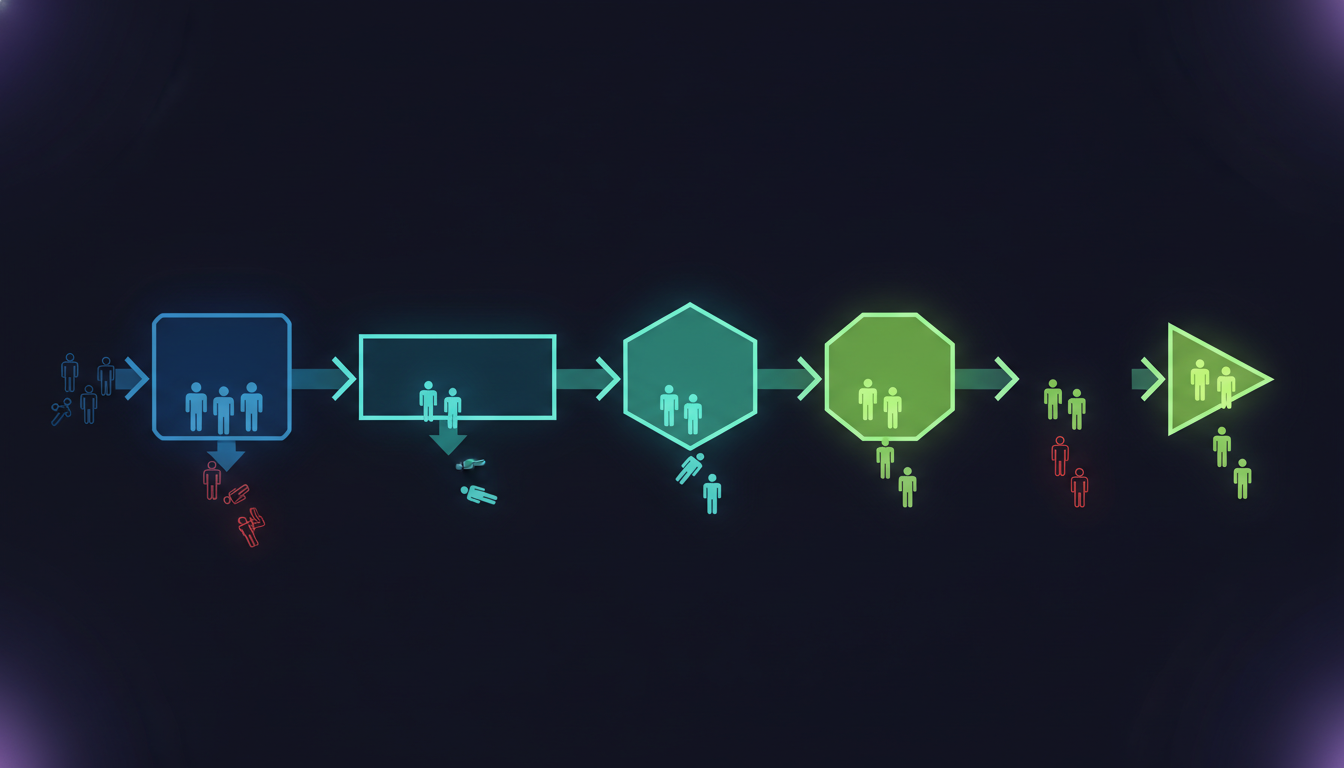
I've iterated on this process across probably 200+ hires over the years. The core principle: every stage tests something the previous one can't, and every stage is designed to be resistant to AI assistance. No single stage is a gate - the combined signal across all five is what matters.
Stage 1: Async Skills Screen (Replaces Resume Screening)
Throw the CV in the bin. Not literally - you still want it for reference - but it's no longer the primary filter. Instead, I use a short async skills assessment. This takes the candidate 30-45 minutes and tests three things:
1. A focused technical problem relevant to the actual role. Not a generic algorithm puzzle. If you're hiring a backend Node.js developer, give them a small API design problem with specific constraints. If it's a React role, give them a component to build with real-world requirements.
2. A written explanation of their approach. This is the AI-resistant part. Ask them to explain WHY they made the choices they did, what tradeoffs they considered, and what they'd do differently with more time. AI-generated explanations have a specific tell: they're comprehensive but impersonal. Real developers mention specific past experiences, express uncertainty about edge cases, and have opinions about tools.
3. A constraint. Time-box it to 45 minutes. Tell them you expect rough, working code - not polished production quality. This removes the incentive to spend hours with an AI perfecting the solution.
96% of tech employers now use some form of skills-based hiring, and companies using skills-based assessments are 12% more likely to make a quality hire. The data is clear: test the skill, not the CV.
Stage 2: Technical Conversation (Not an Interview)
This is a 45-minute video call with a CTO or senior engineer - someone who's actually done the job. NOT a recruiter reading from a script. NOT a junior developer who was told to "ask some technical questions."
The format is conversational, not interrogative. I start by discussing their async submission. "Walk me through your thinking here." "Why this data structure?" "What happens if this endpoint gets 10x the traffic?" Then I expand outwards into their experience. I'm listening for three things:
Depth of understanding. Can they go three levels deep on anything? Pick one technology from their experience and drill into it. How does the event loop actually work? What happens when a PostgreSQL query hits a missing index? Anyone who's actually worked with something for years can go deep. Someone who only used AI to write their resume will hit a wall at level two.
Honest gaps. The best developers I've hired all share one trait: they're comfortable saying "I don't know, but here's how I'd figure it out." AI-coached candidates try to bluff through everything because the AI never says "I don't know."
Architecture thinking. Give them a real scenario from your product and ask how they'd approach it. Not a whiteboard exercise - a conversation. "We've got 50,000 daily active users and the search is slow. What would you look at first?" The answer tells you everything about how they think.
This is where having a CTO do the screening makes all the difference. A fractional CTO who's built and scaled systems can spot the difference between rehearsed knowledge and real experience in about 10 minutes. A non-technical recruiter literally cannot.
Stage 3: Live Pairing Session (1.5-2 Hours)
This is the stage that separates the real from the pretenders. It's a live coding session - but NOT the traditional "solve this algorithm on a whiteboard" format. Research from NC State University found that traditional public coding interviews reduce performance by more than half due to observation anxiety. So I do it differently.
Format: pair programming on a real-ish problem. The candidate shares their screen, uses their own IDE, and works alongside the interviewer. The interviewer is a participant, not just an observer. They can ask questions, suggest approaches, and even write some code. This simulates actual day-to-day development far more accurately than solving HackerRank puzzles.
What I'm testing:
Problem decomposition. Can they break a vague requirement into concrete steps? Do they ask clarifying questions, or do they just start typing?
Real-time debugging. Introduce a bug mid-session. How do they diagnose it? Do they read error messages carefully, or do they just try random things? This is incredibly hard to fake with AI assistance because debugging is inherently conversational and context-dependent.
Collaboration style. How do they respond to suggestions? Do they explain their reasoning when the interviewer challenges a choice? 89% of bad hires fail due to soft skills, not technical ability - the pairing session reveals both at once.
AI tool usage (yes, I allow it). I explicitly tell candidates they can use AI tools like Copilot or Claude during the session. This is the real world. What I'm watching is HOW they use them. Do they blindly accept suggestions? Do they review generated code? Do they know when the AI is wrong? That tells me more about their actual engineering maturity than any ban on AI ever could.
Stage 4: Architecture and System Design (45 Minutes)
For mid-to-senior roles, this is non-negotiable. I present a real system design challenge - usually adapted from an actual problem we've solved at Metamindz or one of our client companies. Not "design Twitter" - that's a cliche every AI can answer perfectly. Something specific to the domain.
Example: "Your client is a healthtech startup processing 100,000 patient records daily. They need real-time search, GDPR-compliant data handling, and an audit log. The current system is a monolith on Heroku. Walk me through how you'd approach the next 6 months of architecture."
The follow-ups are where it gets interesting. "What if they need to expand to Germany? What changes?" "The CEO just got on Dragon's Den and traffic spiked 50x overnight. What breaks first?" "Budget is tight - what would you cut from your plan?"
Real architects handle curveballs because they've seen real curveballs. AI-coached candidates recite textbook answers that fall apart when the constraints change mid-conversation.
Stage 5: Culture Fit and Reference Verification
This is the stage most companies skip, and it's the one that prevents the most expensive mistakes. Two things happen here:
Culture conversation. Not "where do you see yourself in 5 years" - that's useless. I ask about real situations: "Tell me about a time you disagreed with a technical decision your team made. What did you do?" "What's the worst codebase you've worked on, and what would you change first?" "When was the last time you were wrong about a technical choice?"
Technical reference checks. I call previous managers or colleagues and ask specific questions: "How did they handle production incidents?" "Did they mentor juniors?" "Would you hire them again, honestly?" Most reference checks are performative. Mine aren't, because I know what to ask - I've been on both sides of these calls hundreds of times.
Traditional Screening vs CTO-Led Screening
| Aspect | Traditional (Recruiter-Led) | CTO-Led (Metamindz Approach) |
|---|---|---|
| Resume screening | Keyword matching via ATS - easily gamed by AI | Skills-first async assessment - tests actual ability |
| Technical evaluation | Generic coding puzzles or take-home tests | Real-world problems specific to the role and stack |
| Who conducts interviews | Non-technical recruiters + one dev interview | CTOs and senior engineers at every stage |
| AI cheating detection | Usually none - rely on proctoring software | Conversational probing, follow-up depth, allowed AI usage observation |
| Architecture assessment | Often skipped or superficial | Domain-specific, curveball-heavy, 45-minute deep-dive |
| Time to quality profiles | Weeks of volume screening | Typically within 1 week of intro call |
| False positive rate | High - looks great on paper, fails in practice | Low - only candidates who pass rigorous technical vetting reach client |
| Cost of bad hire | Up to 400% of annual salary for senior roles (CIPD) | Significantly reduced through multi-stage technical validation |
7 Practical Anti-Cheating Measures You Can Implement Today
You don't need expensive proctoring software to make your interviews AI-resistant. Here's what I do:
1. Ask "why" three times in a row. AI generates answers. It doesn't generate the reasoning chain behind personal decisions. "Why did you choose Redis here?" followed by "Why not Memcached?" followed by "Why does that matter for your specific use case?" - by the third why, AI-coached candidates are visibly struggling.
2. Change the problem mid-stream. Give a coding problem, let them get 60% through it, then change a core requirement. Real developers grumble and adapt. AI-dependent candidates freeze because their tool needs to regenerate the entire solution.
3. Ask about failures. "What's the worst bug you've shipped?" "When did your architecture decision turn out to be wrong?" AI candidates have suspiciously clean histories. Real developers have war stories with specific details - the ticket number, the 3 AM call, the customer who noticed first.
4. Use domain-specific problems. "Design Twitter" is in every AI training set. "Design a booking system for a veterinary clinic chain with 15 locations, legacy Windows desktop software, and a vet who refuses to use anything but email" is not. Specificity is your friend.
5. Watch for response latency patterns. Real developers pause at hard questions and speed through easy ones. AI-assisted candidates show the opposite pattern - they answer complex questions smoothly (because the AI handles them) but hesitate on simple follow-ups that require personal experience.
6. Allow AI tools and observe usage. This is counterintuitive but effective. Telling candidates they CAN use Copilot or Claude during a live session lets you observe their engineering judgement. Do they review AI output? Do they modify it? Do they know when it's wrong? That's the skill you're actually hiring for in 2026.
7. Do the technical screening yourself - or hire someone who can. Companies without standardised interview processes are 5x more likely to make a bad hire (SHRM). If you're a non-technical founder, you need a CTO in the room for technical hires. Period. Whether that's a full-time CTO, a fractional CTO, or a CTO-led recruitment service - someone technical has to be evaluating technical candidates.
When to Bring in External Help
Not every company needs to build this entire pipeline internally. If you're a seed-stage startup making your first 3-5 engineering hires, it makes no sense to spend months perfecting an interview process you'll use a handful of times.
That's where CTO-led recruitment earns its keep. At Metamindz, the process works like this: you tell us about your product, stack, team, and roadmap. We design a bespoke assessment process for each role. Then we source, assess, interview, and technically test candidates - you only see the ones who've passed every stage. We typically start sending quality profiles within a week of the intro call.
The economics are straightforward. A bad hire at a mid-level developer salary of £65,000-£70,000 costs you £132,000+ when you factor in recruitment fees, onboarding, lost productivity, and rehiring. For senior roles, the CIPD puts the figure at up to 400% of annual salary. Paying for rigorous technical screening upfront is not a cost - it's insurance.
What Good Developers Actually Want From Your Process
Here's something most hiring guides miss: the best developers are screening YOU as much as you're screening them. 78% of developers say the technical assessment experience is a major factor in their decision to accept an offer. Your interview process is your employer brand.
What good developers want: real problems (not algorithm puzzles), respectful use of their time (no 8-hour take-homes), technical interviewers who understand the work (not recruiters reading scripts), transparency about the role and the team, and fast feedback (don't ghost candidates for three weeks).
What drives them away: generic HackerRank tests that have nothing to do with the job, "culture fit" interviews that are actually vibe checks with no structure, interviewers who can't answer their questions about the tech stack, and processes that feel adversarial rather than collaborative.
The pairing-based interview format I described above hits all the right notes. It's collaborative, relevant, and respectful. Candidates leave it feeling like they had a real technical conversation - even when they don't get the offer.
Frequently Asked Questions
How long should a full developer screening process take from application to offer?
For a senior developer, aim for 2-3 weeks end to end. The five stages I describe above take roughly 4-5 hours of the candidate's time total, spread across the stages. Average time-to-fill for senior technical roles is 68 days in 2026, but a well-designed process with dedicated technical screeners can cut that dramatically. At Metamindz, we typically have quality profiles within a week of the intro call.
Should I ban AI tools during technical interviews?
No. Banning AI tools creates an artificial environment that doesn't reflect how developers actually work in 2026 - 92% of developers use AI tools daily. Instead, allow them and observe how candidates use them. Engineering judgement about when to trust, modify, or reject AI output is now a core professional skill worth evaluating.
What if I'm a non-technical founder - how do I screen developers?
You don't - not alone. Either hire a fractional CTO to handle technical evaluations, use a CTO-led recruitment service where actual engineers conduct the screening, or bring in a trusted technical advisor for the interview stages. Non-technical founders making technical hiring decisions is the single most common source of expensive bad hires in early-stage startups.
How do I detect if a candidate is using invisible AI overlays during a video interview?
Watch for response latency inversions - smooth answers to complex questions but hesitation on simple follow-ups that require personal experience. Ask forced clarification rounds ("Can you rephrase that in simpler terms?") which break the AI's scripted flow. And most importantly, use conversational depth-probing: keep asking "why" until you hit real reasoning or a wall.
What's the cost of getting developer screening wrong?
For a mid-level developer on £42,000 in the UK, a bad hire costs over £132,000 when you include recruitment fees, onboarding, lost productivity, and rehiring costs. For senior roles at £80,000+, the total can exceed £150,000. These figures come from CIPD and UK recruitment industry data. Prevention through rigorous screening is always cheaper than correction.