
In-House vs Outsourcing vs CTO-Led: How to Build Software in 2026
In-House vs Outsourcing vs CTO-Led: How to Build Software in 2026
There are three ways to build software in 2026: hire an in-house team, hand it to an outsourcing agency, or run a CTO-led model where a senior technical leader owns the architecture and a lean team executes. In-house gives you the most control at the highest cost. Outsourcing is the cheapest on paper and the most likely to fail. CTO-led splits the difference. This guide breaks down the real costs, the failure rates, and how to actually choose.
So, look. I get asked this every week by non-technical founders, and almost every time they've already framed it as a binary: do we build a team, or do we outsource? That framing is where a lot of money goes to die. The third option, the one most agencies won't tell you about because it threatens their margin, is usually the right one for an early-stage company. I'll get to that. But first, the honest version of each.
I've built and managed all three. I've bootstrapped, I've raised, and I've cleaned up after outsourcing deals that went sideways. One non-technical founder I worked with saved roughly £60,000 by changing how their build was structured, not by finding a cheaper supplier. So this isn't theory. It's what I've watched work and fail across a lot of engagements.
Option 1: Build an In-House Team
Hiring your own engineers gives you maximum control, cultural alignment, and people who actually care about your product past Friday at 5pm. It's also the slowest and most expensive way to start, and the maths surprises people.
A senior developer in London averages around £72,000 a year, which works out at roughly £550 a day loaded before you add anything on top. And you do add things on top. The fully loaded cost of an employee in the UK is typically 30 to 35% above the advertised salary once you count National Insurance, pension, benefits and recruitment fees. A £100,000 role costs the business closer to £130,000-£135,000. A four-person senior team runs to about £360,000 a year before management overhead.
Then there's the time. Hiring a good senior engineer in the UK takes months, not weeks, and that's before you've onboarded them. If you hire the wrong person, and non-technical founders hire the wrong person a lot, you're paying for the mistake, the rehire, and the lost roadmap time. This is exactly why technical screening done by people who can actually read code matters more than a recruiter matching keywords on a CV.
In-house wins when you have product-market fit, predictable funding, and engineering is your core competitive advantage. It's the wrong first move when you're pre-revenue and still figuring out what to build.
Option 2: Hand It to an Outsourcing Agency
Outsourcing is fast to start and cheap by the hour. Typical agency rates sit at $25-$60 an hour depending on region, which is a fraction of a loaded London salary. For an MVP on a tight budget, with a short timeline and a clear spec, it can be the right call. I'm not anti-outsourcing. I run a distributed delivery team across the UK, Ukraine, Poland and Israel. Done properly, it works brilliantly.
The problem is "done properly" is rare. The failure numbers are genuinely grim. Around 50% of businesses fail when outsourcing software development within five years, and 20-25% of outsourcing relationships collapse inside the first two. Quality issues in outsourced code lead to a 27% rework rate on average, which means more than a quarter of what you pay for gets thrown away or redone. Cultural and communication misalignment is behind the majority of offshore project failures.
And this is the bit founders miss: the hourly rate is not the cost. The cost is the rate plus the rework, plus the time you spend translating between a non-technical account manager and a dev team you never speak to directly. The Standish Group's long-running CHAOS data shows only about 35% of software projects fully succeed, 45% are "challenged," and 20% fail outright. Most of the failures aren't because the developers were bad. They're because nobody technical was steering, and the gap between what was asked for and what was built widened every sprint.
The classic outsourcing trap is vendor lock-in. Undocumented code, no handover plan, and a codebase only the agency understands. When you try to bring it in-house or move suppliers, you discover you don't actually own anything you can use. That's not an accident. For a lot of agencies, lock-in is the business model.
Option 3: CTO-Led Development
CTO-led development is the model I think most early-stage companies should default to, and I'd say that even if I didn't run one. The structure is simple: a senior technical leader (a fractional CTO or architect) owns the architecture, the technical decisions, and the quality bar. A lean delivery team executes underneath them. There's no non-technical middleman deciding what "done" means.
A fractional CTO in the UK runs £800-£2,000 a day, or £3,000-£7,000 a month on retainer for one to three days a week. For day-rate-style intensive work like an architecture review or a build kickoff, £1,000-£1,600 a day is normal. That sounds like a lot until you compare it to a full-time CTO hire, which in the US runs $260,000-$400,000 base at Series B-C and commonly clears $1.2M in total comp at growth stage. You get the senior judgement without the senior salary, and you get it now instead of in six months.
What you're actually buying is oversight. The fractional CTO designs a lean, scalable architecture before a line of code is written, peer-reviews what the delivery team ships, and runs daily updates and weekly demos so you always know where you stand. Everything is documented for handover, because the goal is to make you independent, not dependent. That's the opposite of the outsourcing lock-in trap. At Metamindz we run exactly this model: a CTO session up front, a documented architecture, and a delivery team that hands over cleanly whenever you're ready to bring it in-house.
The honest caveat: CTO-led isn't free advice, and it isn't the right call once your engineering team crosses about 15 people, because at that point you need someone full-time and embedded. A good fractional CTO will tell you that themselves. I've told founders they don't need me yet. That's a feature, not a weakness.
The Three Models, Compared
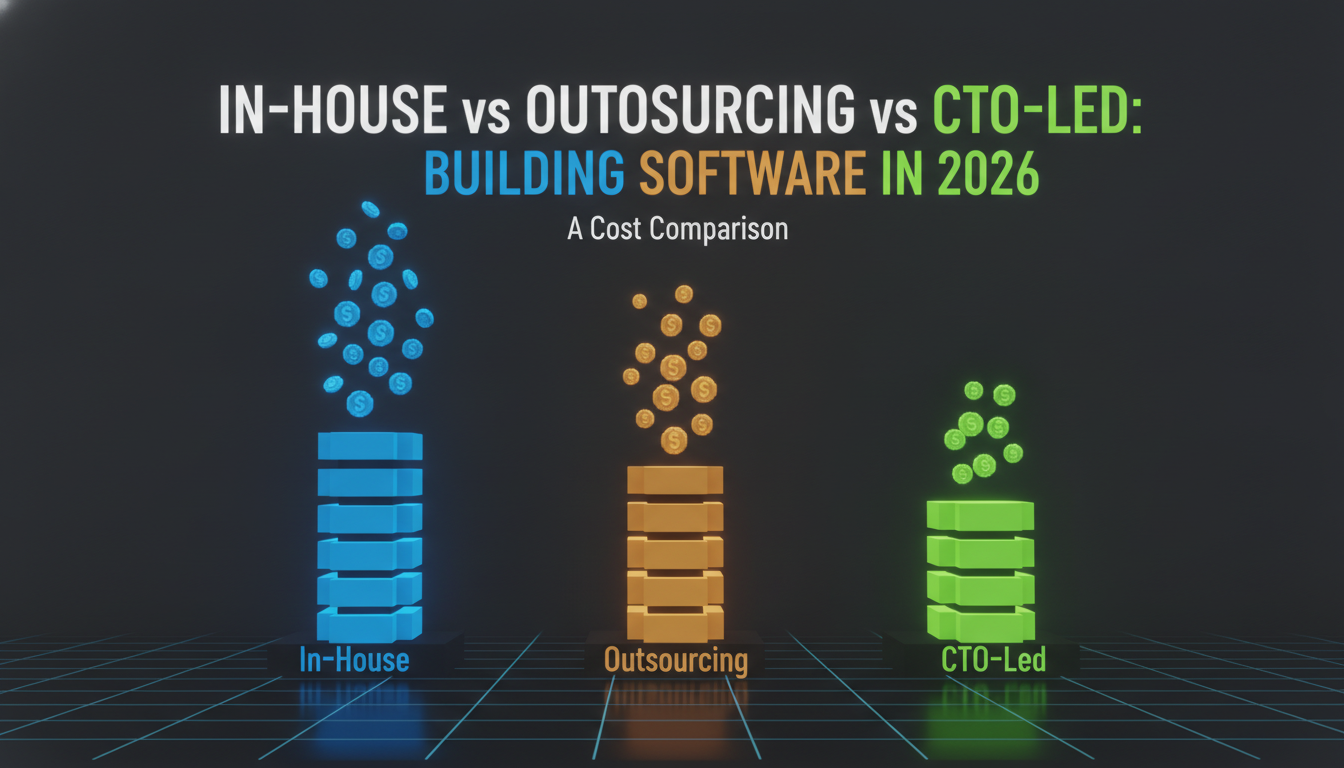
| Aspect | In-House Team | Traditional Outsourcing | CTO-Led Development (Metamindz) |
|---|---|---|---|
| Time to start | 2-4 months to hire | Days to weeks | Days (CTO session, then ramp) |
| Typical UK cost | ~£360k/yr for 4 seniors, loaded | $25-$60/hr, plus rework | £3k-£7k/mo retainer + lean delivery team |
| Technical oversight | Yours (if you have it) | Account manager, often non-technical | Senior CTO owns architecture and quality |
| Quality control | Internal, varies | 27% average rework rate | CTO peer-review on every change |
| Flexibility | Slow to scale up or down | Flexible but inconsistent | Adjust retainer and team size monthly |
| Vendor lock-in | None | High (undocumented code) | None, full documentation and handover |
| Failure risk | Mis-hire risk | ~50% fail within 5 years | Low, technically steered throughout |
| Best for | Post-PMF, engineering as moat | Defined short MVP, tight budget | Seed to Series A, non-technical founders |
The 2026 Twist: AI Has Changed the Maths Entirely
Here's what's different now, and it's the part most "in-house vs outsourcing" articles haven't caught up with. The size of team you need to build a serious product has dropped through the floor. AI-native companies are scaling revenue with a handful of people, and revenue-per-employee has become the metric investors actually watch, not headcount. Cursor (Anysphere) reportedly hit a multi-billion-dollar revenue run rate with a tiny engineering org. The era of "we need 20 engineers to hit a few million ARR" is over.
Agentic coding has gone mainstream this year. 2026 is the year AI coding moved from autocomplete into engineered agent workflows, with Claude Code, Cursor and open-source agents like OpenCode all pushing the same direction. A single engineer with structured AI workflows now delivers materially more output than a traditional one, because the time between intent and shipped code has collapsed.
This reshuffles the whole decision. The "build" question in 2026 isn't "how many bodies do we hire." It's whether you have the technical judgement to orchestrate a small AI-augmented team correctly. That's a CTO-shaped problem, not a headcount problem. A lean team run by someone who knows how to wire AI into the SDLC properly will outbuild a large traditional outsourced team, at a fraction of the cost. We built and shipped MintyAI, a complex bookkeeping product with AI matching algorithms, in about two weeks against a traditional estimate of four to five months. Not because we threw people at it, but because the workflow was structured.
The flip side: AI makes bad decisions faster too. Letting AI churn out code with no senior oversight ("vibe coding") produces security holes and technical debt at speed. That's its own mess, and it's why structured AI adoption with human oversight is the whole game now. Speed without discipline is just faster failure.
How to Actually Choose
Forget the marketing. Run through these questions honestly and the answer usually picks itself.
Do you have a technical co-founder or in-house CTO right now? If yes, in-house or a CTO-managed delivery team both work, because someone competent is steering. If no, do not go straight to outsourcing. That's the most common expensive mistake I see. You'll be paying for code you can't evaluate, managed by someone who can't either.
How defined is the work? A tightly-specced, short MVP with a clear finish line can suit a fixed outsourcing engagement. An evolving product where the spec changes every sprint needs continuous technical judgement, which means in-house or CTO-led.
What stage are you at? Pre-seed to Series A, with a non-technical founder, CTO-led is almost always the highest-leverage option. Post-PMF with engineering as your moat, start building in-house. Crossing 15 engineers, you need a full-time CTO, full stop.
Are you raising soon? This one's underrated. Investors will run technical due diligence on you, and what they find in your codebase directly affects your valuation and whether the deal closes.
What Your Build Choice Looks Like in Due Diligence
If you're planning to raise, your build model isn't just an operational decision, it's a valuation one. Companies with high technical debt spend 30-40% of their change budget on maintenance and ship new features 25-50% slower than competitors. Investors notice. A codebase that's an undocumented outsourced black box, or AI-generated code that nobody on the team fully understands, is a red flag that shows up fast in technical due diligence.
The CTO-led model has a quiet advantage here: because architecture is owned and everything is documented from day one, you walk into DD with a clean story. Investors increasingly evaluate not whether you used AI, but how you used it, looking for intentional architecture and clear ownership. "We had a senior CTO design and review everything" is a far better answer than "our agency built it and we're not totally sure how."
| If this is you... | Default to |
|---|---|
| Non-technical founder, pre-seed to seed | CTO-led development |
| Tight budget, short well-defined MVP | Outsourcing, with a CTO reviewing the work |
| Technical founder, early build | Lean in-house + AI workflows |
| Post-PMF, engineering is the moat | In-house team |
| Raising in the next 6-12 months | CTO-led, for a clean DD story |
| 15+ engineers | Full-time CTO |
Frequently Asked Questions
Is outsourcing software development cheaper than hiring in-house?
By the hour, yes. Agency rates of $25-$60 are a fraction of a loaded UK salary. But the true cost includes a 27% average rework rate and a roughly 50% failure rate over five years. Once you factor in rework and management time, the gap narrows sharply, and often disappears.
What is CTO-led development?
It's a model where a senior technical leader (a fractional CTO or architect) owns the architecture, technical decisions and quality bar, while a lean team executes. There's no non-technical account manager in the middle. You get senior oversight, documented code, and no vendor lock-in, without the cost of a full-time CTO.
How much does a fractional CTO cost in the UK in 2026?
UK fractional CTO rates run £800-£2,000 a day, or £3,000-£7,000 a month on retainer for one to three days a week. Day rates of £1,000-£1,600 are normal for intensive short engagements like an architecture review. London-based senior CTOs sit at the top of that range.
When should a startup build an in-house engineering team?
Build in-house once you have product-market fit, predictable funding, and engineering is a core competitive advantage. Before that, a four-person senior team costing around £360,000 a year is a heavy bet on a product you're still validating. CTO-led delivery is usually the smarter early move.
Does using AI to build software hurt me in due diligence?
Not by itself. Investors care about how AI was used, not whether it was. Intentional architecture, clear ownership and documented code score well. AI-generated code that nobody understands, with no senior review, is a red flag that surfaces quickly in technical due diligence and can affect your valuation.
The Real Decision
So the question was never really "build a team or outsource." It's "who is making the technical decisions, and can you trust them." In-house works when that person is you. Outsourcing works when that person exists and stays in the loop. CTO-led exists precisely for the most common case: a founder with a great product idea who needs senior technical judgement they don't yet have in-house, without burning £130k a year to get it.
If you're staring at this decision right now, that's exactly the conversation we have on a free, no-obligation call, and I'll tell you honestly if you don't need us. Book a chat and let's work out which of the three is right for you.