
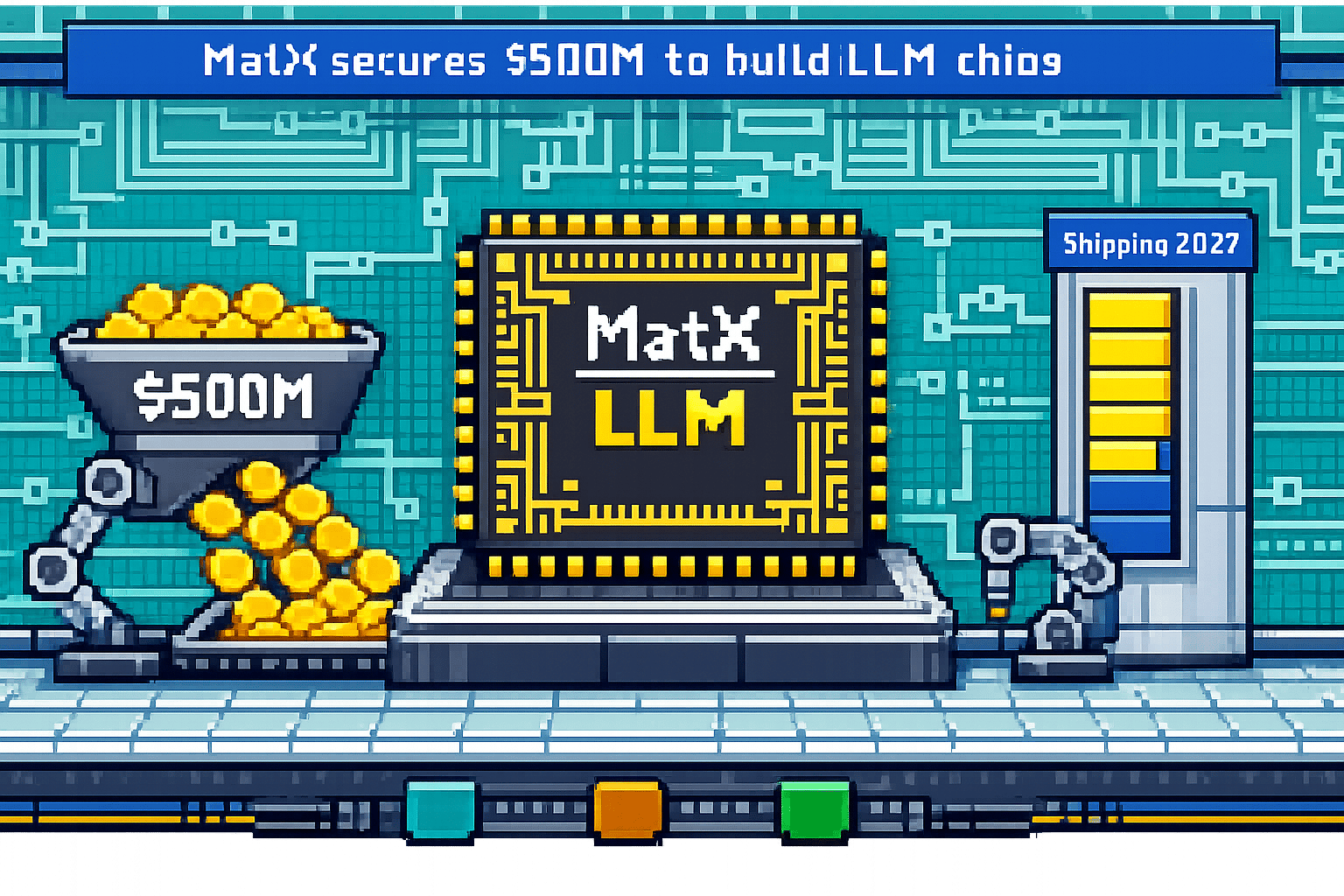
MatX Secures $500M to Develop LLM-Optimized AI Chips
MatX Secures $500M to Develop LLM-Optimized AI Chips
An ambitious new player in the AI hardware race, MatX, has raised over $500 million in funding to develop advanced chips specifically optimised for large language models (LLMs). The startup, founded by two former Google semiconductor engineers, aims to challenge Nvidia’s dominance in the AI chip market by offering cutting-edge solutions tailored to the demands of generative AI.
Backed by Major Investors
The funding round was spearheaded by Jane Street and Situational Awareness, the latter being the investment firm established by ex-OpenAI researcher Leopold Aschenbrenner. Among the other backers are Marvell Technology, venture capital firms NFDG and Spark Capital, as well as Stripe founders Patrick and John Collison. The significant capital injection will allow MatX to secure critical manufacturing resources and address the industry’s current shortages, particularly in memory components.
"It lets us compete on kind of equal grounds with the largest companies in the way that they can scale very quickly", said MatX co-founder Mike Gunter. "This round puts us almost on the same footing as the players who have a huge amount of money."
sbb-itb-fe42743
Google Roots and a Bold Vision
MatX was established by Reiner Pope and Mike Gunter, both alumni of Google’s semiconductor division, after their departure in 2022. Their shared vision centres on creating chips specifically designed to power LLMs, the foundational technology behind AI systems such as chatbots and other generative AI applications.
The company’s stated mission is to broaden access to AI-powered tools for a diverse range of users, enabling applications in fields such as medicine, education, and personal coaching. MatX’s hardware promises to deliver ten times the computing power of current solutions, potentially unlocking new possibilities for AI development and deployment.
The company is part of a growing wave of startups vying for a share of the lucrative AI chip market, which has long been dominated by Nvidia’s graphics processing units (GPUs). According to MatX, internal testing indicates that its upcoming chip design outperforms Nvidia’s anticipated Rubin Ultra chip in computing performance per square millimetre - a key metric for efficiency in AI hardware.
Strategic Manufacturing and Market Entry
MatX plans to finalise its chip design this year and begin shipping products in 2027. To bring its vision to life, the company plans to utilise the manufacturing capabilities of Taiwan Semiconductor Manufacturing Co., a global leader in semiconductor production.
The startup currently employs around 100 people and is aggressively recruiting for engineering positions. However, its strategy emphasises targeting a concentrated market of leading AI labs rather than building a large-scale sales organisation. This approach aligns with the increasing trend of developers, like OpenAI and Anthropic, diversifying their hardware suppliers and cloud providers.
The Challenge of Competing with Nvidia
While MatX’s technology shows promise, the road ahead is fraught with challenges. As co-founder Reiner Pope explained, competing in the AI chip sector demands excellence across multiple domains. "You need to match what is in the market on all of maybe five different important aspects, and you need to be far ahead on at least one of them", he said.
He also cautioned against the typical startup approach of focusing on a single advantage while neglecting other critical areas, noting that such strategies have historically failed in this competitive sector.
Aiming for the Future
MatX’s ambitious funding round puts it in a strong position to challenge industry leaders like Nvidia. By focusing on chips tailored for LLMs and ensuring scalability, the company hopes to carve out a significant role in the evolving landscape of AI hardware. With plans to deliver innovative technology that pushes the boundaries of AI, MatX aims to make an indelible impact on the market while fulfilling its mission of democratising access to advanced intelligence tools.