
Nearshore vs Offshore Development in 2026: A CTO's Honest Comparison
Nearshore vs Offshore Development in 2026: A CTO's Honest Comparison
Nearshore software development means hiring a development team in a nearby country - typically within 1-3 time zones - while offshore development means outsourcing to a country much further away, often 5-12 time zones apart. For UK companies in 2026, nearshore usually means Eastern Europe (Poland, Ukraine, Romania), while offshore means India, the Philippines, or Vietnam. The right choice depends on your project complexity, communication needs, compliance requirements, and budget - not just the hourly rate on a spreadsheet.
I've been running distributed teams across the UK, Ukraine, Poland, and Israel for years. I've also cleaned up the mess left behind by offshore engagements where a non-technical founder handed requirements to an agency in a different time zone and hoped for the best. So I have opinions on this - backed by data and first-hand experience.
The global IT outsourcing market hit $638 billion in 2026, and 72% of organisations now outsource at least part of their software development according to the Deloitte Global Outsourcing Survey. The question isn't whether to outsource - it's how to do it without losing control of your product.
What Nearshore and Offshore Actually Mean in Practice
These terms get thrown around loosely, so let me be specific.
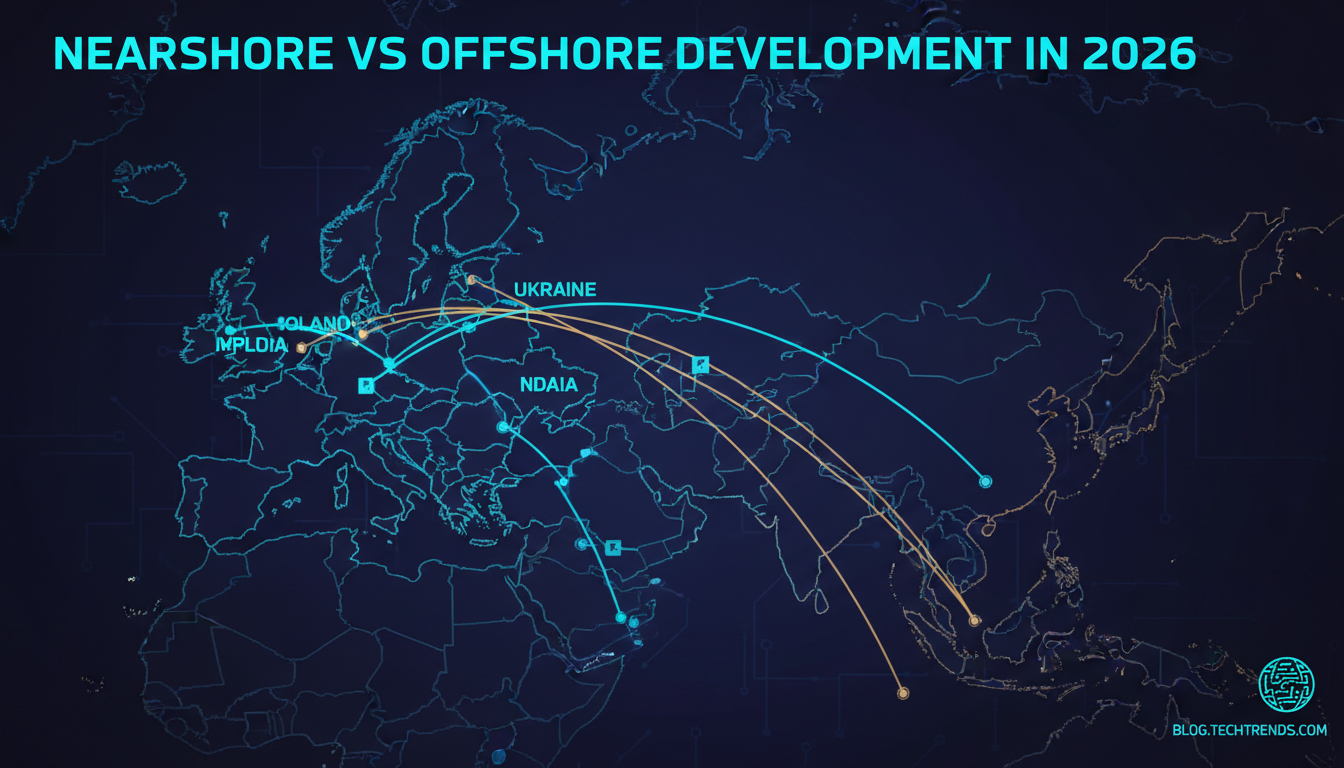
Nearshore for a UK company means a team in a country with 0-3 hours of time zone difference. Think Poland (GMT+1), Ukraine (GMT+2), Romania (GMT+2), Czech Republic (GMT+1), or the Baltics. You share most of your working day. When something breaks at 2pm London time, your nearshore team is still at their desk.
Offshore means a team with 4-12 hours of time zone difference. India (GMT+5:30), the Philippines (GMT+8), Vietnam (GMT+7), or Latin America for US companies. Communication happens through handoffs, not real-time collaboration. Your morning standup is their evening or their middle of the night.
There's also onshore - hiring within the UK itself - which is obviously the simplest operationally but the most expensive. A senior developer in London costs £65,000-£70,000+ per year before employer NICs, pension, benefits, office space, and equipment. That's why 80% of UK businesses report struggling to recruit technical talent domestically, per multiple industry surveys.
The Honest Cost Comparison
Everyone starts with cost. Fair enough - it's usually the trigger for exploring outsourcing in the first place. But raw hourly rates tell you almost nothing without factoring in the hidden costs.
| Factor | UK (Onshore) | Nearshore (Poland/Ukraine) | Offshore (India/Philippines) |
|---|---|---|---|
| Senior developer hourly rate | £80-£120/h | £40-£65/h | £20-£40/h |
| Time zone overlap with UK | 100% | 85-95% | 15-40% |
| Communication overhead | Low | Low-Medium | High |
| Rework rate (industry average) | ~10% | ~15% | ~27% |
| GDPR compliance (built-in) | Yes | Yes (EU/UK adequacy) | Requires extra DPA work |
| Cultural alignment | High | High | Varies significantly |
| English proficiency (senior level) | Native | Advanced/Fluent | Varies widely |
| Effective cost after rework + overhead | £80-£120/h | £45-£75/h | £35-£70/h |
That last row is the one that matters. The 27% average rework rate on outsourced code - combined with communication delays and scope creep causing 20-30% budget overruns - means the headline rate for offshore is misleading. Once you factor in rework, the gap between nearshore and offshore narrows dramatically.
I've seen this firsthand. A healthtech startup came to us after spending £180,000 with an offshore team over 8 months. The codebase was functional but poorly architected - no tests, hardcoded configs everywhere, no CI/CD pipeline, and a data model that would need complete re-architecture before Series A. They ended up spending another £60,000 fixing it. Their "cheap" offshore engagement actually cost more than nearshore would have from the start.
Time Zone Overlap Is Not a Nice-to-Have
This is where nearshore wins decisively, and it's not close.
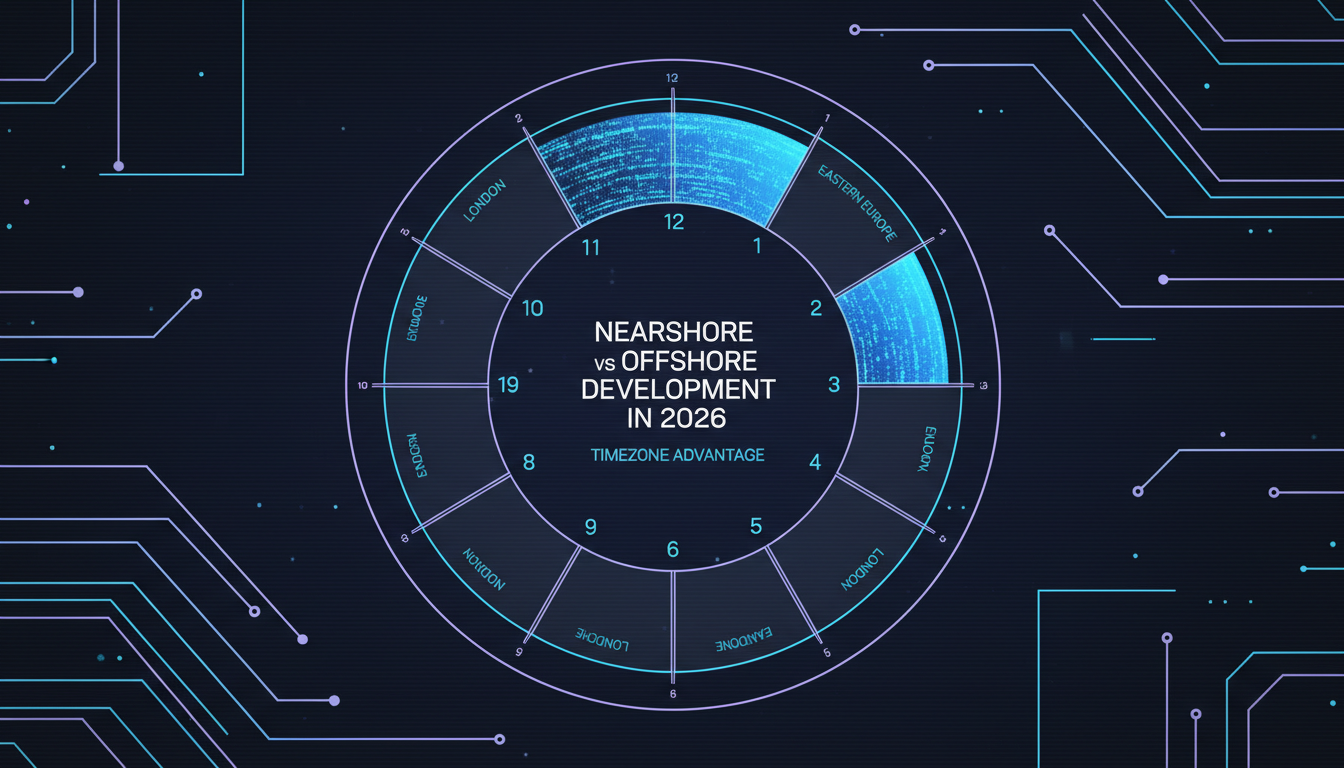
Poland is 1 hour ahead of London. Ukraine is 2 hours ahead. That means if you work 9am-6pm London time, your nearshore team overlaps for 7-8 hours of your working day. You can do real-time pairing sessions. You can resolve blockers during the same sprint. You can have a standup at 10am London / 11am Warsaw / 12pm Kyiv that works for everyone.
With an offshore team in India (GMT+5:30), your overlap might be 10am-1pm London time at best - and that's if the offshore team adjusts their schedule to accommodate you, which creates its own problems. Time zone differences cause 31% of delays in 60% of offshore projects, according to industry data.
Research from Gartner confirms that nearshore and team extension models will dominate software outsourcing strategies by 2026 - and this is exactly why. When a blocker comes up mid-sprint, a nearshore team can deal with it the same day. An offshore team might not see it until tomorrow morning, and by then you've lost a day.
GDPR and Data Compliance: The Hidden Dealbreaker
If you're building anything that handles personal data - so basically everything - GDPR compliance isn't optional. And this is where the nearshore vs offshore distinction gets real.
Poland, Ukraine, Romania, and the Baltics all operate within or adjacent to the EU GDPR framework. The UK has an adequacy arrangement with the EU, meaning data flows are straightforward and legally clean. Your nearshore partner is already operating under GDPR-equivalent rules. Many hold ISO 27001 certifications. SOC 2 compliance is common at established agencies.
With offshore partners outside the EU adequacy framework - India, the Philippines, Vietnam - you need additional Data Processing Agreements, standard contractual clauses, and potentially Transfer Impact Assessments. It's not impossible, but it's friction. And in regulated industries like healthtech or fintech, that friction becomes a genuine risk factor.
I've seen investors flag this during technical due diligence. "Where is your data processed? Who has access? Under which jurisdiction?" If the answer involves complicated cross-border data transfer arrangements with a country that doesn't have an EU adequacy decision, that's a red flag in the DD report.
When Offshore Actually Makes Sense
I'm not going to pretend offshore is always wrong. That would be dishonest, and I'd rather give you the real picture.
Offshore development works well when:
The work is well-defined and modular. If you have a clear spec, detailed acceptance criteria, and the work can be broken into self-contained tickets that don't require much back-and-forth, an offshore team can execute effectively. Think: mobile app UI implementation from a detailed Figma spec, data migration scripts, or batch processing pipelines.
Budget is genuinely the binding constraint. A pre-seed startup bootstrapping with £50,000 has different economics than a Series A company with £2M in the bank. If the choice is between building something with an offshore team or not building it at all, offshore wins.
You have strong in-house technical leadership. If you have a CTO or senior tech lead who can define architecture, write detailed specs, conduct code reviews, and manage the relationship actively, offshore can work. The problems start when non-technical founders try to manage offshore teams directly.
You're scaling a proven, stable product. Adding features to a mature codebase with clear patterns, good tests, and solid documentation is very different from building something from scratch.
When Nearshore Is the Clear Winner
Nearshore development is the better choice - often by a wide margin - when:
You're building a new product from zero. Early-stage development requires constant iteration, rapid feedback loops, and architecture decisions that need real-time discussion. You cannot run a design sprint asynchronously across a 10-hour time zone gap.
Your team is non-technical. If you don't have a CTO or senior developer in-house, you need a partner who can operate with more autonomy and communicate proactively. Nearshore teams - especially CTO-led ones - can fill this gap because the communication overhead is low enough for it to work.
You're in a regulated industry. Healthtech, fintech, edtech - anywhere that GDPR, data residency, or sector-specific compliance matters. European nearshore partners already operate within these frameworks.
Speed-to-market is critical. Same-day blocker resolution, real-time pairing, and overlapping working hours compress your development timeline. The 40% of companies that now combine nearshore and offshore on the same project typically use nearshore for the core product work and offshore for peripheral tasks.
How We Run It at Metamindz: CTO-Led, Not Account-Manager-Led
So here's where I'll be transparent about our positioning, because I think it illustrates the actual problem with most outsourcing.
The standard outsourcing model works like this: you talk to a sales person, they assign a non-technical account manager, the account manager relays requirements to a team lead in another country, and the team lead distributes work to developers you've never spoken to. You're playing telephone with your own product.
| Aspect | Typical Outsourcing Agency | CTO-Led Outsourcing (Metamindz) |
|---|---|---|
| Your main point of contact | Non-technical account manager | A CTO or senior developer |
| Architecture decisions | Made by the team, reviewed (maybe) later | CTO designs architecture upfront, reviews ongoing |
| Code quality | Variable - depends on the assigned team | Peer-reviewed, documented, CI/CD from day one |
| Daily communication | Status reports via PM tool | Shared Slack, daily async updates, weekly demos |
| Documentation | Minimal or post-hoc | Thorough - supports handover at any time |
| Vendor lock-in | Common (poor docs, proprietary patterns) | None - code is yours, documented, handover-ready |
| Scaling the team | Add bodies, hope they ramp up | CTO vets and onboards each new developer |
| If you want to leave | Good luck with the handover | We'll help you transition - it's documented for this |
At Metamindz, every project starts with a fractional CTO session to understand your business context, existing stack, and roadmap. The CTO designs the architecture. The CTO oversees the team. The CTO reviews code. You talk to a technical person, not an account manager translating your requirements into something unrecognisable.
Our team sits across the UK, Ukraine, Poland, and Israel. We chose these locations deliberately - strong engineering talent, 1-2 hour time zone overlap with London, EU-aligned data protection, and cultural proximity that makes daily collaboration feel natural rather than forced.
We will also tell you when you DON'T need us. If your project is a straightforward mobile app with a clear spec and you have a technical founder who can manage the relationship, an offshore team at half the rate might genuinely be the right call. We'd rather say that upfront than take your money and underdeliver on value.
The 5-Question Decision Framework
When founders and CTOs ask me "nearshore or offshore?", I walk them through these five questions:
1. Do you have in-house technical leadership? If no - nearshore with CTO oversight. Managing an offshore team without technical leadership is how you end up with a codebase that needs rebuilding.
2. How defined is your product spec? If you're still figuring things out - nearshore. If you have a pixel-perfect Figma with detailed acceptance criteria - offshore can work.
3. What's your compliance landscape? GDPR, data residency, regulated industry - nearshore (Europe). No special requirements - either can work.
4. What's your iteration speed requirement? Daily feedback loops and rapid pivots - nearshore. Quarterly feature drops with long planning cycles - offshore can handle it.
5. What's your real budget? Factor in rework rates, communication overhead, and management time. If the "real" cost is comparable, choose the model with less risk. Usually that's nearshore.
The Hybrid Model: Best of Both
Increasingly, smart companies aren't choosing one or the other. About 40% of companies now combine nearshore and offshore teams on the same project. The pattern that works:
Nearshore for: Core product development, architecture, frontend work that needs rapid iteration, anything touching user data, anything requiring real-time collaboration with the founders or product team.
Offshore for: QA and testing, data processing, mobile development from finalised specs, DevOps automation, documentation, and internal tooling.
This hybrid approach gives you the communication quality of nearshore for the critical path while using offshore economics for work that's well-defined and less communication-intensive. The key is having CTO-level oversight to manage the split - which developers work on what, how handoffs happen, and ensuring architectural consistency across both teams.
Red Flags When Evaluating Any Outsourcing Partner
Whether you go nearshore or offshore, watch for these:
No technical person in the sales process. If every conversation is with sales and account management, ask who will actually architect and oversee the work. If the answer is vague, walk away.
Resistance to code access. You should have full access to the repository from day one. Any partner who pushes back on this is creating vendor lock-in intentionally.
No documentation commitment. Ask to see documentation from a previous project (with client permission). If they can't show you any, their handover will be painful.
Fixed teams with no flexibility. The developer who starts your project should ideally stay on it. High turnover on outsourced teams is a sign of poor internal culture.
IP assignment concerns. Ensure your contract clearly assigns all IP to you. This sounds obvious but I've seen founders discover mid-tech DD that their outsourcing contract was ambiguous on IP ownership. Investors hate that.
The Bottom Line
For most UK startups and scaleups in 2026, nearshore development - specifically Eastern Europe - is the default choice for good reason. The cost savings over onshore are substantial (40-60%), the time zone overlap makes real collaboration possible, GDPR compliance is built in, and the engineering talent pool is deep and mature.
Offshore still has a place. But it's a narrower place than the outsourcing industry would have you believe, and it requires more internal technical leadership to make it work. 50% of businesses fail when outsourcing software projects within five years - and poor vendor selection causes 29% of those failures. The model you choose matters less than how you manage it.
If you want to talk through your specific situation - nearshore, offshore, hybrid, or just whether outsourcing makes sense at all - book a free CTO session. We'll give you honest advice, even if the answer is "you don't need us."
Frequently Asked Questions
What is the difference between nearshore and offshore software development?
Nearshore development means working with a team in a nearby country with minimal time zone difference - typically 1-3 hours. For UK companies, this usually means Eastern Europe (Poland, Ukraine, Romania). Offshore means working with a team much further away - 5-12 time zones apart - such as India, the Philippines, or Vietnam. The practical difference is how much real-time collaboration is possible during your working day.
How much does nearshore development cost compared to offshore in 2026?
Nearshore senior developers in Eastern Europe cost £40-65 per hour, while offshore senior developers in India or the Philippines cost £20-40 per hour. However, the effective cost gap narrows significantly when you factor in the 27% average rework rate on outsourced code, 20-30% budget overruns from scope creep, and communication overhead. Many UK companies find nearshore delivers better value per pound spent over the full project lifecycle.
Is nearshore or offshore better for startups?
For most startups, nearshore is the better choice - especially if you're building a new product, lack in-house technical leadership, or operate in a regulated industry. The time zone overlap enables the rapid iteration cycles startups need, and GDPR compliance is built in for European partners. Offshore makes more sense for startups with very tight budgets and well-defined, modular work that doesn't require constant collaboration.
What countries are best for nearshore development from the UK?
Poland, Ukraine, and Romania are the top three nearshore destinations for UK companies. Poland has over 500,000 IT professionals and the most mature outsourcing ecosystem. Ukraine offers exceptional deep talent in backend and systems engineering at slightly lower rates. Romania and the Baltics (Lithuania, Latvia, Estonia) round out the options with strong EU compliance and growing tech communities.
How do I avoid outsourcing failures?
The three biggest risk reducers are: (1) ensure a technical person - not just an account manager - oversees the engagement from day one, (2) maintain full repository access and insist on documentation from the start, and (3) choose a partner with genuine time zone overlap so blockers get resolved in hours, not days. Having CTO-level oversight - whether in-house or fractional - is the single biggest predictor of outsourcing success.