
Negotiating Cloud Vendor Contracts: FinOps Tips
Negotiating Cloud Vendor Contracts: FinOps Tips
Cloud costs spiralling out of control? You’re not alone. Research shows that 35% of cloud resources are wasted due to poor planning and underuse. Engaging a fractional CTO can help audit these inefficiencies and align tech architecture with business goals. That "pay-as-you-go" promise can quickly become a financial headache if you're not careful. The solution? Smart contract negotiation with a FinOps approach.
Here’s the gist:
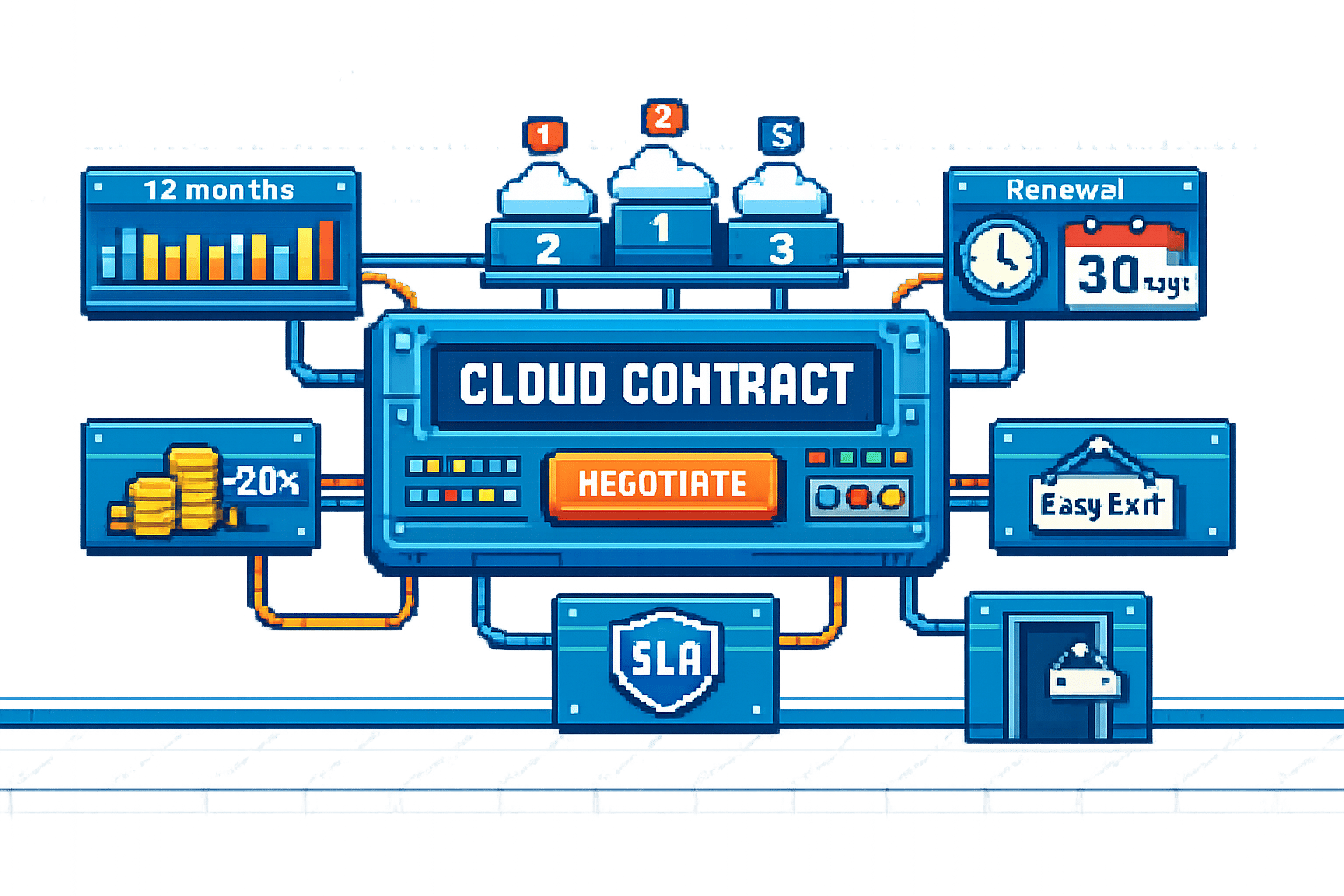
- Start early: Begin negotiations 3–6 months before your contract expires.
- Know your data: Use 12 months of usage stats to identify waste and optimise before forecasting future needs.
- Benchmark wisely: Compare vendor pricing and terms to save 10–30%.
- Leverage timing: Vendors are more flexible near their fiscal year-end or quarter-end.
- Customise terms: Push for better SLAs, flexible renewal options, and clear billing.
Example? A UK fintech saved £875,000 annually by negotiating a 35% AWS discount in 2024. The takeaway? Prep, data, and timing make all the difference. Let’s break it down.
Procurement in a Mature FinOps Organization: Multi-cloud Discounting, Contracting, Invoicing at Uber

sbb-itb-fe42743
Preparing for Cloud Contract Negotiations
Walking into contract negotiations unprepared can cost you - literally. Vendors are skilled at identifying unprepared buyers, and the result is often inflated costs. The key to successful negotiations lies in thorough preparation, which should ideally begin months before your contract renewal date.
Collecting Usage Data and Forecasts
Start by gathering 12 months of usage data to uncover trends and key metrics [1]. Look at things like CPU hours, memory usage in GB, storage tiers, and inter-region network bandwidth [1]. Pay close attention to inefficiencies, such as underutilised instances running at less than 20% CPU capacity or development environments that are active 24/7 without reason [1].
Before you forecast future needs, take the time to optimise your current infrastructure. Actions like rightsizing instances and storage can slash your baseline costs by 30% to 40% [3]. When building your forecast, consider factors like business growth, upcoming product launches, seasonal spikes (think quarter-ends or holiday periods), and plans to retire legacy systems [1]. Accurate forecasts not only make you look more credible to vendors [4], but they also strengthen your position when negotiating for better pricing.
Setting Internal Goals
Once you’ve got a clear picture of your cloud usage, it’s time to set some internal goals to steer your negotiations. These goals should be defined by a cross-functional team, including Finance, IT, Engineering, and Procurement, to ensure technical needs align with budgetary limits [4][5].
As Eric Mulartrick, FinOps Lead, advises:
"Instead of dumping contract purchases over the fence, pull up a chair next to your Procurement professional and work deals together. I find that collaboration... builds a harmony and long lasting relationship where everyone wins."
[4]
Work closely with your Procurement team to align priorities like cost reduction, scalability, or service reliability, and determine which terms are non-negotiable [6]. Begin this process 120 to 180 days before your contract expires [1]. One crucial step: disable any auto-renewal clauses. This forces a proper review of your contract based on current FinOps data, rather than automatically continuing outdated terms [1]. Also, maintain a master calendar to track all contract expiry dates, commitment levels, and discount agreements across your cloud estate [1].
Researching Vendor Benchmarks
Having solid market intelligence gives you a big edge in negotiations. Benchmarking early can lead to substantial savings - anywhere from 10% to 30% compared to simply accepting standard renewal terms [1]. Start by researching pricing models from multiple vendors [7]. Be on the lookout for hidden costs like AWS Enterprise Support, which often costs 3% of your monthly spend or at least £12,000 per month [3].
Also, keep an eye out for clauses like commitment floors or ratchet provisions that lock you into spending as much - or more - than the previous year [3]. Data from 2026 showed that companies starting negotiations six months ahead, incorporating competitor quotes and benchmarking, achieved 39% higher savings than those who waited until the last minute [7]. Armed with detailed data and competitive insights, you’ll be in a strong position to secure favourable terms in the next phase of negotiations.
Timing Your Negotiations for Better Terms
Starting negotiations well in advance can lead to savings of up to 39% [7]. If you wait until the last minute, you risk losing leverage and might end up stuck with less favourable terms.
Starting Negotiations Before Contract Expiry
Kicking off negotiations 3–6 months before your contract expires is ideal. This gives you enough time to benchmark current market rates, create competition among vendors, and account for an average approval process of 3.4 weeks [1][9]. It also keeps your options open, allowing you to walk away if the deal doesn’t meet your needs [7].
Delays in starting negotiations can strip away these advantages. To stay on top of deadlines, set automated reminders at 90, 60, 30, and 14 days before the contract ends [1]. This simple step helps you stay organised and ensures you don’t miss critical opportunities.
Once you’ve got the timing sorted, aligning your negotiation schedule with vendor fiscal cycles can give you even greater leverage.
Understanding Vendor Fiscal Patterns
Cloud vendors often face pressure to meet quarterly and annual revenue targets. This pressure makes their sales teams more likely to offer discounts, flexible pricing, or bundled services as they race to hit their quotas [8]. For companies in the UK, many large cloud providers have fiscal years ending in March or April, which can be a prime time to negotiate better deals [1].
Hokstad Consulting highlights this dynamic:
"Sales teams are often under pressure to meet year-end quotas, which can lead to increased flexibility on pricing and terms." [8]
Plan your final negotiation rounds to coincide with vendor quarter-ends - late March, June, September, and December - or their fiscal year-end [1][8]. For instance, in March 2024, a UK-based fintech company timed its cloud contract renewal with the vendor’s fiscal year-end, securing an additional 10% discount and improved support terms [1].
Securing Better Pricing and Discounts
Cloud Pricing Models Comparison: Savings, Flexibility and Best Use Cases
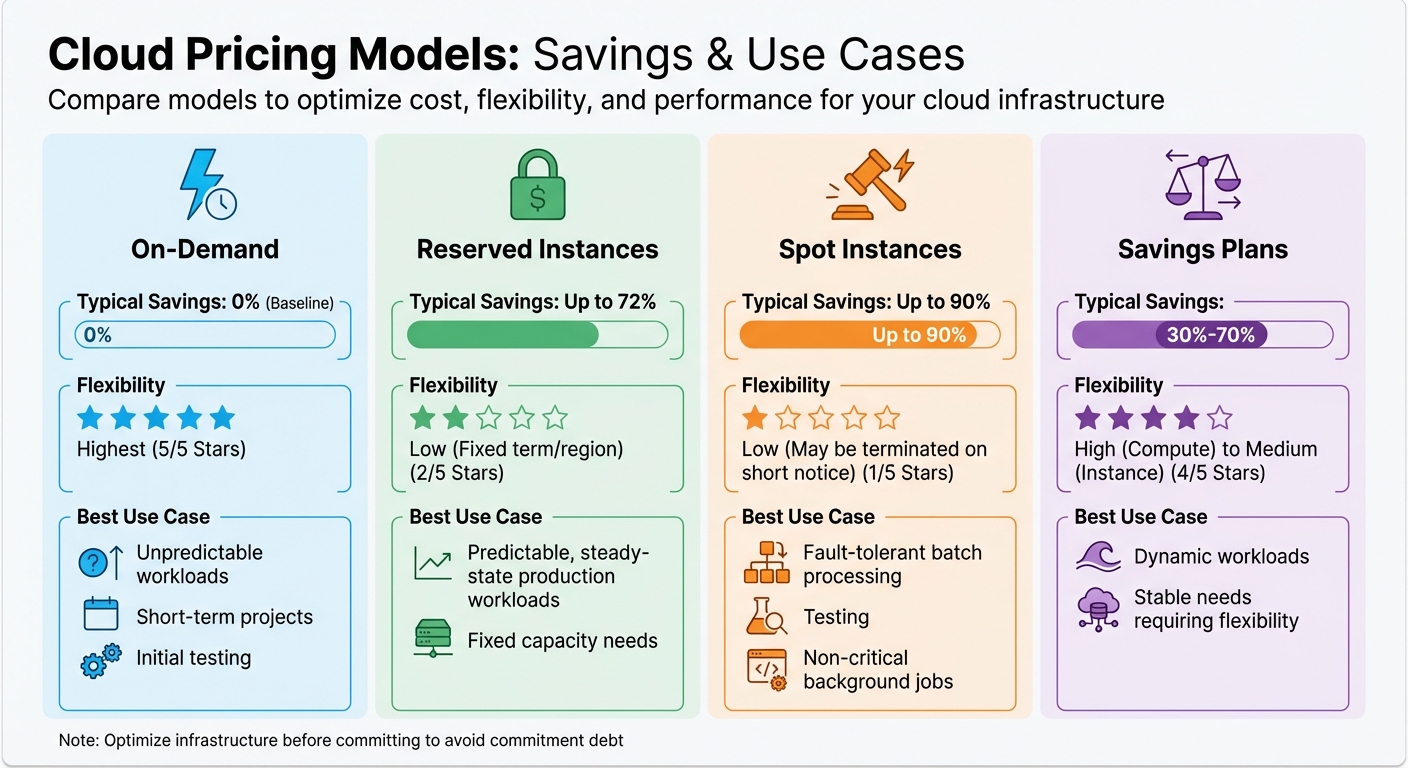
Once you've nailed down the timing, it's time to dive into pricing structures. Cloud providers offer various discount options, with savings ranging from 30% for flexible savings plans to as much as 72% for reserved instances [1][10]. Matching your actual usage patterns to the right pricing model is key to avoiding unnecessary costs.
Comparing Pricing Models
Different workloads call for different pricing approaches. On-demand pricing is the most expensive option but works well for unpredictable or short-term projects. Reserved instances, on the other hand, can save you up to 72%, though they require a one- to three-year commitment to specific instance types and regions - perfect for stable production environments [1]. Spot instances offer the biggest savings - up to 90% - but come with a catch: vendors can reclaim them at any time, so they're best for fault-tolerant tasks like batch processing [11]. Savings plans strike a balance, offering 30% to 70% discounts with more flexibility across instance families and regions [10].
| Pricing Model | Typical Savings | Flexibility | Best Use Case |
|---|---|---|---|
| On-Demand | 0% (Baseline) | Highest | Unpredictable workloads, short-term projects, or initial testing. |
| Reserved Instances | Up to 72% [1] | Low (Fixed term/region) | Predictable, steady-state production workloads. |
| Spot Instances | Up to 90% [11] | Low (May be terminated on short notice) | Fault-tolerant batch processing, testing, and non-critical background jobs. |
| Savings Plans | 30%–70% [10] | High (Compute) to Medium (Instance) | Dynamic workloads or stable needs requiring flexibility. |
Choosing the right pricing model is as important as timing your negotiations. Before committing, ensure your infrastructure is optimised to avoid "commitment debt" - locking yourself into spending based on inefficient usage [3].
Once you've sorted that, you can start leveraging volume commitments for even better discounts.
Using Volume Discounts and Commitments
Cloud providers often offer deeper discounts for higher spending commitments. For example, AWS’s Enterprise Discount Programmes (EDP) require a minimum annual spend of £1 million and can provide discounts ranging from 20% to over 40% [1][3]. Key discount thresholds often kick in at annual spends of £1 million, £1.5 million, £2 million, and £5 million [2].
To hit these discount tiers faster, consolidate spending across all departments and business units under a single management account [2][3]. Another option is to negotiate step-up commitments - agreements where your spend increases annually (e.g., £1.2 million in Year 1, rising to £1.8 million in Year 3) - to align with projected growth while locking in better discounts [2].
Be sure to clarify whether your discount programme is based on net or gross commitment. Many EDPs calculate commitments after applying discounts, meaning you’re committing to a post-discounted amount [3]. Also, watch out for mandatory support tiers like AWS Enterprise Support, which costs 3% of monthly spend or a minimum of £11,500 per month - this can eat into your savings [3].
With volume discounts in place, the next step is customising your savings plans to fit your needs.
Customising Savings Plans
Tailored savings plans let you align cloud spending with actual usage patterns and financial objectives. Start by reviewing 6–12 months of usage data. Tools like AWS Cost Explorer or Azure Cost Management can help you simulate growth, compare savings plans with on-demand pricing, and identify steady-state versus dynamic workloads and peak usage periods [10].
Compute Savings Plans offer the most flexibility, covering any instance family in any region regardless of operating system or tenancy. EC2 Instance Savings Plans, while more restrictive - they apply to specific instance families in specific regions - often provide higher discounts [10]. Decide whether a one-year or three-year duration and payment options (All Upfront, Partial Upfront, or No Upfront) work best for your cash flow and financial situation [10].
For instance, a UK-based tech firm managed to cut its annual AWS costs by over 20% after re-evaluating its usage patterns and renegotiating its contract to include enhanced support and more flexible terms [1]. The takeaway? Customising your savings plan only works if you've optimised your infrastructure first.
Negotiating Custom SLAs
Once you've locked in competitive pricing, the next step is to tailor your service agreements to safeguard your operations. Standard SLAs often offer limited protection - sometimes as little as 10% of monthly fees - even if significant downtime disrupts your business [8]. This is why customising SLAs to align with your specific operational and financial needs is so important.
Securing Uptime and Performance Guarantees
Begin by setting clear uptime targets that reflect how critical each workload is to your business. For example, the difference between 99.5% and 99.9% uptime might seem minor, but it translates to about 1.83 days versus 8.77 hours of downtime annually [8]. For high-stakes applications, that difference can be massive.
Go beyond uptime and include guarantees for latency, storage performance, and API response times. For instance, you could specify API response targets under 100ms for customer-facing systems [8]. You can also define response time tiers for issue resolution - like 15 minutes for critical problems, 2 hours for high-priority issues, and next business day for routine matters [8].
"SLAs should include penalties that genuinely reflect the impact of failures, not just token credits." - Hokstad Consulting [8]
Another must-have is real-time monitoring and alerts. This ensures the vendor notifies you of service issues as they happen, rather than waiting for you to flag them. It shifts accountability where it belongs - on the service provider.
Beyond these performance measures, it’s wise to include additional contractual safeguards to reduce risks during service failures.
Adding Service Credits and Protections
Push for service credits that match the actual impact of SLA breaches. For repeated failures, negotiate escalating financial penalties that increase with each breach [8]. This discourages vendors from treating occasional failures as acceptable.
Include "for cause" termination rights so you can exit the contract without penalties if prolonged downtime or unresolved performance issues occur [8]. You should also advocate for rate caps that limit annual price hikes to 3–5% or tie them to inflation. Without these protections, cloud fees can rise anywhere from 5% to 20% annually, sometimes even higher [13].
Keep in mind that vendors often frame service credits as the "exclusive remedy" for SLA breaches, meaning you can't pursue further damages for those incidents [12]. To protect yourself, negotiate data breach notification clauses that require the vendor to notify you within 72 hours of any security incident [12]. Lastly, secure implementation credits to cover costs like migration, training, or consulting, helping offset your upfront investment.
Structuring Flexible Renewal and Exit Terms
When it comes to contracts, flexibility in renewal and exit terms is just as critical as competitive pricing and solid SLAs. Why? Because without it, you might find yourself stuck with outdated pricing models or paying for resources you no longer need, even if your team has made significant efficiency gains. This is where strategic tech leadership becomes invaluable for aligning contracts with long-term growth. By including these flexible terms, you ensure your contract can evolve alongside your business needs.
Incorporating Usage Banking
One smart move is negotiating the ability to roll over unused credits or capacity into the next billing cycle or year. This way, you're not losing value if your usage fluctuates. Another handy clause is the option to swap out older services for newer, more efficient alternatives. You can also push for rebalancing provisions, which allow you to shift spending between different services without sacrificing volume discounts [8].
Building Ratchet Provisions
Beware of "commitment floors" - these can lock you into a ratchet effect where your annual commitment can only go up, even if you've streamlined your operations and reduced costs. As Ott and Hykell explain:
"The 'commitment floor' creates a ratchet effect where you generally cannot reduce your annual commitment below the previous year's level. This ensures your costs can only escalate, even if your engineering team finds massive architectural efficiencies." - Ott, Hykell [3]
To avoid this, negotiate scalability provisions that allow you to adjust your minimum usage commitments quarterly with just 30 days' notice [8]. Additionally, include a clause that permits reducing commitments on your contract anniversary, with appropriate fee adjustments [14]. Flexibility like this ensures you're not paying for capacity you no longer need, while transparent billing practices help you keep track of any cost changes.
Ensuring Transparent Billing and Reporting
Clear and detailed billing is non-negotiable. Insist on itemised bills that break down costs by service, region, and department [8]. It’s also wise to demand pricing in GBP to protect yourself from currency fluctuations. Finally, cap renewal price increases at 3–5%, or tie them directly to inflation rates [13]. This way, you can avoid any unpleasant surprises when it’s time to renew your contract.
Conclusion
Negotiating cloud vendor contracts isn’t just about snagging discounts - it’s about creating a strategic edge. By digging into your annual usage data, fine-tuning your infrastructure, and timing your negotiations to align with vendor fiscal cycles, you can find some serious savings [1][7]. This approach highlights how a FinOps-first mindset can turn what feels like routine procurement into a genuine advantage.
A FinOps-first strategy ensures your contracts grow with your business, rather than boxing you into outdated terms. Think about custom SLAs, capping price increases, and securing rebalancing options - these elements make sure your agreements can handle your growth without holding you back. As the Business Save Guide wisely puts it:
"The most expensive contracts in 2026 are rarely overpriced on day one. They become expensive because no ceilings were negotiated" [7].
Flexibility is the key to staying ahead. By incorporating features like usage banking, scalability clauses, and transparent billing in GBP, you can shield your budget from currency swings, avoid overcommitting, and ensure you’re only paying for what you actually need. The goal? A partnership that grows with you and keeps your business on solid ground.
FAQs
What data should I bring to a cloud contract negotiation?
To get the best out of a cloud contract negotiation, make sure to come prepared with solid data. Start with your usage patterns and historical consumption - this helps you show the provider exactly how you’re using their services. Add market benchmarks to back up your pricing discussions, and don’t forget to keep an eye on contract timelines, especially for renewals, so you’re not caught off guard.
Bring along financial data that ties your technical needs to your business goals. This could include details of your current discounts, service level agreements (SLAs), and your total spend - both gross and net commitments if you have enterprise agreements in place. Having this information in hand not only gives you leverage to negotiate better discounts but also allows you to customise the terms to suit your specific requirements.
How do I avoid overcommitting to discounts like reserved capacity or savings plans?
To keep from biting off more than you can chew, take a close look at how you're actually using resources and try to predict what you'll need in the future before signing any long-term contracts. It's smart to negotiate terms that give you room to manoeuvre - like the ability to make changes without getting hit with penalties. Make sure to include clear exit clauses or caps on renewal costs in your agreements too.
Another tip? Time your negotiations wisely. For example, vendors might be more open to striking a deal near the end of a fiscal quarter when they're eager to hit their targets. Also, use market benchmarks during your discussions to ensure you're getting a fair deal. This way, you'll avoid being stuck in a rigid agreement that doesn't fit your changing needs.
Which contract clauses reduce risk if performance drops or costs rise?
When crafting a cloud vendor agreement, there are a few key clauses that can help you minimise risks and avoid unpleasant surprises down the line:
- Exit clauses: These should clearly outline the terms for terminating the agreement. Whether you're unhappy with the service or simply need to transition to another provider, having well-defined exit terms ensures you won't be trapped in an unfavourable situation.
- Renewal clauses: It's wise to include limits on price increases during renewals. This prevents sudden, steep cost hikes that could throw your budget off course.
- Usage adjustments or rebalancing: Look for provisions that allow you to adjust your usage or rebalance resources without being hit with penalties. This flexibility is especially handy if your requirements shift over time.
By including these clauses, you can safeguard your organisation against unexpected costs or performance challenges, while maintaining the flexibility to adapt as your needs evolve.