
The Non-Technical Founder's Guide to Reading a Tech DD Report
The Non-Technical Founder's Guide to Reading a Tech DD Report
A technical due diligence (tech DD) report is a detailed written assessment of a startup's technology - covering architecture, code quality, security vulnerabilities, infrastructure, technical debt, and team risk - commissioned by an investor, acquirer, or the founder themselves before a deal closes. A typical report runs 25-50 pages. Most founders receive one and have no idea what to do with it.
So, look - you've just raised your Series A, or you're about to. The investor sends over a 40-page document full of terms like "BOLA vulnerabilities," "bus factor of one," "CI/CD debt ratio," and "P0 findings." Your developer says some of it is fine, the rest is "normal." The investor hasn't said anything either way.
What do you actually do with this?
I've been involved in dozens of tech DD reports - commissioning them, writing them, presenting findings to investors, and helping founders respond to them. The pattern I see every single time: non-technical founders either dismiss the report entirely (big mistake) or panic at every amber finding (also a mistake). Neither gets you to a good outcome.
This post breaks down exactly what a tech DD report contains, what each section actually means in plain English, how to read the severity ratings, and what the red flags are that you genuinely need to act on - versus the ones that are just noise.
Why This Document Matters More Than You Think
According to Sphere, technical issues discovered in due diligence can reduce a startup's valuation by up to 20%. Beyond M&A's investor surveys show 70% of private investors now require tech DD from digital startups before committing capital - up from around 40% five years ago. And approximately 60% of investment deals fall through because of problems uncovered in the technical review.
That last number catches people out. They think the deal lives or dies on the pitch deck and the financials. Often, it lives or dies on this document.
Understanding what your report says - and being able to have an informed conversation about it with your investor - is one of the most important things you can do in a fundraising round.
What a Tech DD Report Actually Contains
Most reputable tech DD reports are structured around five to seven core areas. Every firm has a slightly different format, but the substance is usually the same:
Architecture & System Design - How is the product built? Does the technical structure make sense for the product's current stage and future scale? Are there obvious single points of failure?
Code Quality & Technical Debt - How clean is the codebase? How much existing code will need to be rewritten or refactored before the product can scale or new engineers can work in it efficiently?
Security & Vulnerabilities - Are there known security issues? Have penetration tests been run? Are user data and sensitive systems adequately protected?
Infrastructure & DevOps - How is the product deployed and maintained? Is there a proper CI/CD pipeline? Are there deployment processes that reduce human error? What's the disaster recovery situation?
Team & Key-Person Risk - Is the engineering team healthy? Is there a "bus factor" problem - meaning, what happens if one critical person leaves?
IP & Licensing - Does the company actually own its code? Are there open-source licences that could create obligations? If AI tools were used to generate code, is there documentation of the provenance and ownership?
Data & Compliance - Is customer data handled properly? Is there a GDPR-compliant data handling process? Are there any regulatory gaps?
How to Read the RAG Scoring
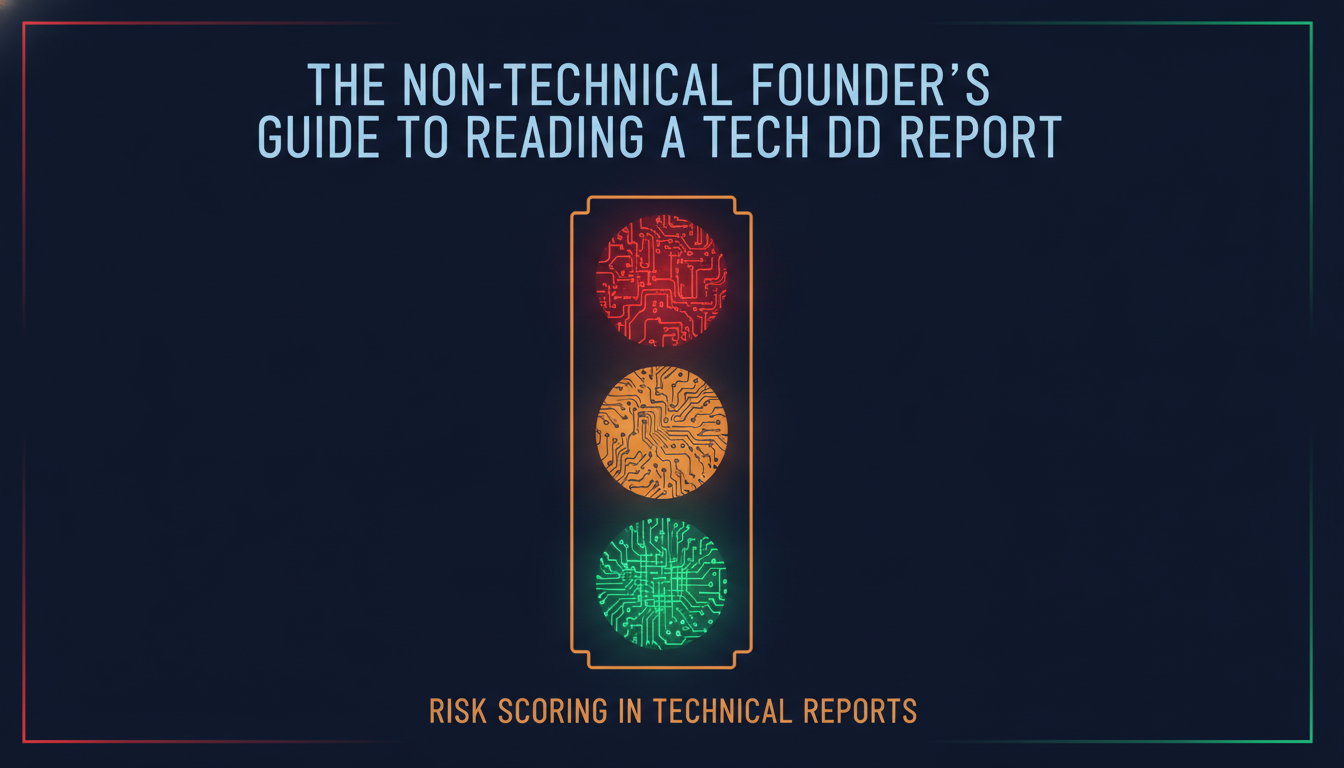
Most tech DD reports use a RAG (Red, Amber, Green) system to score each area. It's a traffic-light framework, and it means exactly what you'd expect - but the details matter.
Green means the area is in good shape relative to the stage of the company. It doesn't mean perfect. A green on security for a pre-revenue startup will look very different to a green for a Series B SaaS with 10,000 customers. Green means: no immediate action required, investor isn't worried about this area derailing the deal.
Amber means there are issues, but they're manageable. This is where most findings sit. An amber rating typically comes with a recommendation and a suggested timeline - fix within 30 to 90 days, or at least have a credible plan. Investors expect ambers. A report with no ambers is unusual and sometimes a sign the review wasn't thorough enough.
Red means there's a problem that needs addressing before or immediately after the deal closes. Not necessarily a deal-breaker on its own, but a red with no response plan from the founder is a deal-breaker. Reds require a clear remediation plan with a named owner, timeline, and estimated cost.
The worst thing you can do when you get a red is to shrug and say "the developer says it's fine." The investor doesn't trust your developer's word on their own code quality - that's exactly why they commissioned an independent review.
The Key Sections Decoded in Plain English
Here's what each section's findings actually mean when you read them:
Architecture & Scalability: When the report says "the architecture cannot support 10x current load without significant re-engineering," that means your current setup will fall over if you hit serious growth. The question isn't whether it's a problem - it is - but whether it can be addressed in a reasonable time and cost window, and what that would involve. Ask the reviewer for a rough estimate (in engineer-months) of what it would take to fix.
Code Quality & Technical Debt: A target debt ratio under 5% and test coverage above 80% are reasonable benchmarks for a funded startup's codebase. If your test coverage is 12% and debt ratio is 40%, that means a significant chunk of the time and cost of any new development will be spent managing the existing mess rather than building new features. The report should express this in engineer-months or estimated cost - if it doesn't, ask for that translation.
Security & Vulnerabilities: Security findings are typically scored using CVSS (Common Vulnerability Scoring System), a 0-10 scale. Scores 9.0-10.0 are Critical and need fixing before launch or before onboarding any new significant customers. Scores 7.0-8.9 are High - these should be addressed within days or weeks, not months. Scores 4.0-6.9 are Medium and get scheduled into the next sprint cycle. Below 4.0 is Low - monitor, don't panic. A good tech DD report will show the CVSS score for each finding and a recommended fix timeline. If yours shows three Critical-rated findings and the founder response is "we'll look at it after the raise," that's a red flag to the investor - not the finding itself, but the response to it.
Infrastructure & DevOps: "No CI/CD pipeline in place" means every deployment is done manually by a developer, which means every deployment is a potential source of human error and an unplanned outage. This is consistently one of the most common findings in early-stage startup DDs. It's fixable, it's not a deal-breaker, but it needs a plan. Similarly, "no disaster recovery documentation" means that if something goes catastrophically wrong - a database deletion, a cloud account compromise - there's no tested plan for getting back up. Investors care about this because it's a sign of operational maturity, not just technical hygiene.
Team & Bus Factor: The "bus factor" (sometimes called "hit by a bus" or "key-person risk") is one of the most commonly misunderstood findings. A bus factor of 1 means there is exactly one person who understands a critical part of the system. If they leave, you have a very expensive problem. This isn't a criticism of that person - it's a structural risk in the team. The fix is documentation, cross-training, and knowledge sharing. Investors want to see that the team isn't built around irreplaceable individuals whose departure would break the product.
IP & Licensing: If code was written by freelancers or contractors without proper IP assignment agreements, the company may not legally own that code. In 2026, this also applies to AI-generated code - if your team used AI coding tools without documenting the provenance, some investors (particularly in the US) are treating this as an IP risk until the legal landscape settles. This is genuinely one of the most common deal-breaker findings I see in early-stage DD, and it's one of the easiest to fix in advance if you know it's coming.
Data & Compliance: GDPR isn't optional if you have EU users, and data handling gaps are increasingly treated as serious risks rather than paperwork issues. The EU AI Act adds another layer in 2026 if your product uses AI features. The report will flag any obvious gaps; the question is whether there's a remediation plan with a realistic timeline.
The 3 Severity Tiers - and What to Do With Each
Good tech DD reports group findings into three action tiers. If yours doesn't, ask the reviewer to do it:
Tier 1 - Fix before the deal closes (or as a condition of closing): These are the Critical-rated security findings, the IP ownership gaps, and any showstopper architecture issues that make the product fundamentally unfit for purpose. These aren't negotiable. Investors will either require them fixed, or they'll price the cost of fixing them into the deal structure (lower valuation, earn-out, or escrow).
Tier 2 - Fix within 30-90 days post-close: High-severity security findings, significant infrastructure gaps, the absence of a CI/CD pipeline, most bus factor issues. These go into the post-close technical roadmap with clear owners and timelines. Investors want to see these in the use-of-proceeds or the 100-day plan.
Tier 3 - Schedule into the roadmap: Everything else. Medium and low technical debt, test coverage improvements, documentation updates, refactoring backlog. This is just the normal ongoing work of running an engineering team.
The founder's job is to be able to speak confidently about each tier. "We have three Tier 1 findings - here's the specific fix for each, who owns it, and the timeline" is a very different conversation to "yeah, the tech review flagged some things but our developer says most of it is fine."
CTO-Led DD vs Automated Report: What You're Actually Getting
| Area | Automated / Generalist Report | CTO-Led Review (Metamindz) |
|---|---|---|
| Architecture assessment | Checklist-driven, surface-level review | Deep dive by CTOs who have built and scaled similar systems |
| Technical debt scoring | SonarQube or similar tool output, raw numbers | Translated into engineer-months and remediation cost |
| Security findings | Automated scan with CVSS scores, often without context | Contextualised by actual exploitability in your environment |
| Bus factor analysis | Not usually included in automated reports | Team interviews, codebase knowledge mapping, named risks |
| IP & AI code provenance | Rarely covered; not automated | Explicitly reviewed with contractor agreements and tool usage audit |
| Report audience | Written for technical readers, often impenetrable for founders | Written for investment committees and non-technical founders |
| Post-report support | None - report delivered and that's it | Founder walkthrough, investor Q&A support, remediation plan |
| Founder preparation | Not offered - you're on your own | Pre-raise codebase preparation available to get you DD-ready first |
What to Do When You Get a Bad Report
Getting a red-heavy tech DD report is not the end of the world. What matters is how you respond to it.
First, don't dismiss it. Don't instruct your developer to write a rebuttal arguing with every finding. That approach signals to investors that you're not capable of independent technical oversight - which is precisely the problem a tech DD is designed to surface.
Second, get an independent read on the findings before you respond. If the report was commissioned by the investor, you're entitled to commission your own independent review of the same codebase. A credible second opinion that agrees with the findings and adds a clear remediation plan is far more valuable than a developer's denial.
Third, separate the structural from the cosmetic. A finding like "no CI/CD pipeline" can be fixed in a week. A finding like "the data model fundamentally cannot support multi-tenancy without a full rewrite" is a multi-month project. Know the difference before you walk into the conversation with the investor.
Fourth, come to the conversation with a concrete remediation plan. Named owners. Specific timelines. Realistic cost estimates. This is where a fractional CTO earns their keep - if you don't have a senior technical leader who can prepare and present this plan credibly, you need one before that investor meeting, not after.
And if you're reading this before you've started a fundraising process - get a pre-raise technical assessment done on your own codebase first. Find the problems yourself before the investor's team does. It's cheaper, it gives you time to fix things, and it means you walk into the DD process with no surprises.
Frequently Asked Questions
What is a tech DD report and why does it matter?
A technical due diligence (tech DD) report is an independent assessment of a startup's technology - covering architecture, code quality, security, infrastructure, team risk, and IP ownership. It matters because 70% of investors now require one before committing capital, and issues found in the report can reduce your startup's valuation by up to 20% or cause the deal to fall through entirely.
What does Red, Amber, Green (RAG) mean in a tech DD report?
RAG is a traffic-light scoring system used in tech DD reports. Red means there's a problem requiring immediate action or a clear remediation plan before the deal closes. Amber means there are issues but they're manageable within 30-90 days post-close. Green means the area is in reasonable shape for the company's stage, with no urgent action required. Most reports have a mix of all three - a clean all-green report is rare and sometimes suspicious.
What is "bus factor" in a tech DD report?
Bus factor (also called key-person risk) measures how many people would need to leave the company before a critical system becomes unworkable. A bus factor of one means a single developer holds all the knowledge for a key part of the product - if they leave, the system becomes very hard to maintain or extend. Investors treat a bus factor of one as a structural risk requiring documentation, cross-training, and knowledge transfer plans.
What does CVSS score mean in a security section?
CVSS (Common Vulnerability Scoring System) is a 0-10 scale used to rate the severity of security vulnerabilities. Scores of 9.0-10.0 are Critical and should be fixed immediately. Scores of 7.0-8.9 are High and need addressing within days or weeks. Scores of 4.0-6.9 are Medium and go into the next sprint. Below 4.0 is Low. The number alone doesn't tell you everything - context and exploitability in your specific environment matter - but a Critical finding with no remediation plan is a serious red flag to investors.
What should I do if I get a bad tech DD report?
Don't dismiss it and don't panic. Commission an independent read from a senior CTO who can translate findings into a credible remediation plan with named owners, realistic timelines, and cost estimates. Come to the investor conversation with concrete actions, not denial. The worst response is "our developer says it's fine." The best response is a specific, costed plan to address every Tier 1 and Tier 2 finding within a defined timeframe.