
The Orchestrator Engineer: What the Agentic Coding Shift Means for How You Hire in 2026

The Orchestrator Engineer: What the Agentic Coding Shift Means for How You Hire in 2026
An orchestrator engineer is a software developer whose primary value is no longer writing code line by line, but directing, evaluating, and correcting the output of AI coding agents. As agentic AI tools handle an increasing share of implementation work, the most important engineering skills in 2026 are system design, agent coordination, evaluation architecture, and the judgment to know when not to trust what the agent produced. The developer role has not disappeared — it has moved up the stack.
So, look — the "AI is going to replace developers" conversation has been running for two years now, and it's still mostly wrong. But it's not entirely wrong either. Something is genuinely changing in what makes an engineer valuable. And if you're hiring developers right now without accounting for this shift, you're optimising for the wrong things.
Here's the actual change that's happening. It's not that engineers are disappearing. It's that the job description for a good engineer has fundamentally rewritten itself, and most hiring processes haven't caught up.
What Is an Orchestrator Engineer, Exactly?
In Anthropic's 2026 Agentic Coding Trends Report, the central finding is that engineers are moving from implementers to orchestrators of agent systems. The report found that while developers now use AI in roughly 60% of their work, they can "fully delegate" only 0–20% of tasks. That gap — 60% usage, 20% full trust — is the orchestrator's job description in a single statistic.
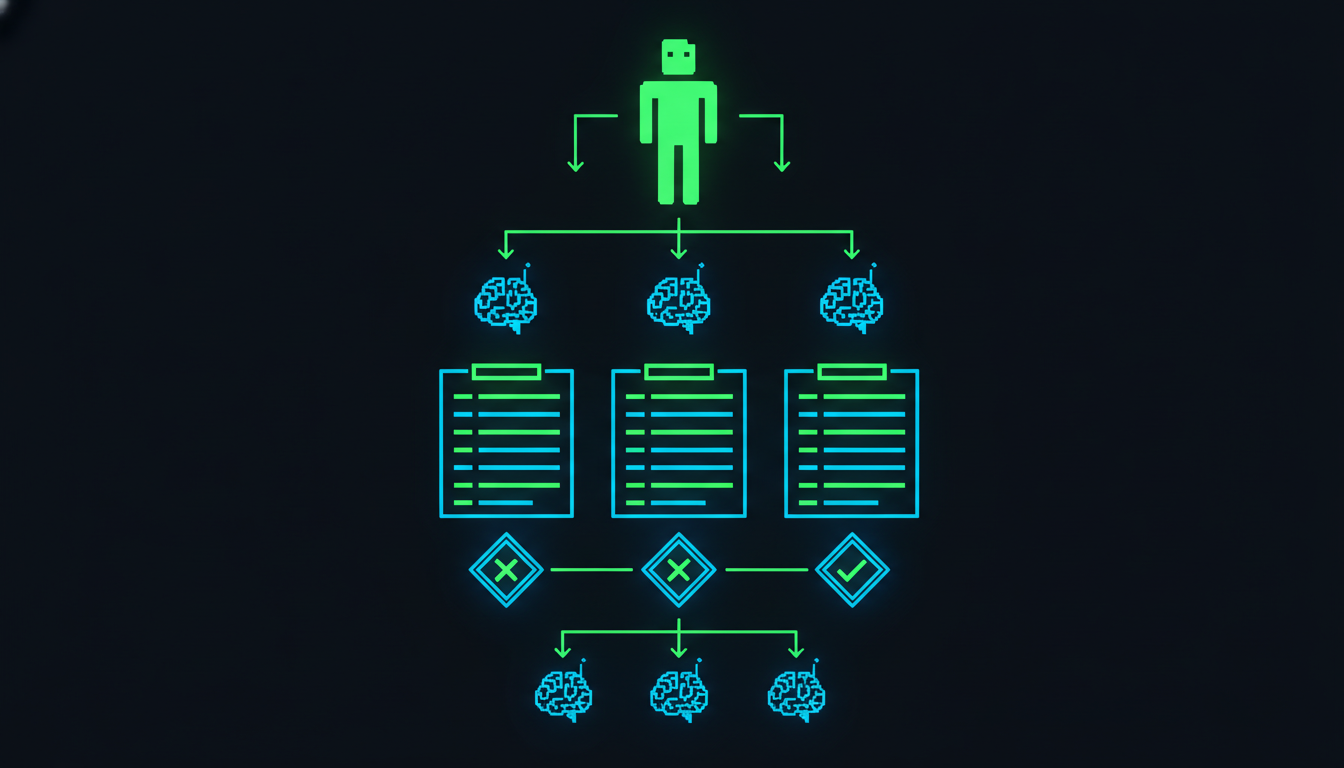
The orchestrator engineer takes a business requirement, breaks it into constrained, specific prompts a swarm of agents can execute, manages the data flow between those agents, and applies the critical judgment needed to validate the output. One agent writes the schema. Another builds the frontend. A third tries to break what the first two made. The human sits above this, resolving conflicts and making sure the final thing is actually what was needed.
That is a MORE senior skill than writing a CRUD API. It requires deeper architectural thinking, better system design instincts, and — critically — genuine experience with failure modes. You cannot orchestrate agents well if you've never seen what they consistently get wrong.
Why the Demand Is Outpacing Supply Right Now
Agentic AI job postings grew 280% year-over-year in 2026, reaching roughly 90,000 US postings — and that's almost certainly undercounting, because a lot of companies are writing these requirements into standard senior developer JDs without explicitly naming the skill.
The talent gap is severe: 63% of businesses report AI talent shortages. The reason is straightforward. Multi-agent orchestration, tool-use design, safety guardrails, evaluation frameworks, and human-in-the-loop architectures barely existed as a coherent discipline two years ago. The skills required are genuinely new, and the pool of people who have them in production — not just in a tutorial — is vanishingly small.
PwC's 2025 Global AI Jobs Barometer found a 56% wage premium for AI-skilled workers, up from 25% the prior year. That premium is compressing upward fast. The engineers who have real agentic system experience know exactly what they're worth.
The Five Skills That Actually Separate Good Candidates From Bad
The old resume signal — "built with LangChain and Pinecone" — is now table stakes, and in many cases a yellow flag. It tells you someone followed a tutorial in 2024. It doesn't tell you anything about whether they've debugged a multi-agent pipeline at 2am when the orchestrator started looping.
Based on what production AI teams are actually screening for in 2026, these are the five skills that differentiate mid-level from senior orchestrator engineers:
1. Eval design. Can the candidate build evaluation infrastructure — automated tests that tell you whether the agent output is actually correct? This is universal. Every serious agentic system needs it, and it's the skill most candidates lack. Ask for specific examples of eval pipelines they've built and what metrics they tracked.
2. Cost optimisation. Agentic systems can burn through inference budget at extraordinary speed. Engineers who have only worked in sandboxed environments have never had to care about this. Ask them to walk through how they'd instrument and control token spend in a production multi-agent system. Vague answers catch lab-only experience immediately.
3. MCP integration. Model Context Protocol has become the plumbing layer for enterprise agentic systems in 2026. Familiarity with MCP — and specifically its security model and attack surface — screens for engineers who are actively reading the field, not just running their existing stack.
4. Agent orchestration failure modes. Ask them what goes wrong. Not what works — what breaks. Timeout handling, state corruption across tool calls, sub-agent drift, prompt injection in tool outputs. Senior orchestrator engineers have specific, painful stories here. Junior candidates recite architecture patterns without any failure context.
5. Frontier model fluency. Do they have genuine opinions about when to use a reasoning model vs a fast model vs a fine-tuned specialist? Do they know the practical performance-cost tradeoffs? This separates people building real systems from people building demos.
How This Changes Your Team Structure
The traditional team structure — a few seniors and a larger group of juniors doing implementation work — is inverting. When AI agents handle a growing share of implementation, the bottleneck shifts from "who writes the code" to "who reviews the code" and "who specifies precisely what to build."
This has two practical consequences. First, you need a higher ratio of senior engineers to juniors than you might have planned. Second, the skills you're hiring for have changed even if the titles haven't. A senior developer hired for their raw coding speed in 2023 may not be the right person to lead an agentic workflow in 2026 — not because they're bad, but because the job has moved.
Gartner projects that 40% of enterprise applications will embed task-specific AI agents by end of 2026, up from less than 5% in 2024. That's not a distant transition. If you're hiring for a team that'll be operating in 12 months, you're already hiring for a world where this is normal.
Traditional vs Orchestrator Engineering: What Actually Changes

| Dimension | Traditional Senior Developer | Orchestrator Engineer (2026) |
|---|---|---|
| Primary output | Lines of code written | Agent pipelines designed and validated |
| Core daily skill | Writing correct implementations | Specifying, evaluating, and correcting agent output |
| Value ceiling | Limited by how fast one person can type | Multiplied by how many agents run in parallel |
| Key failure mode | Writing slow or buggy code | Under-specifying inputs, over-trusting outputs |
| Interview screen | LeetCode / system design / take-home | Eval design, failure mode reasoning, live orchestration task |
| Onboarding priority | Codebase familiarity, tool access | Agent framework conventions, context standards, cost guardrails |
| Metamindz screening approach | Technical screen + architecture grilling | Technical screen + agent failure mode deep-dive + live eval design exercise |
What This Means for Your Interview Process
Most technical interview processes are still optimised for 2023. LeetCode. System design whiteboard. Take-home CRUD app. None of these tell you anything meaningful about whether someone can orchestrate agents safely in production.
Here's what actually works. First, replace the take-home with an agent orchestration task. Give the candidate a real-ish business requirement and ask them to design the agent system — not build it, design it. What agents would you use? What are the inputs and outputs of each? What evals would you run? What would cause this to fail? This is a 90-minute exercise and it's extraordinarily diagnostic.
Second, add a cost sensitivity screen to your technical interview. Ask the candidate to estimate the token cost of a given agentic workflow and identify where they'd add guardrails. Engineers who have never run real production systems will have no intuition here. Engineers who have will have immediate, specific answers.
Third, run a post-mortem exercise. Give them a fictional agent failure — "our multi-agent pipeline started producing subtly wrong outputs for 48 hours before anyone noticed" — and ask how they'd diagnose and prevent it. The quality of their failure reasoning tells you more than any algorithm test.
At Metamindz, our CTO-led recruitment process has been adapting these screens over the last six months specifically because the candidates who pass traditional technical interviews are not always the candidates who can operate effectively in agentic environments. The skill sets have diverged enough that you genuinely need different screens.
What To Do If Your Current Team Isn't There Yet
Most teams aren't. That's not a criticism — the tooling has moved fast enough that even senior engineers who were shipping production code last year may not have orchestrator experience. The question is whether you upskill the team you have or hire for the gap.
In most cases, upskilling first is the right call. Engineers who already understand your architecture, your domain, and your codebase are enormously valuable — they just need to layer on the agent orchestration skills. That's a training programme, not a team rebuild. At our AI adoption engagements, we typically see teams reach a workable orchestrator capability in 6–10 weeks of structured practice, not the months-long ramp you'd expect if you were starting from zero.
Where you do need to hire, be precise about what you actually need. A generalist "AI engineer" who built a RAG chatbot is not the same as someone who has orchestrated multi-agent systems in production. Write the JD with specific framework names — LangGraph, Temporal, LangSmith for tracing. Be explicit about what production looks like: "You will build on LangGraph with a Postgres-backed checkpoint store." That specificity filters candidates and attracts the right ones.
And be prepared on compensation. The 56% wage premium for AI-skilled workers is real. Senior orchestrator engineers in London with genuine production experience are commanding significantly more than their 2024 equivalents. If your salary band is set to 2023 benchmarks, you will not be competitive.
The Fractional CTO Bridge
One pattern we're seeing frequently: startups that haven't yet built out their orchestrator engineering capability use a fractional CTO as a bridge. Not to do the orchestration themselves, but to define the standards — the agent framework conventions, the eval infrastructure, the context protocols — that the team will build to. This is significantly faster than hiring a full-time senior, and it gets you the architecture right before you build the team around it.
The risk with agentic systems is getting the patterns wrong early and then inheriting a pile of fragmented, untestable pipelines. Getting the right technical leadership in place before you scale the team is worth a lot.
Frequently Asked Questions
What is an orchestrator engineer?
An orchestrator engineer is a software developer who directs and evaluates AI coding agents rather than primarily writing code themselves. Their core skills are system design, agent pipeline architecture, evaluation framework design, and the critical judgment to identify where AI agent output is incorrect or unsafe. It is a more senior and architecturally demanding role than traditional implementation-focused development.
How do I hire for orchestrator engineering skills when I can't easily test for them?
Replace LeetCode with agent system design exercises. Ask candidates to design a multi-agent workflow for a real business requirement and articulate the eval strategy. Run a post-mortem exercise using a fictional agent failure. Test cost sensitivity by asking them to reason through token spend for a given pipeline. These screens are more diagnostic than algorithmic coding tests for this skill set.
Do I need to rebuild my entire engineering team for the agentic era?
Almost certainly not. Engineers who know your architecture and domain have enormous carry-on value — they just need to layer orchestrator skills on top. A structured AI adoption programme typically gets an existing team to workable orchestrator capability in 6–10 weeks. Hire for the gap where upskilling genuinely cannot bridge it, particularly for architects defining the agent framework standards from scratch.
What frameworks should orchestrator engineers know in 2026?
LangGraph for stateful multi-agent workflows, LangSmith or similar for agent tracing and evaluation, Temporal for long-running agentic workflows, and MCP (Model Context Protocol) for enterprise tool integration. Vector DB and RAG architecture remain relevant as context layers. The specific frameworks matter less than genuine production experience with any of them — candidates who have debugged real failures are more valuable than candidates who have completed tutorials in all of them.
How does CTO-led recruitment differ from standard technical recruitment for these roles?
Standard technical recruiters screen for keywords — LangChain, Python, vector databases — which no longer distinguish strong from weak candidates. CTO-led recruitment screens for genuine production experience: failure mode reasoning, eval design, cost control instinct. At Metamindz, our technical screens are run by engineers who have built and operated these systems, not by recruiters who have read the JD once. That's the difference between filtering for credentials and filtering for competence.