
Prompt Injection Is Now Remote Code Execution: What Every Startup CTO Needs to Know

Prompt Injection Is Now Remote Code Execution: What Every Startup CTO Needs to Know
Prompt injection is a security vulnerability where an attacker manipulates an AI agent's inputs to make it perform unintended actions - and in 2026, those actions now include executing arbitrary code on your servers. Once limited to chatbot misbehaviour, prompt injection has evolved into a full remote code execution (RCE) primitive, ranked the number one AI threat by OWASP for two consecutive years. If your engineering team uses AI coding tools or deploys AI agents with tool access, this is the single most important security shift you need to understand right now.
So.. I've been doing fractional CTO work for years, and the security conversations I'm having with founders have changed dramatically in the last six months. It used to be "are we storing passwords properly?" and "do we have SSL everywhere?" Now it's "can someone hack our AI agent into running arbitrary code on our infrastructure?" And the answer, unfortunately, is yes - if you haven't thought about this properly.
What changed: from chatbot tricks to server compromise
For most of 2024 and early 2025, prompt injection was mainly a content problem. You could trick a chatbot into saying something rude, leak a system prompt, or bypass content filters. Annoying, embarrassing, but not catastrophic.
Then AI agents got tools.
The moment you connect an LLM to plugins that can read files, execute code, query databases, or write to your filesystem, prompt injection stops being a content issue and becomes an execution risk. Microsoft's own security research team put it bluntly in their May 2026 research paper: when prompts become shells.
That's not a metaphor. They demonstrated a single prompt that launched calc.exe on a machine running a Semantic Kernel AI agent. No browser exploit. No malicious attachment. No memory corruption. The agent simply did what it was designed to do - interpret natural language, choose a tool, and pass parameters into code. The parameters happened to be malicious.
The CVEs you need to know about
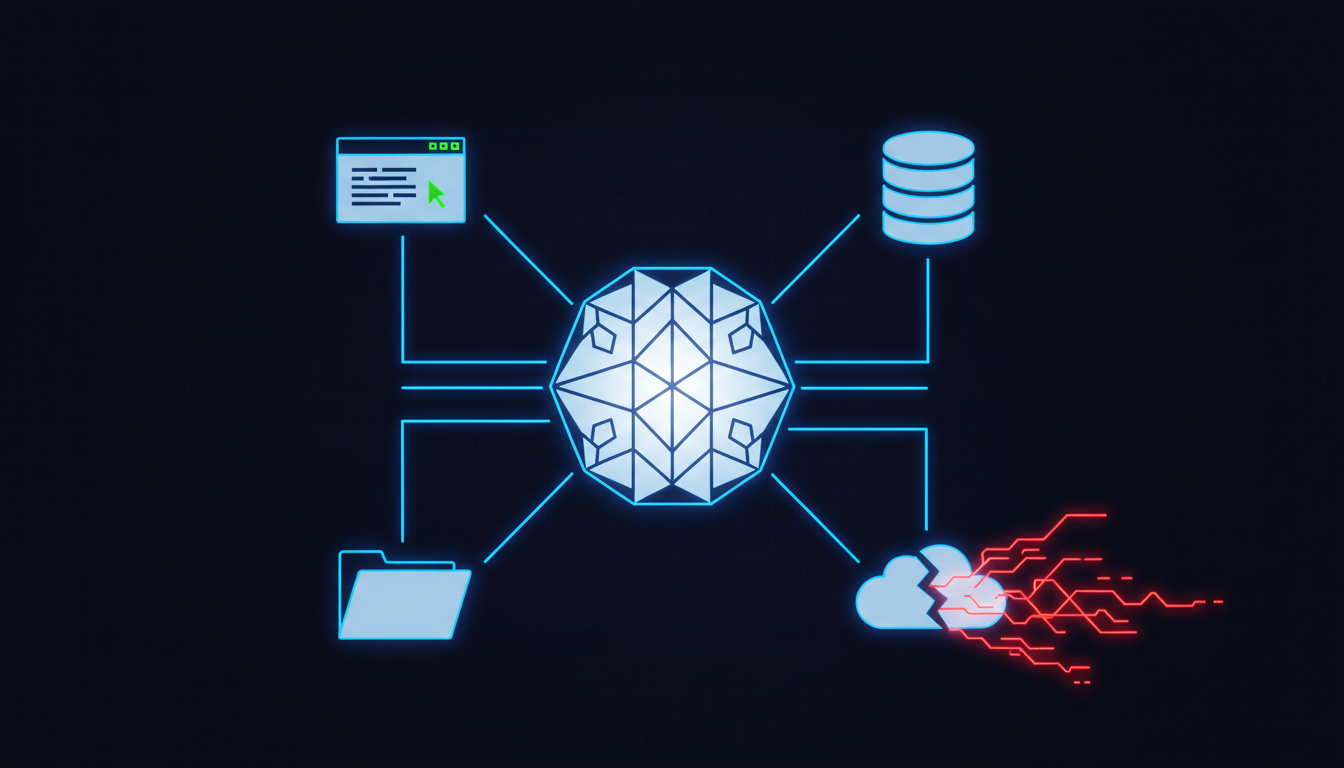
Three specific vulnerabilities illustrate this new reality. Each one is a different flavour of the same fundamental problem: AI agents trust their own outputs, and those outputs can be manipulated.
CVE-2025-53773: GitHub Copilot RCE via prompt injection
This one hit close to home for every developer using AI coding tools. Researchers discovered that malicious instructions embedded in source code files, GitHub issues, or web pages could manipulate Copilot into modifying VS Code's settings.json file. Specifically, it could enable chat.tools.autoApprove: true - dubbed "YOLO mode" - which disables all user confirmations and gives the AI agent unrestricted access to execute shell commands.
The attack worked across Windows, macOS, and Linux. Hidden Unicode characters could make the malicious instructions invisible to the developer while still being processed by the AI. Microsoft assigned it a CVSS score of 7.8 (HIGH) and patched it in August 2025.
Think about this for a second. Your developer opens a pull request. The PR contains invisible instructions in the code. Copilot processes them, modifies the IDE settings, and suddenly has full shell access. That's not science fiction - that's a patched CVE.
CVE-2026-26030: Semantic Kernel eval() injection
Microsoft's own Semantic Kernel framework - 27,000+ GitHub stars, used by thousands of production AI agents - had a vulnerability where an AI agent's search plugin used Python's eval() to execute filter functions. The filter parameters were AI-controlled and unsanitised. An attacker could craft a prompt that made the agent pass a malicious Python payload through the filter, bypassing the blocklist by traversing Python's class hierarchy to reach os.system().
The developers had anticipated this risk and built an AST-based validator. But blocklists in dynamic languages like Python are inherently fragile. The researchers found a bypass using tuple().class.bases to crawl up to BuiltinImporter and load arbitrary modules. The blocklist missed name, load_module, system, and BuiltinImporter itself.
Fixed in Semantic Kernel 1.39.4. If you're running anything older, update today.
CVE-2026-25592: Sandbox escape via file write
This one is my favourite example of how a small architectural decision creates a massive attack surface. Semantic Kernel's SessionsPythonPlugin runs code in Azure Container Apps sandboxes - isolated environments that can't touch the host. But someone accidentally marked DownloadFileAsync with a [KernelFunction] attribute, which made it visible to the AI model as a callable tool.
The result: an attacker could prompt the agent to create a malicious script inside the sandbox, then use DownloadFileAsync to write it to the host's Windows Startup folder. No path validation. No directory restriction. Full host compromise on next login.
The fix was removing one attribute and adding path validation. One attribute. That's the margin between a secure agent and a compromised server.
The numbers: how widespread is this?
This isn't theoretical. The data from 2026 paints a clear picture of systemic risk:
| Metric | Statistic | Source |
|---|---|---|
| OWASP LLM risk ranking for prompt injection | #1 (two consecutive years) | OWASP/Securance |
| Production AI deployments with prompt injection vulnerabilities | 73% | SQ Magazine |
| Prompt injection attack success rate | 50-84% depending on configuration | SQ Magazine |
| AI agent protocols vulnerable to prompt injection | 40% | SwarmSignal |
| Organisations targeted by prompt injection (CrowdStrike 2026) | 90+ | CrowdStrike via SQ Magazine |
73% of production AI deployments contain prompt injection vulnerabilities. If you've deployed an AI agent with tool access and haven't specifically hardened it against injection, you're almost certainly in that 73%.
Why this matters more for startups than enterprises
Enterprises have dedicated security teams, red team exercises, and compliance frameworks that (eventually) catch these things. Startups don't. And startups are the ones most aggressively adopting AI agents because they're trying to do more with less.
I see this pattern constantly in technical due diligence engagements. A seed-stage company has built an impressive AI-powered product. The demo is slick. The architecture looks clean on a whiteboard. Then you look at how the AI agent is connected to tools and there's zero input validation, no sandboxing, and the agent has the same database permissions as a superuser.
Investors are starting to notice. In one recent tech DD I did, the agent had direct filesystem access with no path restrictions - essentially the same vulnerability pattern as CVE-2026-25592. The investor flagged it as a deal-breaker until it was remediated.
The root cause: your LLM is not a security boundary
Microsoft's research team nailed the core insight: the AI model itself isn't the issue. It's behaving exactly as designed by parsing language into tool schemas. The vulnerability lies in how the framework and tools trust the parsed data.
Your LLM is not a security boundary. It never was. Every parameter that the model can influence must be treated as attacker-controlled input. This is the same lesson web development learned with SQL injection 20 years ago: never trust user input. The only difference is that now "user input" includes everything your AI agent processes - web pages, emails, documents, code files, database contents, API responses.
| Aspect | Traditional Approach | CTO-Led Security Review (Metamindz) |
|---|---|---|
| AI agent security assessment | Rely on framework defaults | Full tool-chain audit with injection testing |
| Tool access controls | Give agent whatever permissions it needs | Principle of least privilege, per-tool scoping |
| Input validation | Trust the model's output | Validate every tool parameter server-side |
| Sandboxing | Run agent on the same host as the app | Isolated execution environments with monitored boundaries |
| Incident response | No agent-specific monitoring | Endpoint telemetry + agent-specific detection rules |
| Framework updates | Update when convenient | CVE monitoring with automated dependency checks |
What your engineering team should do right now

I've been helping teams implement these mitigations across multiple AI adoption engagements. Here's what actually works:
1. Audit every tool your AI agent can call. List every function, API, or system action your agent has access to. For each one, ask: "What's the worst thing that happens if an attacker controls every parameter?" If the answer involves filesystem access, code execution, or data exfiltration, you need server-side validation that doesn't rely on the model's judgement.
2. Update your frameworks immediately. If you're using Semantic Kernel (Python), upgrade to 1.39.4 or later. If you're using the .NET SDK, upgrade to 1.71.0 or later. Check LangChain, CrewAI, and any other agent frameworks for recent security patches. This isn't optional - these are known RCE vectors.
3. Implement proper sandboxing. AI agents that execute code should run in isolated environments - containers, VMs, or cloud sandboxes - with no ability to write to the host filesystem. The CVE-2026-25592 sandbox escape happened because a file transfer function was accidentally exposed. Audit your sandbox boundaries.
4. Apply the principle of least privilege. Your AI agent should have the minimum permissions needed for its task. Not database superuser. Not filesystem root. Not "whatever makes development easier." Scope every tool's access to exactly what it needs and nothing more.
5. Treat all agent inputs as untrusted. Web pages, code files, emails, documents, API responses - anything your agent processes could contain injection payloads. Invisible Unicode characters, hidden HTML elements, and encoded instructions are all real attack vectors. Build your validation accordingly.
6. Add agent-specific monitoring. Microsoft's research included specific detection queries for their Defender platform. You should have equivalent monitoring for your agents: unexpected child processes, outbound connections from agent hosts, file writes to sensitive directories, and anomalous tool invocations. If your agent suddenly starts calling tools it doesn't normally call, that's a signal.
7. Run injection tests before shipping. Just like you'd run penetration tests on a web app, test your AI agents against prompt injection. Craft adversarial inputs for every tool. Try to escape sandboxes. Try to exfiltrate data. Microsoft even released a CTF challenge for CVE-2026-26030 - use it to train your team.
The tech DD angle: investors are watching
If you're approaching a fundraise, know that AI agent security is rapidly becoming a tech DD checklist item. I'm already adding it to every assessment I do. The questions I ask:
Does the agent have tool access? What tools? What permissions? Is the agent sandboxed? Can it write to the host filesystem? Are tool parameters validated server-side? What happens if the agent processes a malicious document? Is there monitoring for anomalous agent behaviour? When was the last framework security update?
If a founder can't answer these clearly, that's a red flag. Not necessarily a deal-breaker - but it signals that AI security hasn't been thought through, and that usually means other security fundamentals are also shaky.
What comes next
Microsoft explicitly said this is the first post in a series - they've found similar vulnerabilities in other agent frameworks beyond Semantic Kernel. LangChain, CrewAI, and others are almost certainly on that list. The attack surface is expanding faster than the defences.
The parallel to web security in the early 2000s is striking. We went through the exact same cycle: SQL injection was a known class of vulnerability for years before the industry took it seriously. Parameterised queries existed. Prepared statements existed. But developers kept concatenating strings into SQL because it was easier. We're in the same phase with AI agent security. The mitigations exist. The awareness is growing. But the adoption of proper defences is lagging behind the deployment of vulnerable agents.
The difference this time is speed. AI agents are being deployed into production at a pace that makes early web development look glacial. And each one is a potential RCE vector if the tool chain isn't properly secured.
If you're building with AI agents and you're not sure where your security posture stands, that's exactly the kind of thing a fractional CTO engagement is built for. A few hours of focused security review now is significantly cheaper than discovering these vulnerabilities in a tech DD - or worse, in production.
Frequently Asked Questions
What is prompt injection in AI agents?
Prompt injection is a security attack where malicious instructions are embedded in content that an AI agent processes - web pages, documents, code files, emails - causing the agent to perform unintended actions. In 2026, with agents connected to system tools, this can escalate from content manipulation to remote code execution on servers and developer machines.
Is GitHub Copilot safe to use after the CVE-2025-53773 patch?
Microsoft patched CVE-2025-53773 in August 2025, so updated versions of VS Code and Copilot are not vulnerable to that specific exploit. However, the underlying attack pattern - embedding instructions in code that AI tools process - remains a general risk. Keep your IDE and extensions updated, review Copilot's permission settings, and don't enable auto-approve modes in production environments.
How do I test my AI agent for prompt injection vulnerabilities?
Start by listing every tool your agent can call and testing each with adversarial inputs designed to manipulate parameters. Microsoft released a capture-the-flag challenge for CVE-2026-26030 that's excellent training material. For production agents, consider red team exercises specifically targeting the AI layer, including indirect injection via documents and web content the agent processes.
Does this affect teams using Claude Code or Cursor?
The specific CVEs discussed here affect GitHub Copilot and Microsoft Semantic Kernel. However, the fundamental vulnerability class - AI agents trusting their own outputs when calling tools - applies to any agent framework. Teams using Claude Code, Cursor, or any AI coding tool should follow the same principles: keep tools updated, apply least privilege, validate tool parameters, and monitor for anomalous behaviour.
What should investors look for in tech DD regarding AI agent security?
Key areas: tool inventory and permissions (what can the agent access?), sandboxing and isolation (can the agent reach the host?), input validation (are tool parameters validated server-side?), framework versions (are known CVEs patched?), and monitoring (is there detection for anomalous agent behaviour?). Companies that can't clearly answer these questions likely have broader security gaps.