
Spec-Driven Development: 7 Rules That Beat Vibe Coding in 2026
Spec-Driven Development: 7 Rules That Beat Vibe Coding in 2026
Spec-driven development (SDD) is a way of building software where a written, version-controlled specification is the source of truth and the code is generated from it by an AI agent. You write what the system must do, the edge cases, and the constraints first. The agent then plans, builds, and verifies against that spec instead of guessing from a one-line prompt.
So, look. For about a year now I've watched founders ship something in a weekend with an AI tool, demo it to me, and ask why I keep banging on about "structure". The demo works. It looks finished. Then three months later the same founder is in my inbox because nobody on the team can change the login flow without breaking the basket, and the codebase reads like it was written by six different people who never met. Because, in effect, it was.
That gap, between the brilliant demo and the unmaintainable mess, is the whole story of AI coding in 2026. And the thing that closes it has a boring name: spec-driven development. It's a discipline, not a tool you buy. Here are the seven rules I give every team I work with, and the data behind why they matter.
Why vibe coding hits a wall (the numbers)
First, the lay of the land. AI coding isn't fringe anymore. JetBrains and Stack Overflow's developer surveys put regular AI tool usage at around 85% of developers, and Y Combinator's CEO Garry Tan told CNBC that for roughly a quarter of the Winter 2025 batch, 95% of the code was written by AI. This is the default now, not the experiment.
"Vibe coding" is the loose version of it. Andrej Karpathy coined the term in early 2025 for prompting an agent in plain English and accepting whatever it produces without reading every line. He scoped it for "throwaway weekend projects". Somewhere along the way people started shipping it to production, and the bill arrived.
The bill is well documented. GitClear's study of 211 million lines of code found refactoring activity dropped around 60% between 2021 and 2024 while copy-pasted code climbed past refactored code for the first time, with code duplication rising roughly fourfold. On security, the Cloud Security Alliance's 2026 research reported that about 45% of AI-generated code samples failed security tests, and a scan by Escape.tech of more than 1,400 vibe-coded production apps found 65% had security issues and 58% carried at least one critical vulnerability, including hundreds of exposed secrets. Surveys put adoption of vibe coding at around 84% of developers but trust at just 29%. People are using a thing they openly don't trust.

The pattern even has a shape. Analysts at Codebridge, cited in Augment Code's vibe coding vs SDD breakdown, describe a decay curve: euphoria in months one to three, a plateau around months four to nine, decline from ten to fifteen, and a stall around sixteen to eighteen where teams stop understanding their own system. I've been called in at month eleven more times than I can count. It's always the same diagnosis.
Spec-driven development is the structured alternative. Early-adopter reports from GitHub and AWS, summarised in the 2026 SDD guide, claim roughly 3-10x higher first-pass success rates from agents on non-trivial tasks when the work starts from a spec. AWS has documented customer cases where features estimated at 40 hours shipped in under 8 hours of human time when authored spec-first. That's the prize. Here's how you actually get it.
How spec-driven development actually works
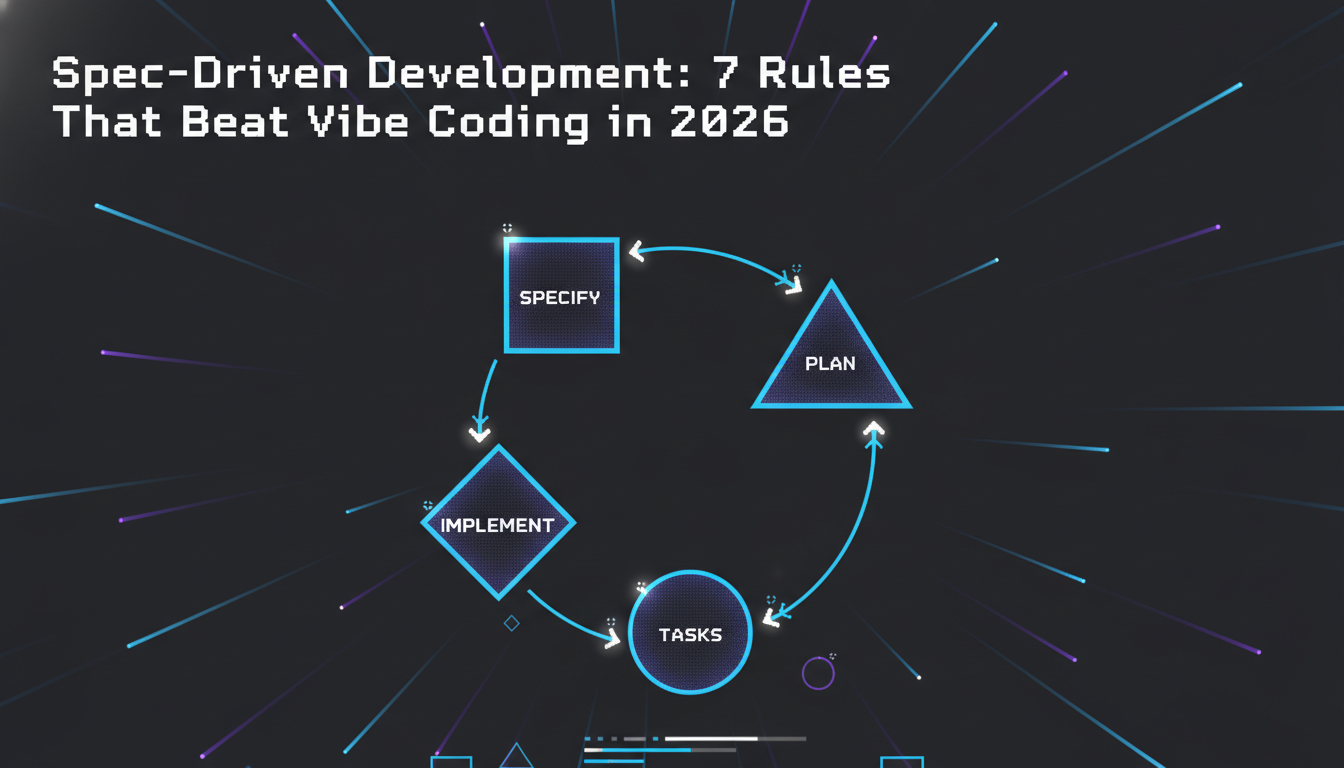
Every serious SDD framework converges on the same four phases: Specify, Plan, Tasks, Implement. You write the spec (the what and why), the agent drafts a technical plan (the how), the plan is broken into atomic tasks (in what order), and only then does the agent write code, verifying each task against the acceptance criteria. A human reviews at every boundary. That's the loop.
The tooling caught up fast. GitHub open-sourced Spec Kit in September 2025 and it now carries more than 90,000 stars and works across 30-plus agents including Claude Code, Copilot, Cursor and Gemini CLI. AWS shipped Kiro, a dedicated SDD IDE, to general availability in November 2025 after more than 250,000 developers used the preview. Claude Code added SDD skills, Cursor leans on Plan Mode and an AGENTS.md file, and there's OpenSpec, BMAD-METHOD, Tessl for regulated industries, and Google Antigravity. DeepLearning.AI even launched a dedicated short course on it in late 2025. When the education arm shows up, the methodology has crossed from experiment to standard.
You don't need all of them. You need the discipline underneath them. These seven rules are that discipline.
Rule 1: Write the spec before you write the prompt
The phrase doing the rounds in GitHub and AWS posts is "the spec is the prompt". It's right. "Add login" is not a requirement, it's a wish. The model fills the gaps with reasonable defaults, and reasonable defaults are almost never what you actually wanted. A spec captures intent, behaviour, edge cases, and the non-functional bits (performance budgets, security constraints, what happens when it fails) before a single line is generated.
The maths is brutal in your favour. An extra hour writing a spec saves days of agent thrash and weeks of code review. I tell clients to treat the spec phase as the slowest, most valuable hour of the feature. It's the one place where thinking is cheaper than building.
Rule 2: Use EARS notation so the agent can't guess
If your acceptance criteria are vague, the agent invents its own. EARS, the Easy Approach to Requirements Syntax, fixes that. It was created by Alistair Mavin and colleagues at Rolls-Royce back in 2009 for safety-critical systems, and it's quietly become the secret weapon of SDD because each pattern collapses to a single testable claim.
There are five patterns. The two you'll use most: event-driven ("WHEN a user submits the login form THE system SHALL validate credentials against the auth provider") and unwanted-behaviour ("IF credential validation fails three times in 60 seconds THEN THE system SHALL lock the account for 15 minutes"). Notice there's no ambiguity about trigger, scope, or response. An agent can read that, build it, and write a test that proves it. Write "it should handle errors gracefully" and you've told it nothing.
Rule 3: Put a constitution at the root of the repo
A constitution is a project-level rules file, usually AGENTS.md at the root or constitution.md in the spec directory, that every spec and every agent action must respect. It's where the durable decisions live: TypeScript strict mode, no new runtime dependencies without an architecture decision record, reject PRs that lower test coverage, never let AI touch the auth or payments logic without human sign-off.
Without it, every new feature re-litigates the same five decisions and the agent drifts a little further from your stack each time. With it, you've given the AI a spine. This is exactly the kind of guardrail I help teams write in an AI adoption engagement, because the constitution is where your team's actual standards get encoded, and most teams have never written theirs down.
Rule 4: Keep the spec in the repo, versioned with the code
Specs in Notion, code in Git, is how specs rot. Within a sprint the doc and the code disagree and nobody trusts either. The spec has to live in the same repo, in the same pull requests, versioned alongside what it describes. One feature, one spec directory: specs/004-magic-link-auth/ holding spec.md, plan.md, and tasks.md.
When this works, code review changes character. Instead of a reviewer staring at a thousand-line AI code dump trying to reverse-engineer intent, they read a focused diff against a spec they already approved. GitHub's own framing is blunt: you review focused changes that solve specific problems, not walls of generated code. Cite the spec in the commit message and the whole history becomes traceable.
Rule 5: Review at every phase boundary, not just at the end
This is the rule people skip, and it's the one that makes SDD predictable. Review the spec before the plan. Review the plan before the tasks. Review the tasks before implementation. Cheap iterations on a plan beat expensive iterations on code every single time, because a wrong assumption caught at the plan stage costs you a paragraph, and the same assumption caught after the agent has written 800 lines costs you a rewrite.
Letting an agent run from prompt to merged PR with no human checkpoint isn't spec-driven development. It's vibe coding wearing a costume. The human checkpoints are the point. They're also where a senior engineer or fractional CTO earns their keep, by catching the architectural mistake on the plan instead of in production.
Rule 6: Vibe-code to explore, spec-drive to ship
I'm not anti-vibe-coding. For a throwaway spike, a prototype, an internal script, or learning an unfamiliar framework, prompting an agent and iterating fast is genuinely the right tool. A GitHub study found developers completed defined tasks around 55% faster with AI generation. Speed of discovery is real.
The skill is knowing when to transition. The signals are clear: the agent fixes one bug and breaks three files it never saw, new features stop respecting existing patterns, more than one person now needs to understand the code, or real users are about to depend on it. When any of those land, you stop exploring and you formalise what you learnt into a spec. The mature pattern most teams settle on: vibe-code a spike, distil it into a spec, then spec-drive the production version.
Rule 7: Spec the negative space, and keep it short
Two failure modes sit either side of a good spec. Under-specification ("it should work well") tells the agent nothing. Over-specification ("use a Map not an Object") strangles it with implementation detail that belongs in the plan phase, and bloats the document until nobody reads it. Aim for one to three pages per feature. If it's getting bigger, split it.
And spec the negative space. What the system will NOT do bounds the agent as firmly as what it will do. "Out of scope: no social login in v1, no admin panel, no multi-region" stops the agent helpfully building three things you didn't ask for. The out-of-scope section is as important as the requirements, and it's the one almost everyone forgets.
Spec-driven, done properly vs the default
Tools won't save a team that hasn't decided how it works. The difference isn't Kiro vs Spec Kit. It's whether someone senior owns the workflow and enforces it. Here's the honest comparison between the default way AI coding happens and the CTO-led way we run it at Metamindz.
| Aspect | Default (vibe coding / ungoverned agents) | CTO-Led Spec-Driven (Metamindz) |
|---|---|---|
| Starting point | One-line prompt, agent guesses the rest | Versioned spec with EARS acceptance criteria |
| Project standards | Live in someone's head, drift every feature | Written into a constitution the agent must follow |
| Code review | Thousand-line AI dumps, reverse-engineered | Focused diffs reviewed against an approved spec |
| Human oversight | Accept output if it "looks right" | Sign-off at every phase boundary |
| Auth, payments, data | Often AI-generated without scrutiny | Ring-fenced; never touched without senior review |
| Month 12 outcome | The three-month wall, then a rewrite | Specs outlive the code; team still understands it |
| Investor due diligence | Unexplainable codebase, valuation risk | Traceable specs, clean provenance, defensible |
That last row matters more than people expect. When an investor's technical reviewer opens your codebase, "the AI wrote it and we're not sure how it works" is a red flag that costs valuation or kills the deal. A versioned spec history is the opposite signal. It's one of the first things I check on a fractional CTO engagement when a client is heading into a raise, and it's central to how we run CTO-led development, where the spec and documentation are deliverables, not afterthoughts, so there's no vendor lock-in when you take it in-house.
And if you're reading this at month eleven, staring at a codebase nobody can safely change, that's fixable too. It's most of what our vibe-code fix work actually is: writing the spec and the constitution that should have existed on day one, then refactoring back to something a human can reason about.
Where to start this week
Don't boil the ocean. Pick one small feature you'd ship this week. Spend 30 minutes writing it as a Spec Kit-style spec with EARS acceptance criteria and an out-of-scope section. Add a one-page constitution for the repo. Run it through Claude Code or Cursor with review at each phase. Then compare that experience to the last thing you vibe-coded. The gap is the whole argument. You won't go back.
Frequently Asked Questions
What is spec-driven development?
Spec-driven development is a methodology where a structured, version-controlled specification is the source of truth and code is generated from it by humans and AI coding agents. You define requirements, edge cases, and constraints first, then the agent plans, builds, and verifies against that spec rather than guessing from an ad-hoc prompt.
What is the difference between spec-driven development and vibe coding?
Vibe coding means prompting an AI agent in plain English and accepting whatever it produces, which is fast for prototypes but decays in production. Spec-driven development adds an upfront spec, a plan, atomic tasks, and human review at each phase. Vibe coding delivers discovery speed; spec-driven development delivers production durability.
Does spec-driven development replace vibe coding?
No, they're complementary. Use vibe coding for spikes, prototypes, throwaway scripts, and exploring new frameworks. Use spec-driven development for anything destined for users, multiple maintainers, or regulated environments. The pattern most teams adopt is to vibe-code a spike, distil it into a spec, then spec-drive the production build.
What is EARS notation and why does it matter?
EARS (Easy Approach to Requirements Syntax) is a set of five sentence patterns created at Rolls-Royce in 2009 that turn fuzzy requirements into unambiguous, testable statements. It matters for AI because each pattern collapses to a single claim the agent can build and verify, removing the guesswork that produces drift and bugs.
Is spec-driven development worth it for a small startup?
Yes, once code is destined for real users or more than one person will maintain it. The overhead is roughly an extra hour per feature writing the spec, which early-adopter data suggests is repaid several times over in fewer rewrite cycles and faster review. For a true throwaway prototype, plain vibe coding is still fine.
Sources linked throughout. If you want a second opinion on whether your AI coding workflow is heading for the three-month wall, a no-obligation discovery call is free, and I'll tell you honestly if you don't need us.