
The 10x Developer Myth: What Actually Makes Teams Fast in 2026

The 10x Developer Myth: What Actually Makes Teams Fast in 2026
The "10x developer" is the idea that one exceptional engineer produces ten times the output of an average one. It is a myth. Speed in 2026 comes from the system a team works inside, not from a single hero coder. The best independent data shows AI lifts real output by roughly 10%, not 10x, and that lone experts often become the biggest risk on the team.
So.. I've been hiring, screening, and running engineering teams for over 15 years, and I still hear it in nearly every founder call: "I just need to find a 10x developer." As if there's a mythical person out there who'll ship your roadmap single-handedly and make the whole hiring problem go away.
They won't. And in 2026, with AI coding tools everywhere and the "one engineer plus an agent equals a team" narrative getting louder, the 10x myth is doing more damage than ever. It's driving bad hires, bad org design, and bad due diligence. So let me pull it apart, myth by myth, with the actual data.
What is a "10x developer" anyway?
The term comes from a 1968 study on programmer productivity that found large variance between individuals. Somewhere along the way that turned into a folk belief: hire the one genius, ten-times the results. The problem is that the original research measured individuals on isolated tasks, not teams shipping and maintaining production software over years. The moment you put someone inside a real system, "individual output" stops being the thing that matters.
Myth 1: A 10x developer gives you 10x the value
Here's what nobody puts on the pedestal: your 10x developer is very often a bus factor of one. That's the number of people who can be hit by a bus (or resign, or burn out) before your project grinds to a halt. A healthy team has a bus factor of three or more. A codebase where one person is the only one who understands the architecture, the deployment quirks, and the hidden workarounds has a bus factor of one, which is a critical risk (FoundersBar).

I've seen this exact thing sink a Series A raise. Investors now routinely check bus factor during technical due diligence, and a company that depends on one irreplaceable engineer is harder to fund and harder to sell (MindCTO). When I run a tech DD, one of the first things I map is where the knowledge actually lives. If it all lives in one head, that's a finding, not a feature. The 10x hero you're so proud of is a liability with a ping-pong table.
Myth 2: AI turns your average developers into 10x developers
This is the 2026 version of the myth, and it's the one being used to justify hiring freezes. The data does not support it. getDX analysed a random sample of 400 companies from November 2024 through February 2026. AI usage went up by an average of 65%. Pull request throughput went up by 7.76% (getDX). Most organisations land in the 5 to 15% range. That's a real gain. It is not 10x. It's barely 0.1x.
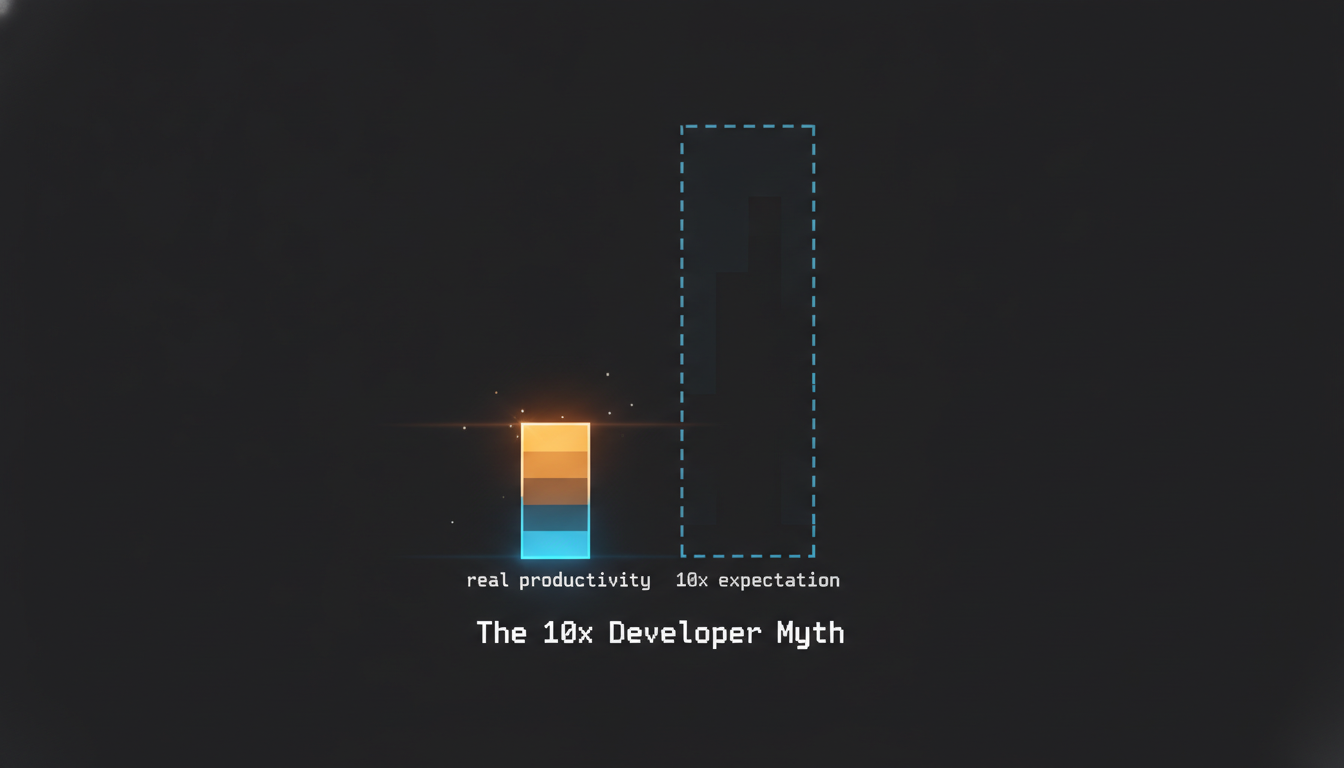
It gets worse for the hype. In a randomised controlled trial by METR, experienced open-source developers estimated AI made them 24% faster. Measured against reality, they were 19% slower (METR). That's a 40-point gap between how fast people FEEL and how fast they actually are. And trust in AI-generated code has collapsed to around 29%, with 66% of developers reporting they spend more time fixing "almost-right" AI code than they save (ShiftMag).
AI is a genuine productivity multiplier when it's used with structure and oversight. It is not a cheat code that manufactures 10x engineers out of thin air. This is exactly why we run structured AI adoption for engineering teams instead of just telling people to "use Cursor more."
Myth 3: The fastest teams have the best individual coders
Coding is a small slice of the job. Developers spend only about 14% of their time actually writing code (getDX). The rest goes on reviewing, planning, waiting for handoffs, meetings, debugging, and understanding existing code. So even if your 10x hero writes code ten times faster, you've supercharged 14% of the pipeline and left the other 86% exactly where it was. That's Amdahl's Law with a hoodie on.
The teams that ship fast aren't the ones with the flashiest coders. They're the ones that have removed friction from the whole flow: fast code review, small batches, low work-in-progress, clean CI/CD, and clear ownership. A disciplined engineer with clean architecture, tests, and documentation will out-ship a "genius" who leaves a mess behind for everyone else to decode.
Myth 4: More AI usage means you ship faster
The 2025 DORA report (Google's long-running study of software delivery) found that AI amplifies whatever's already there. Strong teams get stronger. Weak systems get worse, faster. DORA also found AI adoption has a negative relationship with delivery stability unless you fix the underlying system first (Google Cloud / DORA 2025).
The mechanism is simple. When AI helps you generate more code, you generate more pull requests. Teams with high AI usage merge far more PRs, but review time climbs sharply, and delivery metrics don't budge. You've just moved the bottleneck downstream to your senior engineers, who are now drowning in review. Generating code was never the hard part. Reviewing, integrating, and safely shipping it is.
Myth 5: You can spot a 10x developer by their output
Lines of code, commit count, pull requests merged, story points burned down. These are all vanity metrics, and story points in particular are an arbitrary, rubbish way to measure anything real. A developer who deletes 2,000 lines of dead code and replaces it with 200 clean ones has "negative output" by these measures and has made your product dramatically better.
If you reward volume, you get volume: more PRs, more code, more surface area to maintain, more places for bugs to hide. The QA Wolf team half-jokingly named the "-10x engineer", the person who feels productive shipping AI-generated code all day while quietly creating a maintenance burden that costs the team far more than their output is worth. Measure outcomes: is the software stable, does it ship, does it recover quickly when it breaks? That's what the DORA metrics actually track, and it's what I care about when I audit a team.
Myth 6: Hire a 10x developer to fix a slow team
This is the most expensive myth of the lot. Your team is slow, so you go and hunt for a superstar to come and unblock everything. Nine times out of ten your team isn't slow because it lacks talent. It's slow because of the system: unclear priorities, giant batches of work-in-progress, a review process that takes days, no tests so everyone's scared to change anything, and an architecture that fights back.
Drop a brilliant new hire into that and you get one of two outcomes. They get ground down by the same friction as everyone else, or they route around it, become the new bus-factor-of-one, and make the underlying problem worse. You can't hire your way out of a broken system. You fix the system. That's most of what I do as a fractional CTO, and it's usually cheaper and faster than the hero hunt.
What actually makes teams fast in 2026
Real speed is boring and structural. Small batches so work flows instead of piling up. Low work-in-progress so people finish things instead of juggling ten. Fast, high-quality code review so PRs don't rot. Tests and CI/CD so changes are safe. Documentation and shared ownership so no single person is the only map to the system. And AI used with human oversight, not as an unsupervised code cannon. None of that is glamorous. All of it compounds.
Here's the honest comparison between chasing the 10x hero and building a 10x system, which is the approach we take at Metamindz.
| Aspect | Chasing the 10x Hero | Building a 10x System (CTO-Led / Metamindz) |
|---|---|---|
| Where speed comes from | One exceptional individual | Flow, small batches, fast review, clean architecture |
| Bus factor | Often 1 (critical risk) | 3+ through shared ownership and documentation |
| Effect of the person leaving | Roadmap stalls, knowledge walks out the door | Team absorbs it, work continues |
| How AI is used | Unsupervised, "make everyone 10x" | Structured workflows with human oversight on auth, payments, data |
| What gets measured | Lines of code, PR count, story points | DORA outcomes: stability, lead time, recovery |
| Due diligence readiness | Red flag for investors | Distributed knowledge that passes tech DD |
| Hiring approach | Hunt for a superstar to fix everything | Hire for the system, screened by people who've built one |
This is also why we don't let non-technical recruiters run technical hiring. If you're hiring to strengthen a system rather than to find a mythical genius, the person screening candidates has to understand the system. That's the whole point of CTO-led recruitment, and it's the same reason our software development work is built to hand over cleanly with no vendor lock-in. No bus factor of one, including us.
Frequently Asked Questions
Do 10x developers exist at all?
Exceptional engineers absolutely exist, and some are genuinely far more effective than average. But the "10x" figure is folklore, not measured fact, and effectiveness comes from how someone works within a team, not raw individual output. A great engineer who documents, mentors, and reduces complexity is worth far more than a fast lone coder.
Can AI make my developers 10x more productive?
No. Independent data from getDX across 400 companies shows AI adoption raised pull request throughput by about 7.76% while usage rose 65%. Most teams see 5 to 15% real gains. AI is a useful multiplier with structure and oversight, but it does not manufacture 10x developers, and unsupervised use can slow experienced engineers down.
What is a bus factor and why does it matter?
Bus factor is the number of people who can leave before a project stalls. A bus factor of one means a single person holds critical knowledge, which is a serious risk. Investors check it during technical due diligence. A healthy team spreads knowledge across three or more people through documentation and shared ownership.
How do I actually measure engineering team performance?
Measure outcomes, not activity. The DORA metrics track deployment frequency, lead time for changes, change failure rate, and time to restore service. These reflect whether software ships and stays stable. Avoid lines of code, commit counts, and story points, which reward volume and are easy to game without improving anything real.
My team feels slow. Should I hire a senior star to fix it?
Usually not first. Most slow teams are slow because of the system: unclear priorities, high work-in-progress, slow reviews, missing tests, and awkward architecture. Fixing those is often cheaper and faster than a hero hire, and a new star dropped into a broken system typically gets stuck too. Diagnose the system before you hire.
So, look, the next time someone tells you they're waiting to find their 10x developer, ask them what their code review time is, how many people understand their architecture, and what happens if their best engineer resigns tomorrow. If they can't answer, they don't have a talent problem. They have a system problem. And that one you can actually fix.
If you want an honest read on where your team's real bottleneck is, that's exactly the kind of thing we do on a free, no-obligation call. Have a look at how our fractional CTO service works, or just book a chat and I'll tell you straight, including if you don't need us.