AI MVP Development for Non-Technical Founders
- This Startup Built Their MVP in Just 6 Weeks Using No-Code + AI
- How to Build an AI-Driven MVP
- AI Tools and Platforms for MVP Development
- Best Practices and Common Mistakes
- How Metamindz Supports Non-Technical Founders
- Conclusion
- FAQs
- What are the benefits of using no-code and low-code platforms for non-technical founders when building an AI MVP?
- How can non-technical founders prioritize features for their AI-driven MVP to solve the core problem effectively?
- How can non-technical founders successfully scale their AI MVP into a full product while keeping it user-focused and scalable?
AI MVP Development for Non-Technical Founders
You don’t need to be a tech expert to create an AI-powered MVP. With tools like no-code platforms and AI-driven solutions, non-technical founders can now quickly test ideas, reduce costs, and gather feedback without writing a single line of code.
Here’s how to get started:
- Define the problem: Focus on a specific issue your product will solve.
- Prioritize core features: Avoid adding unnecessary elements; stick to essentials.
- Leverage AI tools: Use platforms like Bubble, Glide, or ChatGPT for prototyping, automation, and user insights.
- Launch and iterate: Release a basic version, gather feedback, and improve over time.
AI tools simplify tasks like research, design, and automation, allowing you to validate ideas and save up to 40% on development costs. By combining no-code tools with a clear focus, you can bring your idea to market in weeks instead of months. The key is starting small, staying user-focused, and adapting based on feedback.
This Startup Built Their MVP in Just 6 Weeks Using No-Code + AI
How to Build an AI-Driven MVP
Creating an AI-driven MVP is a practical way for non-technical founders to quickly test and refine their product ideas. By blending AI capabilities with a clear business focus, you can validate your concept without unnecessary complexity.
Define Your Problem and Target Audience
Every successful AI MVP begins with a solid understanding of the problem it’s designed to solve [2]. Before diving into tools or development, take time to identify a specific issue your target audience faces. The goal is to address real challenges where AI can make a meaningful difference.
To do this, conduct thorough market research and engage directly with potential users. Use interviews or surveys to uncover their pain points [3][4]. Avoid the temptation to prioritise flashy technology over solving actual problems [4]. Once you’ve clearly defined the problem, you can move on to identifying the core features that will bring value to your users.
Choose and Prioritise Core Features
One of the biggest pitfalls for non-technical founders is trying to launch a product packed with too many features. Extra features not only increase costs but also complicate the user experience without adding real value [5]. Instead, focus on one or two essential features that directly address the problem you’ve identified [5].
To decide what to include, consider using frameworks like the MoSCoW method (Must-have, Should-have, Could-have, Won’t-have) [5]. This approach helps you objectively prioritise features, ensuring that your MVP solves a key problem while encouraging user engagement and satisfaction. Always ask yourself: is this feature absolutely necessary for launch? [7][6].
Pick the Right Development Approach
With your core features in place, the next step is to choose a development model that matches your technical skills, budget, and timeline. For non-technical founders, several options make building an AI-driven MVP more accessible.
No-code and low-code platforms are great starting points. These tools often include drag-and-drop interfaces and pre-built functionalities, making it easy to integrate AI services like natural language processing, image recognition, or predictive analytics - no heavy coding required.
Another option is to use Concierge or Wizard of Oz MVPs. These approaches allow you to manually simulate AI functions to test your concept before fully automating them.
For instance, the startup Mytender, founded by non-technical entrepreneurs, validated their AI tool with an initial $250,000 in funding [8].
While traditional MVP development can take months and involve significant costs, AI-powered MVPs built on no-code platforms can often be completed in weeks. This faster timeline allows for quicker market validation [9]. Additionally, involving technical advisors or consultants can help ensure scalability and adherence to best practices. Adopting agile development practices also provides flexibility, enabling you to adapt based on user feedback and changing needs.
AI Tools and Platforms for MVP Development
Picking the right tools can speed up your AI MVP development process and help you validate your concept faster. The low/no-code market is expected to hit $51.25 billion by 2028 [11], and by 2025, 70% of new enterprise applications will rely on low-code or no-code technologies [10].
AI-Powered No-Code and Low-Code Platforms
These platforms simplify coding by turning it into user-friendly, drag-and-drop workflows, making them accessible to non-technical founders. They can also significantly cut costs - low-code platforms can reduce development expenses by up to 70% [12]. Many of these platforms offer free tiers or affordable plans starting at $20-$50 per month [12].
- Bubble: Known for its flexibility, Bubble is ideal for building complex web applications. It supports extensive API integrations and scales well as your business grows. While it has a steeper learning curve, it’s a solid choice for projects like marketplaces, SaaS tools, or multi-user platforms.
- Glide: Perfect for creating apps from spreadsheets, Glide is great for lightweight applications or internal MVPs. You can get a prototype up and running in just a few hours, though it’s not suited for more intricate projects.
- Adalo: Designed for mobile-first startups, Adalo lets you build both iOS and Android apps without writing code. It’s great for consumer-facing apps, but performance may lag for larger or more complex builds.
- FlutterFlow: This platform generates Flutter code, blending no-code simplicity with traditional development flexibility. It supports cross-platform apps and allows you to export and customise code later, making it a good option if you plan to scale.
- OutSystems: Tailored for enterprise-grade applications, OutSystems handles complex needs with minimal coding. However, its high cost - starting at $1,500 per month - may deter smaller businesses.
- Softr: Ideal for web apps and portals, Softr integrates directly with Airtable, making it a strong choice for MVPs requiring user logins, memberships, or content management systems.
AI Tools for Research, Design, and Automation
Beyond development platforms, specialised AI tools can streamline tasks like research, design, and automation. Leveraging AI in product development has been shown to reduce time-to-market by 30% for startups, while companies using AI for customer interactions see a 25% boost in user engagement [13].
-
ChatGPT: A go-to tool for brainstorming and content creation. Eddie Larsen, a Solo SaaS Founder, highlights its value:
"ChatGPT helps me skip the blank screen and jump straight into problem-solving mode." [14]
He also notes the importance of balancing exploration with focus:
"AI helps me explore. Buildpad helps me narrow down and commit. That balance matters." [14] - Midjourney: This tool excels in visual content creation. For instance, a fashion startup used Midjourney to generate realistic sneaker mockups for their website and marketing materials, saving on design costs and photoshoots. By analysing user engagement and pre-orders, they identified the most popular designs before production [13].
- HeyGen: Offers AI-generated video avatars, making it easy to create onboarding or educational content. A personal finance app used HeyGen to produce weekly financial tips and onboarding videos, cutting costs and increasing engagement [13].
- Airtable: More than just a database, Airtable integrates with no-code platforms to organise user feedback, track feature requests, and automate repetitive tasks.
- OpenAI’s Platform: For advanced AI integration, OpenAI allows businesses to build custom AI assistants. A legaltech startup used it to create an AI-powered contract assistant that indexed legal documents, summarised clauses, and provided explanations with citations. This innovation saved time for lawyers and compliance teams [13].
Platform Comparison Guide
The right platform depends on your specific needs, technical skills, and future goals. Here’s a breakdown of the major platforms:
| Platform | Best For | Ease of Use | Scalability | Monthly Cost | Key Strength |
|---|---|---|---|---|---|
| Bubble | Complex web apps | Medium | High | $25+ | API integrations & flexibility |
| Glide | Simple mobile apps | High | Low | $20+ | Spreadsheet-to-app conversion |
| Adalo | Mobile-first startups | High | Medium | $50+ | iOS/Android support |
| FlutterFlow | Cross-platform apps | Medium | High | $30+ | Code generation & export |
| OutSystems | Enterprise applications | Low | Very High | $1,500+ | Enterprise-grade performance |
| Softr | Data-driven web apps | High | Medium | $29+ | Airtable integration |
When deciding, think about your target audience (web or mobile), the integrations you’ll need, your budget, and whether exporting code will be important down the line. With 87% of companies already using low-code tools [11], and 60% of managers viewing them as critical for their company’s future [11], these platforms are becoming a cornerstone of development.
Start with no-code tools to quickly validate your idea, then transition to low-code or full development as your needs evolve. Matching the platform to your immediate goals while keeping scalability in mind is key to a successful MVP. This foundation sets you up to explore best practices and avoid common pitfalls in AI MVP development.
sbb-itb-fe42743
Best Practices and Common Mistakes
For non-technical founders diving into AI-driven tools, understanding the right steps and avoiding common errors can make the difference between success and failure. With 42% of startups failing due to misreading market needs [20] and 70% struggling from scaling too soon [20], following a clear plan is crucial for turning an idea into a scalable product.
Tips for Building a Successful AI MVP
Start with validation before building. Test your idea by engaging with users through interviews, social media, and online communities [16]. A great example is Dropbox, which created a simple explainer video to showcase its concept. The overwhelming response confirmed demand before a single line of code was written [24].
Solve one specific problem. Keep your MVP focused on addressing a single pain point. Techniques like the MoSCoW method can help you prioritise features [16].
Define metrics early. Establish key performance indicators (KPIs) that align with your business goals before launching [18].
Create a feedback loop. Use analytics to track user behaviour and collect feedback. Prioritise changes that improve core functionality. Organise development into short sprints to stay agile and responsive [16].
Launch early with a soft rollout. Release your MVP to a small group of target users to identify and fix issues before expanding [16]. Stick to a strict timeline - such as 90 days - and focus solely on the essentials [19]. AlterSquare puts it best:
"Launching an MVP isn't about perfection - it's about validating your idea and gathering feedback early." [16]
Use AI for efficiency, not everything. Let AI handle repetitive tasks, but rely on human judgement for critical decisions [17].
These practices lay a strong foundation, but avoiding common mistakes is equally important to ensure your MVP succeeds.
Mistakes to Avoid
Overcomplicating your MVP adds unnecessary delays and costs. Adding too many features can extend timelines by 40-60% and increase costs by an average of 35% [20].
Ignoring technical feasibility can lead to expensive surprises. Test technologies early to avoid setbacks. Opt for reliable tools that offer flexibility as your product evolves [18][20].
Trying to please everyone weakens your product's focus. One-third of startups fail because they create something nobody truly needs [21]. Narrow your audience, create detailed user personas, and stick to them throughout development [19][20].
Overlooking security and scalability can create technical debt. Incorporate security measures from the start, plan for growth with cloud systems, and use RESTful architecture with versioning [20].
Choosing the wrong development approach can derail your project. Avoid untested methods and gain a basic understanding of technical processes [15].
Expanding scope unnecessarily is a classic pitfall. Resist the urge to add features without thorough evaluation to prevent scope creep [20].
Moving from MVP to Full Product
Once your MVP has proven successful, the next challenge is scaling it into a full-fledged product. This transition requires careful planning and disciplined execution. Traditional software development practices become crucial for building robust infrastructure, adding complex features, and ensuring security and compliance [1].
Focus on improving user experience by prioritising features based on user data. Test thoroughly and introduce updates gradually to maintain stability [23]. Keep your core product fast and reliable while rolling out new features in phases.
Plan for algorithmic scalability. As your user base grows, ensure your algorithms can handle the load. Techniques like decision trees or linear regression can be effective. Use cloud platforms to scale resources as needed, and invest in automation to boost efficiency [22][23].
Develop a sustainable revenue model. A strong revenue strategy ensures long-term growth. Spotify's approach is a great example - they prioritised user acquisition and expanding their music catalogue over early profits, which helped them dominate the streaming market [23].
Hire strategically to support growth. Streamline onboarding and focus on roles that directly contribute to scaling. As Jeff Bezos famously said:
"If you double the number of experiments you do per year, you're going to double your inventiveness." [24]
Proactively address challenges. Zoom's response to rapid growth during the pandemic is a prime example. By tackling security flaws with end-to-end encryption and stronger features, they restored trust and solidified their market position [23].
Just as in the MVP phase, leveraging reliable AI platforms and seeking technical guidance will be critical as you scale. Staying focused on your core value while building the necessary infrastructure will prepare you for long-term success and help position your product as a market leader.
How Metamindz Supports Non-Technical Founders
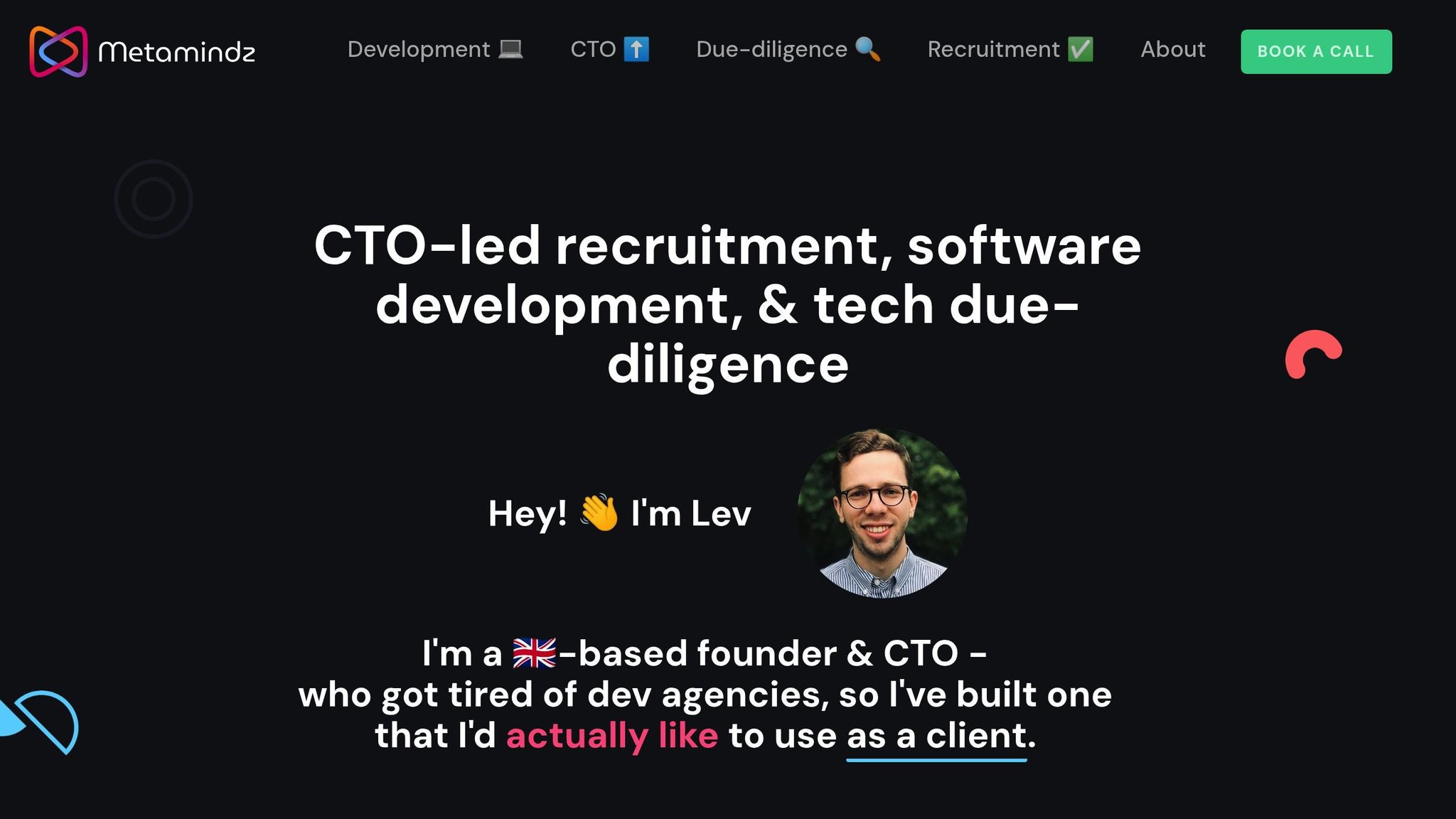
Creating an AI-powered MVP without a technical background can feel overwhelming, but you don’t have to tackle it on your own. Metamindz steps in to bridge the gap, offering tailored services that simplify complex technical challenges into clear, actionable steps. Their goal? Helping non-technical founders make informed decisions that align with their vision.
Fractional CTO Services for Expert Guidance
Metamindz provides access to seasoned technical leadership through their Fractional CTO service - without the need to hire a full-time CTO. This service offers expert guidance on software development, detailed tech evaluations, and even recruitment, all through a flexible subscription model. Starting at $2,750 per month, it ensures that every technical decision is aligned with your business goals, giving you peace of mind as you build your product [25].
Custom MVP Development and Technical Reviews
Beyond strategic advice, Metamindz delivers hands-on development services and thorough technical evaluations. They specialise in building AI-driven MVPs for industries like B2B SaaS, e-commerce, consumer apps, and IoT [25]. For $3,750, their technical due diligence service provides a deep dive into your codebase and tech stack. A Metamindz CTO will review your code, assess the architecture, spot weaknesses, and deliver a prioritized roadmap to improve your MVP [26]. This process is designed to strengthen your product and set it up for long-term success.
Why Choose Metamindz?
When you partner with Metamindz, you’re working with a team that truly understands the challenges non-technical founders face in building AI-driven products. Their experienced professionals bring a nuanced understanding of technical requirements, offering a combination of fractional CTO services, custom development, and in-depth technical assessments. With a UK- and Europe-based team operating in compatible time zones, they ensure smooth communication and provide a free consultation to get you started. This comprehensive support system is designed to grow with you, complementing earlier-discussed AI tools and best practices to help your MVP scale effectively and sustainably.
Conclusion
Creating an AI-driven MVP is now within reach, even for founders without technical expertise. The secret lies in following a clear plan: define the problem you aim to solve, understand your target audience, and focus on the features that tackle genuine pain points. By using AI-powered no-code tools like Bubble, Glide, and Figma, you can quickly turn your ideas into a working prototype [27][29]. This method ensures consistency from the initial concept to scaling your product.
No-code and low-code solutions can drastically reduce development time - from months to just weeks - while also saving significant costs [9][29]. It's no surprise that over 60% of startups now rely on these tools to build their first MVPs, making this strategy the go-to for early-stage product development [29].
To succeed, keep your MVP streamlined. Launch to a small, targeted group of users and use their feedback to refine your product. Pay close attention to key metrics like user engagement, retention, and how features are being used. This data-driven approach will help you identify what works and make necessary improvements [27]. A well-executed MVP sets the stage for evolving into a scalable product.
While AI tools make product development more accessible, scaling up requires moving to custom-built solutions that can handle a growing user base [28]. At this point, seeking expert guidance can be a game-changer. Partnering with experienced professionals can help you avoid pitfalls, ensure technical reliability, and prepare your product for long-term growth. By continuing to adapt and leverage expert advice, you can ensure your product stays aligned with user needs as it evolves.
FAQs
What are the benefits of using no-code and low-code platforms for non-technical founders when building an AI MVP?
No-code and low-code platforms provide non-technical founders with an efficient and budget-friendly way to turn their AI MVP into reality. These tools streamline the development process, letting founders focus on refining their ideas without diving into complex coding.
Here’s why these platforms stand out:
- Speed: Transform your idea into a working product in just days, allowing for quicker market entry and user feedback.
- Cost Efficiency: Cut down on development costs by reducing the need for hiring specialised developers.
- Adaptability: Build, test, and tweak your product with ease to ensure it meets user expectations and market trends.
By leveraging these platforms, founders can validate their concepts and make informed decisions, all without needing a technical skillset.
How can non-technical founders prioritize features for their AI-driven MVP to solve the core problem effectively?
To determine which features should take priority for your AI-driven MVP, zero in on addressing the main problem your product is designed to solve. The goal is to pinpoint the smallest set of features that genuinely benefit users, while steering clear of unnecessary bells and whistles. This keeps your MVP streamlined and focused.
Get user feedback as early as possible by releasing your MVP to a small group of testers. Use their input to fine-tune your priorities. Leveraging AI tools to sift through feedback can uncover patterns and help you tweak features to better meet user needs. The key here? Start small, test your assumptions, and use real-world data to guide improvements for an efficient and effective MVP.
How can non-technical founders successfully scale their AI MVP into a full product while keeping it user-focused and scalable?
To transform your AI MVP into a fully developed product, the first step is to establish a solid technical foundation. Partnering with seasoned experts, such as fractional CTOs or technical consultants, can help you design an architecture that supports scalability and positions your product for long-term success.
Listening to user feedback should be a top priority. By fine-tuning features and focusing on a user-first design, you can ensure your product evolves to meet the changing needs of its audience.
As your user base grows, adopting scalable cloud infrastructure becomes essential to manage increased traffic and maintain reliability. Additionally, crafting a clear product roadmap and keeping thorough technical documentation will streamline development and future updates. These strategies will help you transition seamlessly from an MVP to a product that’s dependable, user-centric, and ready to scale.