
Technical Due Diligence in 2026: 5 Myths That Sink AI-Built Startups
Technical Due Diligence in 2026: 5 Myths That Sink AI-Built Startups
Technical due diligence is an independent review of a startup's codebase, architecture, security, team and IP, usually run before an investment, acquisition or fundraise. In 2026 it has one new job: working out whether an impressive demo is actually held together by AI-generated code that nobody on the team fully understands.
So, look. I've sat on both sides of this table. I've prepped founders for their Series A tech DD, and I've been the person on the investor's side poking holes in someone else's codebase. In the last twelve months the conversation has changed completely.
It used to be about whether the architecture could scale. Now half my time goes on a different question: who, or what, actually wrote this, and does anyone in the room understand it?
That's not me being precious about AI. I shipped MintyAI in roughly two weeks using structured AI workflows, work that would've taken a traditional team four or five months. I'm all in on the tooling. But there's a gap the width of the Thames between "AI helped us build this fast" and "AI built this and we hoped for the best." Tech DD is where that gap gets exposed, usually at the worst possible moment for the founder.
Why this matters more in 2026 than ever
The context is simple. AI now writes a huge chunk of the code going into startups, and investors know it. In Y Combinator's Winter 2025 batch, founder Garry Tan said that for about a quarter of the companies, 95% of the code was written by AI. That's not a fringe experiment any more. It's the default for a meaningful slice of the startups raising right now.
The problem is that AI-generated code looks great in a demo and behaves very differently under load. A 2026 survey found that 43% of AI-generated code changes needed manual debugging in production even after passing QA and staging. And the safety net is fraying: Faros AI's engineering data shows pull requests merged with no review at all, human or agentic, up 31.3%. Code is shipping faster than anyone can check it.
Investors have responded by leaning harder on the tech review. Independent technical due diligence has gone from a nice-to-have to a standard gate before a cheque clears, and the AI angle is now front and centre in how VCs and PE firms run their tech DD. Here are the five myths I see founders cling to, and what actually happens when the scan beam comes on.
Myth 1: "AI wrote it, so the code is basically clean"
This is the big one. There's a quiet assumption that because a frontier model generated the code, it's competent code. It generates confident code. Not the same thing.
GitClear's analysis of 211 million lines of code found roughly 8x more duplicated blocks, far less refactoring, and code churn that doubled as AI adoption climbed. In plain English: more copy-paste, more near-identical functions, more code that gets written then thrown away weeks later. When I open a codebase like that, I find the same auth check reimplemented in five places, three of which are subtly wrong.
AI is brilliant at producing something that runs. It's weak exactly where due diligence digs hardest: authorisation logic, data modelling, edge cases, and the boring consistency that keeps a system maintainable at 100,000 users instead of 100. A demo never tests those. A tech DD does.
Myth 2: "Investors care about traction, not the code"
Traction gets you the meeting. The tech review decides whether the term sheet survives contact with reality. Founders who treat the codebase as a backstage detail get a nasty surprise.
The numbers are blunt. Technical issues uncovered in due diligence can reduce a startup's valuation by up to 20%, and by some estimates close to 60% of deals fall through over problems surfaced in the technical review. Zoom out to M&A and it's the same story: inadequate due diligence drives around 31% of failed deals, and technology integration issues account for roughly 30% of failed mergers according to Deloitte.
So no, the code is not backstage. It's the thing that gets a 20% haircut applied to your valuation while you're trying to close the round. I've watched a deal slip six months while a team rebuilt a core component the founder swore was fine. The traction was real. The codebase couldn't carry it.
Myth 3: "We'll clean up the tech debt after we raise"
Everyone says this. Almost nobody does it, because the money raised on the promise of growth gets spent on growth, not on rewriting the foundations. Meanwhile the debt compounds.
The data on AI-era tech debt is sobering. Rushed AI implementations can burn up to 30% of a project budget on rework and governance gaps, that's £300,000 on a £1M build vanishing into fixing things. Worse, unmanaged AI-generated code can push maintenance costs to roughly 4x normal levels by year two as the churn and duplication catch up with you. Some forecasts have technical debt hitting moderate-to-high levels for 75% of organisations as AI usage spreads.
"After we raise" is the most expensive sentence in a founder's vocabulary. The cheapest time to fix an AI-built codebase is before an investor's reviewer ever sees it. This is precisely the kind of cleanup our vibe-code fixes and CTO-led development work exists for, and ideally you do it on your timeline, not under deal pressure.
Myth 4: "The founder doesn't need to understand the codebase"
In an AI-built startup this is the quietest killer. A non-technical founder commissions an AI-heavy build, the demo works, money comes in, and nobody on the team can actually explain how the thing is put together. Then a reviewer asks "walk me through your authorisation model" and the room goes silent.
That silence is a red flag in any tech DD I run. Not because the founder must write code, but because someone accountable has to understand the architecture, the data model, the third-party dependencies, and where the AI was let loose. With AI systems the code is only part of the picture anyway, outcomes are driven by data quality, model behaviour, prompts and dependencies, so clean-looking code can still produce unreliable or unsafe results.
There's also the bit founders forget entirely: IP and provenance. If 95% of your code came out of an AI tool, an investor's lawyer will ask who owns it, what licences the training touched, and whether any of it is reproducing someone else's copyrighted code. "The AI made it" is not a satisfying answer to a due diligence questionnaire.
Myth 5: "Tech DD is just a code scan, so we'll run a tool and tick the box"
A static analysis tool like SonarQube or CodeScene is useful. It is not technical due diligence. It tells you where the smells are, not whether the architecture is right for the business, whether the team can maintain it, or whether the AI-generated bits will hold under real traffic.
And most DD is rushed: the average middle-market deal allows 30-45 days for due diligence when proper depth needs 60-90. A tool-only review inside a rushed window misses exactly the things that sink deals later: scalability ceilings, security holes in custom auth, key-person risk, undocumented architecture decisions. Tools find syntax problems. People find business-ending problems.
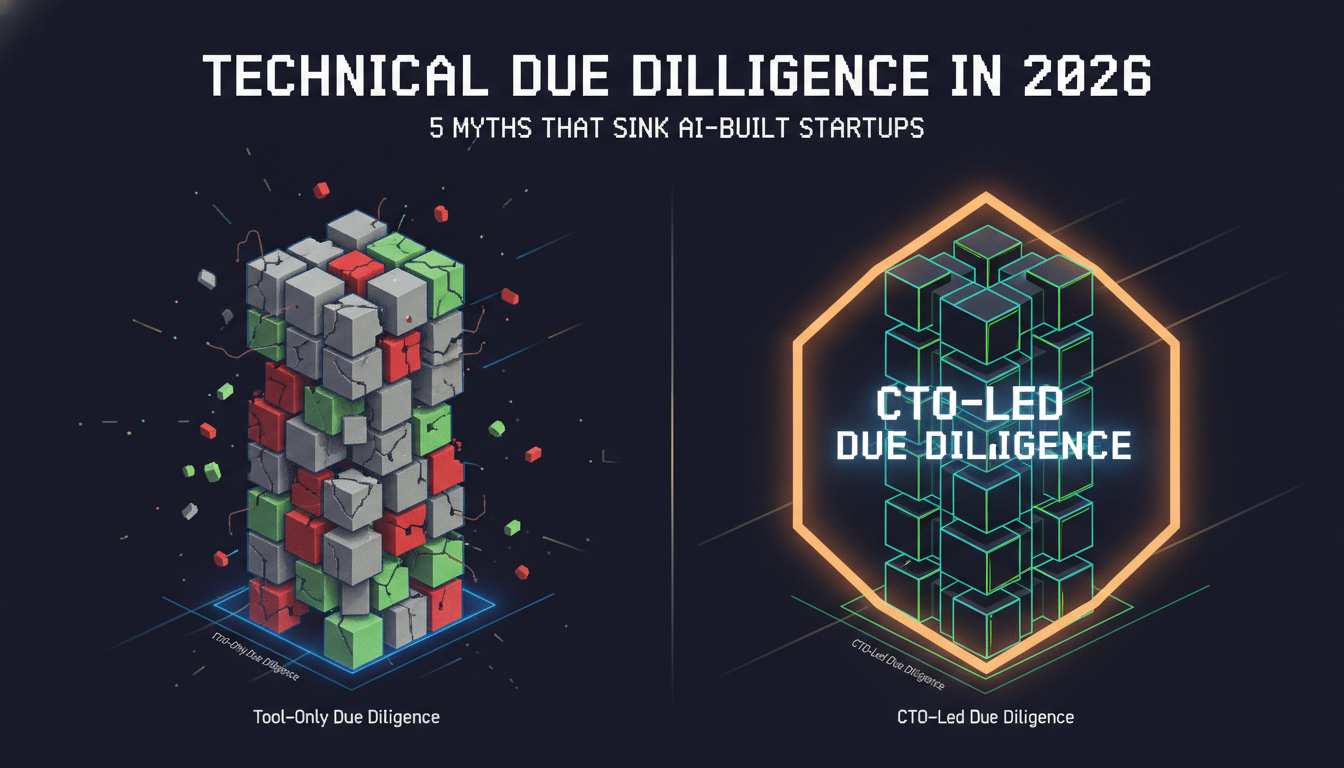
Tool-only or generalist DD vs CTO-led DD
This is where the difference between a checkbox and a real review shows up. Here's the honest comparison.
| Aspect | Tool-only / generalist DD | CTO-led DD (Metamindz) |
|---|---|---|
| Who runs it | A scanner, or a consultant who reads dashboards but hasn't shipped production code | A working CTO who reads the actual code and has built systems at this stage |
| AI-generated code | Treated as normal code; provenance and AI-specific failure modes ignored | Flagged, traced, and pressure-tested for the failures AI actually introduces |
| What gets checked | Code smells, dependency counts, surface metrics | Architecture fit, data model, auth, scalability, security, team, IP chain |
| Depth of finding | "High complexity in module X" | Screenshots of the exact lines that break, and what to do about them |
| Output | A 40-page auto-generated PDF nobody reads | A prioritised report with concrete next steps and effort estimates |
| Honesty | Incentivised to find work / upsell remediation | Will tell you when the codebase is fine and you don't need us |
| After the report | You're on your own to interpret it | Hand-holding through the fixes, or a clean handover to your team |
That last row matters. A genuinely useful tech DD report includes screenshots of specific lines of code that need fixing, not vague gestures at "elevated risk." If you can't act on it, it wasn't due diligence, it was a receipt.
What to actually do before a reviewer opens the hood
If you've built fast with AI and you're heading into a raise, this is the short version of what I tell founders:
1. Get someone technical and independent to read the code before the investor's reviewer does. Surprises in your favour are rare; find your own problems first. 2. Document the architecture and the data model in plain language, the decisions, not just the diagrams. 3. Nail down IP and licensing, including which AI tools generated what, and confirm you own the output. 4. Map your dependencies and your key-person risk. If one contractor understands the whole system, that's a finding. 5. Fix the auth and authorisation logic specifically, because that's where AI-generated code fails most and where breaches actually happen.
None of this needs a full-time hire. A few days of focused review from an experienced engineer changes the entire shape of your DD. That's most of what a fractional CTO is for at this stage, and it's a lot cheaper than a 20% valuation cut.
The honest take
AI-built startups aren't the problem. Building fast is a genuine edge, and the founders shipping in two weeks instead of five months deserve the lead they've earned. The problem is treating "it works in the demo" as if it means "it'll survive scrutiny." Those are different claims, and tech DD is the one place where the difference costs you real money.
Find your problems before the investor does. Build with AI, but build with someone who reads the code. Do that, and the scan beam holds no fear, you've already seen what's underneath.
If you're raising or selling in the next few months and you want an honest read on whether your AI-built codebase will pass, that's exactly the kind of thing we do via CTO-led technical due diligence. And if it's solid, we'll tell you that too. Book a no-obligation call and let's look under the hood together.
Frequently Asked Questions
What is technical due diligence?
Technical due diligence is an independent assessment of a company's software, architecture, security, engineering team and intellectual property, usually carried out before an investment, acquisition or fundraise. It tells investors whether the technology can scale, is secure, is legally clean, and matches the claims the founders are making.
Can AI-generated code pass technical due diligence?
Yes, if it has been properly reviewed and structured. AI-generated code fails due diligence when it ships without human oversight, because it tends to introduce duplication, weak authorisation logic and unclear IP provenance. Around 43% of AI code changes need debugging in production, so reviewers scrutinise it closely. Clean it up first.
How much can technical issues reduce a startup's valuation?
Technical problems found during due diligence can cut a startup's valuation by up to 20%, and close to 60% of deals fall through over issues surfaced in the technical review. High technical debt also forces expensive post-deal remediation, which lowers the true value of the deal even when it closes.
How long does technical due diligence take?
It varies with scope, but most middle-market deals allow only 30-45 days when proper depth needs 60-90. For a seed or Series A startup, a focused CTO-led review typically runs one to three weeks. Rushed, tool-only reviews are where the deal-killing problems get missed.
Should I prepare for tech DD before raising?
Absolutely. The cheapest time to fix a codebase is before an investor's reviewer sees it. A few days of independent technical review to document architecture, tidy authorisation logic and confirm IP ownership can prevent a valuation cut or a collapsed round. Find your own problems first.