
Developer Onboarding in 2026: You Have 49 Days, Not 91
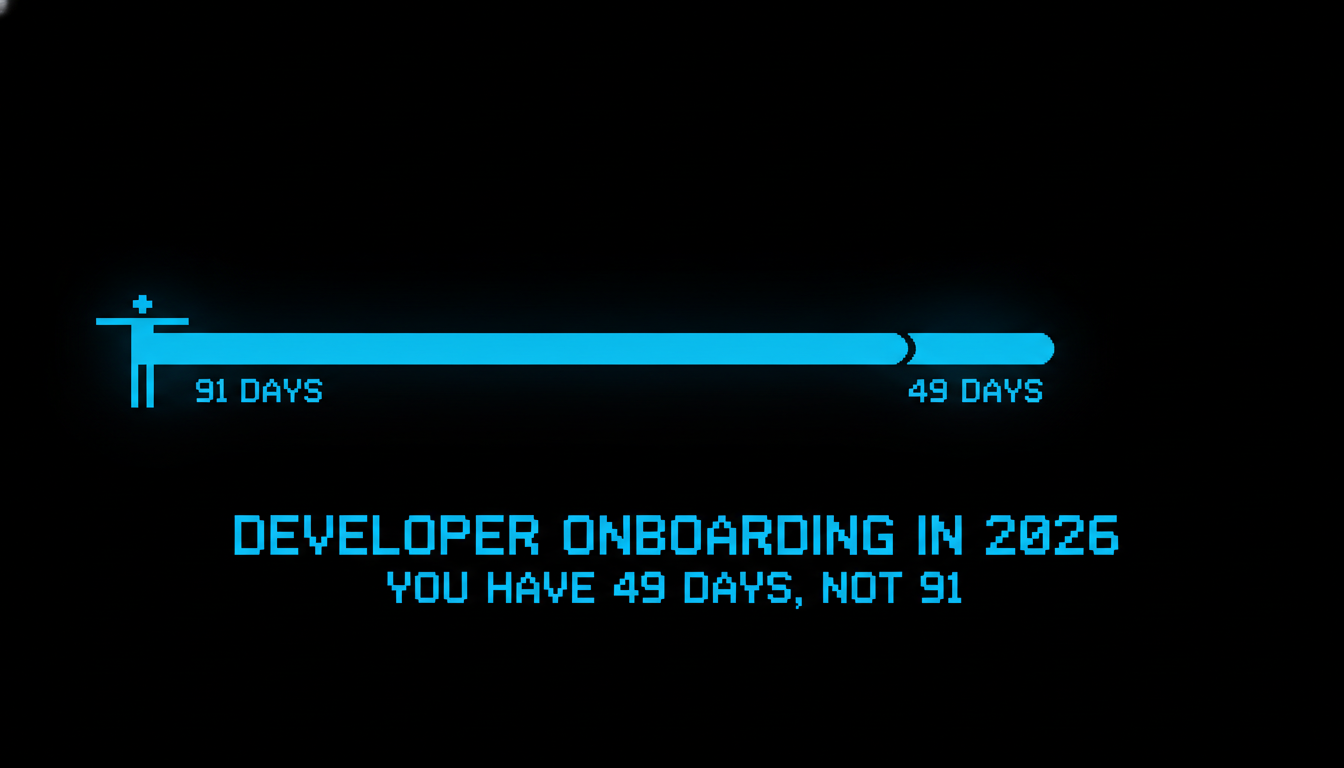
Developer onboarding is the process of taking a new engineer from first-day access to independent, trusted contribution in your codebase. In 2026 it runs about twice as fast as it used to. Engineers using AI daily reach their 10th pull request in 49 days, against 91 days for engineers who don't use it at all.
So, look. That 49-day number is the single most useful piece of engineering management data I've read this year, and almost everyone I've shown it to has drawn the wrong conclusion from it.
They see "onboarding is twice as fast" and hear "we can hire more people, quicker". What it actually means is that the window in which you shape an engineer's habits has halved, and most companies haven't changed a single thing about what they put into that window.
What developer onboarding actually covers
Most onboarding checklists split into three parts, and that part hasn't changed:
- Base setup - laptop, SSO, email, calendar, chat, password manager.
- Dev setup - IDE, terminal, Docker, SDKs, database access, CI permissions.
- Functional onboarding - architecture, domain, team standards, review process, the path to a first meaningful change.
The first two are a solved problem. If a new engineer can't run your stack locally by lunchtime on day one, that's a platform failure and you should fix it with tooling, not with a buddy system. I wrote a practical sequence for this in 10 steps for onboarding developers in startups, and the mechanics there still hold.
The third one is where all the money is, and it's the one AI has quietly rearranged.
Where the 49-day number comes from
DX analysed onboarding data across six multinational enterprises, measuring time to a new hire's 10th pull request, which is a reasonable proxy for "actually productive rather than just committing". The results:
| AI tool usage | Days to 10th PR | Still under 10 PRs at 3 months |
|---|---|---|
| Daily | 49 | Under 20% |
| Weekly | 73.5 | - |
| Monthly | 84 | - |
| None | 91 | About 50% |
Two details in there matter more than the headline. First, the gap keeps going after onboarding ends: daily AI users continued shipping 1.3 changes a week against 0.65 for non-users. Second, in a separate DX study of more than 20,000 developers, new hires using AI daily out-shipped more tenured engineers who used it less often, by up to 55%.
Read that again. Your new starter can now outpace your third-year engineer inside two months. That is a genuinely new problem, and "give them a buddy and a Notion page" is not a response to it.
Why faster isn't automatically better
Buried in the same DX write-up is a finding from Microsoft researcher Brian Houck that I think is the most important sentence in the whole piece. By a developer's 10th PR, he can predict with better than 50% accuracy "what their code output patterns will look like 2 years in the future".
Ten PRs. That's the whole window. Whatever habits an engineer forms getting to their 10th pull request tends to be the engineer you have two years later.
Before AI, that window was 91 days. Ninety-one days of code review, architecture conversations, someone senior saying "no, we don't do it that way here, and here's why". Plenty of time for the culture to soak in.
Now it's 49 days. Same number of habit-forming PRs, roughly half the calendar time, and a tool sitting in the middle that will confidently produce code that matches the average of GitHub rather than the standards of your team.

Nobody is measuring this. Companies track time to first commit, celebrate that it dropped from three weeks to four days, and never ask what got skipped.
What new engineers now skip
The thing an engineer used to get from a slow ramp-up wasn't the code. It was the map. Which services talk to which, where the load-bearing hacks are, which module everyone is scared of, why that queue exists.
You used to acquire that map by being forced to read the code, because there was no other way to get anything done. AI removed the forcing function. An agent can answer "where is billing handled" in four seconds, produce a working change, and the engineer never builds the model in their own head.
That's fine until something breaks at 2am and the agent's context window doesn't contain the reason your retry logic is deliberately non-idempotent.
The developers themselves are clear-eyed about the quality problem, even as they lean on it. In the 2025 Stack Overflow Developer Survey, trust in AI accuracy fell to 29% from 40% the year before, 46% actively distrust the output, and the single biggest frustration, at 66%, is AI solutions that are almost right but not quite.
"Almost right but not quite" is a rough thing to hand a person who has been at the company for three weeks and has no basis for spotting the difference. A senior engineer smells it. A new starter ships it.
How to run developer onboarding when AI is doing the typing
Five things I now put into every onboarding plan I set up for a client. None of them are about slowing anyone down.
1. Make the first task a read, not a write. Day two, before any feature work: have them trace one complete user journey through the system and write up what they found, in their own words, in a shared doc. Payment flow, signup, whatever your riskiest path is. Half a day. You get a genuine comprehension check and a free audit of your documentation from the only person who can see the gaps.
2. Ban AI from the first two PRs, then require it. The first two changes get written by hand, deliberately small, deliberately reviewed hard. After that, use every tool available. The point isn't purity, it's calibration - they need to know what your codebase feels like under their own fingers before they start supervising a machine that writes it for them.
3. Review for understanding, not correctness. The reviewer's job changes when the code arrives pre-polished. Stop asking "is this right" and start asking "why did you do it this way", "what happens if this is called twice", "what did you consider and reject". If they can't answer, the PR doesn't merge. Cheap to run, and it's the only reliable test of whether the human learnt anything.
4. Write the CLAUDE.md, AGENTS.md or cursor rules before the hire starts. Your conventions, your architecture decisions, the things you don't do. If the agent doesn't know your standards, it will apply the internet's. This file is now part of onboarding infrastructure, sitting alongside your README, and it's the highest-leverage document in the repo.
5. Keep measuring at 90 days, not 49. Speed to 10th PR tells you they can operate the tools. What you want to know is whether they can debug something they didn't write, review someone else's work usefully, and push back on a bad ticket. Those show up in month three or not at all.

The cost of getting this wrong isn't abstract. Replacing a technical hire runs to roughly 80% of their annual salary once you count recruiter fees, interview time and the productivity hole. And people leave early: BambooHR found 44% of new hires regret the decision within a week, with early-departure rates generally landing somewhere in the 22-33% range depending on whose survey you read.
An engineer who ships fast for two months and then quietly discovers they don't understand anything they've built is a retention risk, not a win.
Typical onboarding vs CTO-led onboarding
| Aspect | Typical approach | CTO-led approach (Metamindz) |
|---|---|---|
| Success metric | Time to first commit | Time to independent debugging, measured at 90 days |
| First task | A small ticket, any ticket | Trace a critical path and write up what they found |
| AI tooling | Handed over on day one, unconfigured | Repo conventions written before the hire starts, introduced from PR three |
| Code review | Checks correctness | Checks reasoning, by someone who's shipped that stack |
| Who runs it | HR checklist plus a nominated buddy | A working CTO who reads the PRs personally |
| Screening link | Onboarding starts after the offer | The assessment that hired them tells us what to onboard |
| Honesty | Bill the placement, move on | We'll tell you if the gap is your codebase, not your hire |
That last row is the one that costs us money and I'd still keep it. A good half of the "our new engineers take forever to get productive" conversations I have turn out to be an onboarding problem in name only. The real issue is a codebase nobody can reason about, usually with a large layer of unreviewed AI-generated code in it. No onboarding process fixes that. Fixing the codebase does.
We come at this from both ends. CTO-led recruitment means the person who grilled a candidate on architecture hands over notes on exactly where they'll need support, so onboarding starts with real information instead of a CV. And through CTO-as-a-Service we'll sit in the first few weeks of PRs ourselves, which is generally where you find out whether the process works. If the wider issue is that your team adopted AI tools with no structure at all, that's a separate conversation and usually the more urgent one.
How long should developer onboarding take?
Rough targets I'd hold a team to in 2026:
- Day 1: environment running locally, first change deployed to a dev environment. If this takes a week, fix your tooling.
- Day 2-3: one critical path traced and written up.
- Week 1: first hand-written PR merged, small and heavily reviewed.
- Week 4: shipping features with AI assistance, reviewed for reasoning.
- Week 8: reviewing other people's PRs and catching real problems.
- Week 12: can debug production code they didn't write. This is the actual finish line.
Week 12 is the one to defend. Everything before it is now easy to hit and tells you much less than it used to.
Frequently Asked Questions
What is developer onboarding?
Developer onboarding is the process of taking a new engineer from first-day access to independent contribution in your codebase. It covers three layers: base setup like accounts and hardware, dev environment setup, and functional onboarding into your architecture, domain and standards. The third layer is the one that determines whether the hire works out.
How long does developer onboarding take?
Time to a 10th pull request now averages 49 days for engineers using AI daily and 91 days for those who don't, per DX data across six enterprises. Practical first commits happen in days. Full independence, meaning they can debug code they didn't write, still realistically takes about 12 weeks.
Does AI actually speed up developer onboarding?
Yes, measurably. Daily AI users hit their 10th PR in 49 days against 91 for non-users, and keep shipping at roughly twice the rate afterwards. The caveat is that faster ramp-up shortens the window in which your team's standards and habits get established, so the onboarding content has to work harder.
What should a developer onboarding checklist include in 2026?
Same three layers as always, plus two additions: a repo conventions file for AI agents such as CLAUDE.md, AGENTS.md or cursor rules written before the hire starts, and a comprehension task in the first week where the engineer traces a critical path and writes up what they found in their own words.
Why do new engineers leave in the first 90 days?
Usually unclear expectations and a sense they aren't contributing meaningfully. BambooHR found 44% of new hires regret the decision within a week. Ironically, AI can mask this: an engineer ships plenty early on, never builds real understanding, and disengages around month three when the work needs judgement.
The 49 days are the point
Everyone I talk to has read the "AI halves onboarding time" headline and filed it as good news. It is good news. It's also the clearest deadline engineering leaders have ever been handed, and it's the one nobody is treating as one.
You get ten pull requests to shape an engineer who'll be with you for years. You now get them in seven weeks instead of thirteen. Same job, half the time, and a very confident machine in the room making suggestions.
Spend those 49 days deliberately. If you want a second pair of eyes on how yours are being spent, book a call - no obligation, and if your onboarding is already fine I'll say so.