
Technical Assessment Tools 2026: What Each One Is For
What are technical assessment tools?
Technical assessment tools are platforms that test a developer's skills before you hire them. They fall into four types: auto-scored screening tests (HackerRank, Codility, CodeSignal), live pair-programming pads (CoderPad), general skills-test libraries (TestGorilla) and done-for-you interview services (Karat). Under about 20 engineering hires a year, most startups need one live pad and a structured interview, not an enterprise suite.
So.. I get asked "which technical assessment tool should we buy?" a lot. Usually by a founder who has just had a bad hire, or a Head of Talent whose CTO has stopped answering Slack.
My answer is almost always a question back: what are you trying to find out, and at which stage? Every tool on the market is good at one job. The money gets wasted when a company buys a screening platform to do an interviewer's job, or the other way round.
I've run technical hiring for over 15 years - as a fractional CTO, building teams from zero, and now through CTO-led recruitment at Metamindz. So this is the guide I wish someone had handed me: what each of the main tools is for, what it costs per candidate at today's list prices, and where each one falls down. Prices below were read from each vendor's own pricing page on 19 October 2026, in US dollars, before VAT. None of them list GBP prices.
The four types of technical assessment software
Before comparing brands, get the categories straight. Most bad tool purchases are a category mistake.
- Auto-scored screening tests. The candidate gets a link, solves timed problems alone, and the platform scores it. Good for filtering volume. Bad at telling you how someone thinks. HackerRank, Codility, CodeSignal and Coderbyte live here.
- Live pair-programming pads. A shared editor with a real runtime where you and the candidate code together on a call. Good for seeing reasoning, debugging and communication. Useless without a competent interviewer on your side. CoderPad is the reference product; HackerRank and Codility both have an "Interview" module too.
- Take-home and project-based assessments. A realistic task done in the candidate's own environment, reviewed afterwards. Closest to the actual job, highest drop-off if you make it too long.
- Interview-as-a-service. You outsource the first technical interview to the vendor's interviewers. Karat is the best known. Good for consistency at scale, expensive, and the interviewer doesn't know your codebase.
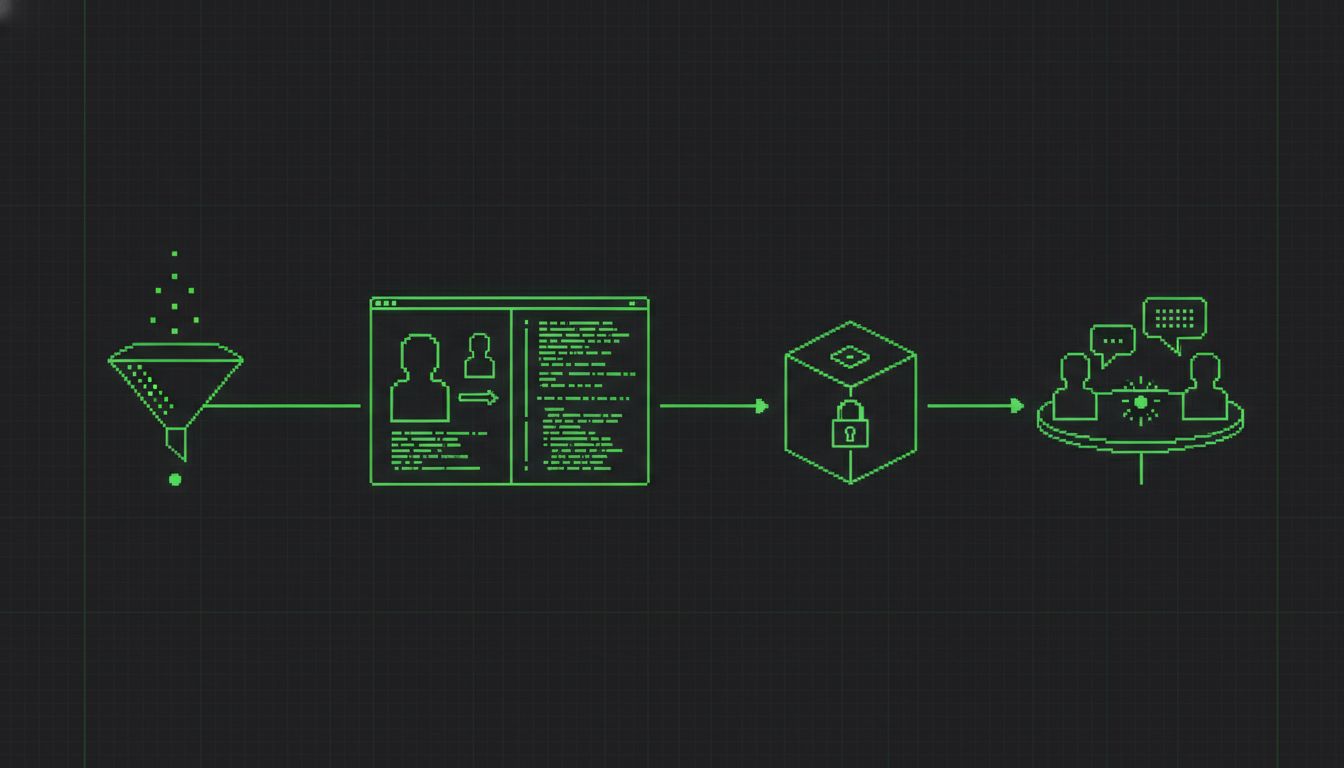
One pipeline can use all four. A company hiring 200 engineers a year might run Codility as the filter, CoderPad for the live round, and a take-home for seniors. A seed-stage startup hiring three engineers this year needs maybe one of them.
The best technical assessment tools in 2026, tool by tool
HackerRank
The default. Huge question library, recognisable to candidates, and it now ships an AI interviewer (they call it Chakra) plus an "agentic IDE" on every plan. Starter is $79/month billed annually ($948/year) for 60 candidate attempts a year, unlimited users and pair-programming interviews. Pro is $419/month billed annually ($5,028/year) for 360 attempts, and adds ATS and calendar integrations. Extra attempts are $20 each (HackerRank pricing).
Where it falls down: the library is famous, which means the questions are famous. Candidates practise on the same platform. If you use stock questions, you are partly measuring who has ground through HackerRank prep.
Codility
The more "engineering simulation" flavour of screening, with task leakage protection (leaked tasks are pulled from the library) and an AI copilot whose activity you can review per assessment. The entry plan is listed at $1,200 with up to 120 invite credits a year and one platform user. The next tier is $6,000 for up to 300 credits and three users, and lets you build custom tasks from your own codebase via MCP. The desktop app that detects "undetectable" cheating tools and the in-house occupational psychologists are enterprise-only (Codility pricing).
Where it falls down: the genuinely interesting bits are on the enterprise tier. On the self-serve plans you get a decent screen, which is what everyone else sells too.
CodeSignal
Strong on standardised, benchmarked scoring, which is why larger US tech companies like it. CodeSignal doesn't publish prices; it's quote-based, and buyers report it's priced on assessment volume (Vendr). If you need to compare thousands of candidates on one scale, it's built for that.
Where it falls down: for a 30-person startup, standardised scoring at volume solves a problem you don't have, and you'll be in a sales cycle before you see a number.
CoderPad
The best live pad, full stop. It now runs Claude Code and Codex inside the pad on its Frontier tiers, so you can watch a candidate work with an agent the way they would on the job. Starter is $80/month billed annually for 60 interviews a year; Team is $400/month billed annually for 360 a year; Frontier Lite, which unlocks the agentic interviews, is $1,000/month on annual billing only. Extra tests or interviews are $30 each (CoderPad pricing).
Where it falls down: a pad is only as good as the person on the other side of it. Give it to an interviewer who can't read the candidate's code and you've bought a very nice text editor.
TestGorilla
A general skills-testing library (350+ tests on the paid plans) that covers coding but also cognitive, personality and role-specific tests. There's a free plan with 10 credits a month; Core is from $215/month billed annually; Plus, from $520/month, adds custom coding challenges, job simulations and ID verification (TestGorilla pricing).
Where it falls down: it's built for recruiters hiring across many roles. For senior engineers, a generic coding test tells you very little you couldn't get from a 30-minute call with someone technical.
Coderbyte
The budget option with an unusual model: the Pro plan is $1,999/year for unlimited candidates and admins (Coderbyte pricing). If you're running high volumes of junior screening on a tight budget, the unit economics are hard to beat.
Where it falls down: smaller library and less polish than HackerRank or Codility. Fine for filtering, not for deciding.
Karat
Interview-as-a-service: Karat's engineers run your first technical interview to a structured rubric. Quote-based pricing. I've covered Karat, HackerRank and CodeSignal head to head, including what each catches on AI cheating, in a separate comparison, so I won't repeat it here.
Technical assessment tools compared: price per candidate
Here's what the list prices work out to per candidate. I've divided the annual price by the included attempts, so this is the best case where you use every credit. Unused credits generally don't roll over, so your real cost per candidate is higher.
| Tool | Type | Entry plan (list, annual) | Included per year | Approx. cost per candidate | Best for |
|---|---|---|---|---|---|
| HackerRank Starter | Screen + live interview | $948 | 60 attempts | $15.80 (then $20) | Small teams wanting one familiar platform |
| HackerRank Pro | Screen + live interview | $5,028 | 360 attempts | $13.97 (then $20) | Steady hiring with an ATS |
| Codility (entry) | Screen + live interview | $1,200 | Up to 120 invites | $10.00 | Cheap structured screening, one user |
| Codility (growth) | Screen + live interview | $6,000 | Up to 300 invites | $20.00 | Custom tasks built from your own code |
| CoderPad Starter | Live pad | $960 | 60 interviews | $16.00 (then $30) | Live coding rounds at low volume |
| CoderPad Team | Live pad + take-homes | $4,800 | 360 interviews | $13.33 (then $30) | Live rounds at volume |
| TestGorilla Core | Skills-test library | From $2,580 | Shared credit pool | Depends on package | Non-technical roles plus basic coding |
| Coderbyte Pro | Screen | $1,999 | Unlimited | Falls with volume | High-volume junior screening |
| CodeSignal, Karat | Screen / interview service | Quote only | Negotiated | Not published | Large, standardised hiring programmes |
Look at the numbers for a second. At list price, a technical screen costs $10 to $20 per candidate. A bad engineering hire costs far more than that in salary alone, before you count the damage to the codebase. The tool is never the expensive part. The expensive part is a process that lets the wrong person through.
What actually predicts whether a developer will be good
This is the bit vendors leave out of their comparison posts.
In 2022, Paul Sackett and colleagues re-ran the big meta-analyses on how well different selection methods predict job performance, correcting a statistical over-correction that had inflated the old numbers for decades. The revised ranking, as summarised by SIOP: structured interviews came out top with a validity of .42, followed by job knowledge tests (.40), empirically keyed biodata (.38) and work sample tests (.33). General cognitive ability, long treated as the king of predictors, came in at .31.
Two things fall out of that for anyone choosing technical assessment software:
- The highest-signal method is a structured interview. Same questions, same rubric, scored by someone who knows what a good answer looks like. Software can host it. It can't run it.
- Work samples beat puzzles. A task that looks like the job (fix this bug in a small real codebase, design this endpoint, review this pull request) is a work sample. A timed algorithm puzzle is closer to a cognitive test with extra steps.
So if your process is "HackerRank score above 80%, then a culture chat with the founder", you've built it around the weakest signals and skipped the strongest one.
The AI problem every technical assessment tool now has
Here are the numbers that changed my view of async screening. Fabric, which sells an AI interviewing platform, analysed 19,368 AI-run interviews on its own platform between July 2025 and January 2026 (Fabric). 38.5% of candidates were flagged for cheating behaviour. In technical roles it was 48%, against 12% in sales. And using a score of 7.0 as the pass mark, 61.1% of the flagged cheaters would have passed. Dedicated tools like Cluely and Interview Coder made up 45% of cases and LLM voice mode another 34%. It's a vendor's own data from its own platform, so treat the exact figures with care.
Meanwhile, 84% of developers are using or planning to use AI tools in their work, and 51% of professional developers use them daily (Stack Overflow 2025 Developer Survey).
Put those together and banning AI in assessments looks increasingly odd. You're testing people on a way of working that half of them abandoned, and the ones willing to break the rule score best. The vendors have clearly reached the same conclusion: HackerRank ships an agentic IDE on Starter, CoderPad runs Claude Code and Codex inside the pad, and Codility lists Claude Code CLI on enterprise.
My view: let candidates use AI, tell them so in writing, and assess what AI can't do for them. Can they explain the code the agent wrote? Spot the bug it introduced? Say why they'd reject its first suggestion? That's the job now. Our AI adoption work with engineering teams is built on the same principle.

Which technical assessment software do you need at your stage?
This is the part I'd actually use. Volume decides most of it.
| Engineering hires per year | What I'd use | Rough annual tool spend (list) | What not to do |
|---|---|---|---|
| 1 to 5 | No screening platform. A short realistic task, then a structured live session (CoderPad Starter or even a shared repo and a call) | $0 to $960 | Sign an annual contract for 360 attempts you'll never use |
| 5 to 25 | One live pad plus one realistic take-home, scored against a written rubric | About $960 to $4,800 | Let a platform score decide who gets rejected without a human reading the code |
| 25 to 100 | An auto-scored screen for volume (Codility, HackerRank Pro) plus a live round, with ATS integration | About $5,000 to $12,000+ | Use stock library questions that candidates have already practised |
| 100+ | Enterprise screening with custom tasks, proctoring and fairness analysis, or interview-as-a-service | Quote-based | Assume the vendor's interviewers understand your architecture |
If you're at the top of that table, the honest answer is that you don't need software. You need someone technical on your side who can run a good one-hour session. If you don't have that person yet, a fractional CTO fills that gap faster than any platform.
The typical approach vs a CTO-led technical assessment
Most hiring disasters I've seen didn't come from the wrong tool. They came from who was running it.
| Aspect | Typical approach | CTO-led approach (Metamindz) |
|---|---|---|
| Who designs the test | Recruiter picks a stock test from the library | A CTO writes a task based on your real stack and the actual role |
| Who reads the result | The platform's pass/fail score | A senior engineer reads the code and the reasoning |
| AI in the assessment | Banned, then quietly used by half the candidates | Allowed and declared; we assess judgement over the AI's output |
| Live round | A "culture chat" or an algorithm puzzle | 1.5 to 2 hours of live coding plus architecture questions on how things work behind the scenes |
| Interview fraud | Left to the platform's proctoring | Camera on, follow-up questions on their own code, identity checks; see our guide to deepfake interviews |
| Tool spend | Annual enterprise contract, credits expire unused | Whatever the volume justifies, often just a pad and a rubric |
| What you see | A pile of scores | A shortlist of people who have passed a real technical interview |
The tools are fine. HackerRank, Codility and CoderPad are all decent products. What none of them can do is know what "good" looks like for your codebase, your stage and your team.
How I'd set up a technical assessment process in a week
- Day 1: write down what the role actually does. Three to five real tasks from the last month. "Built a Stripe webhook handler", not "strong backend skills".
- Day 2: turn one of those into a take-home. Cap it at two hours, say so in the brief, and include a small existing codebase rather than a blank folder. Our free take-home task generator will draft the task, a marking rubric and follow-up questions from your job description.
- Day 3: write the rubric before anyone submits. Four or five criteria, each scored 1 to 4, with an example of what a 4 looks like. This is what turns an interview from a vibe into a structured interview, which is the .42 predictor above.
- Day 4: design the live round around their own submission. "Walk me through why you did this", "now extend it to handle X", "the agent suggested Y, would you accept it?" Anyone who outsourced the take-home falls over here in about ten minutes.
- Day 5: pick a tool only if volume demands it. If you're interviewing more than about five people a month, a CoderPad or HackerRank seat starts paying for itself in scheduling and recording alone. Below that, a shared repo and a video call work fine.
That's it. Most companies can run this without buying anything. The older guide to the eight technical assessment methods goes deeper on the methods themselves if you want the detail.
Frequently asked questions
What is technical assessment software?
Technical assessment software is a platform for testing developer skills during hiring. It covers auto-scored coding tests (HackerRank, Codility, CodeSignal), live collaborative coding pads (CoderPad), skills-test libraries (TestGorilla) and outsourced interview services (Karat). Most add proctoring, plagiarism detection, ATS integration and, in 2026, AI-assisted or agentic coding environments for candidates.
Which assessment tools are best for real-world technical tasks?
For real-world tasks, use a take-home or project-based assessment in a small existing codebase, followed by a live session on the candidate's own submission. CoderPad's take-homes, Codility's custom tasks built from your codebase and HackerRank's projects all support this. A realistic work sample predicts performance better than timed algorithm puzzles do.
How much do technical assessment tools cost in 2026?
At list price on 19 October 2026: HackerRank from $948 a year for 60 attempts, CoderPad from $80 a month billed annually for 60 interviews, Codility from $1,200 for up to 120 invites, TestGorilla Core from $215 a month billed annually, and Coderbyte Pro $1,999 a year for unlimited candidates. CodeSignal and Karat are quote-only.
Should candidates be allowed to use AI in a technical assessment?
In most cases, yes. 84% of developers use or plan to use AI tools, and banned-AI screens mostly reward candidates willing to break the rule. Allow it openly, then assess what AI can't do for them: explaining the generated code, catching its mistakes and justifying design decisions in a live follow-up.
Does a startup need a technical assessment platform?
Usually not before about five engineering hires a year. A realistic two-hour take-home, a written rubric and a structured live session run by someone technical will outperform an off-the-shelf screening test. If nobody on the team can run that session, the gap is technical leadership, and a fractional CTO or CTO-led recruiter fills it faster than software.
So, back to the question: which tool should you buy? Whichever matches your volume, and only after you've decided what good looks like and who's going to judge it. If you'd rather have a CTO design the assessment and run the technical interviews for you, that's exactly what our CTO-led recruitment does. Book a free call and I'll tell you honestly whether you need us, or just a better rubric.