
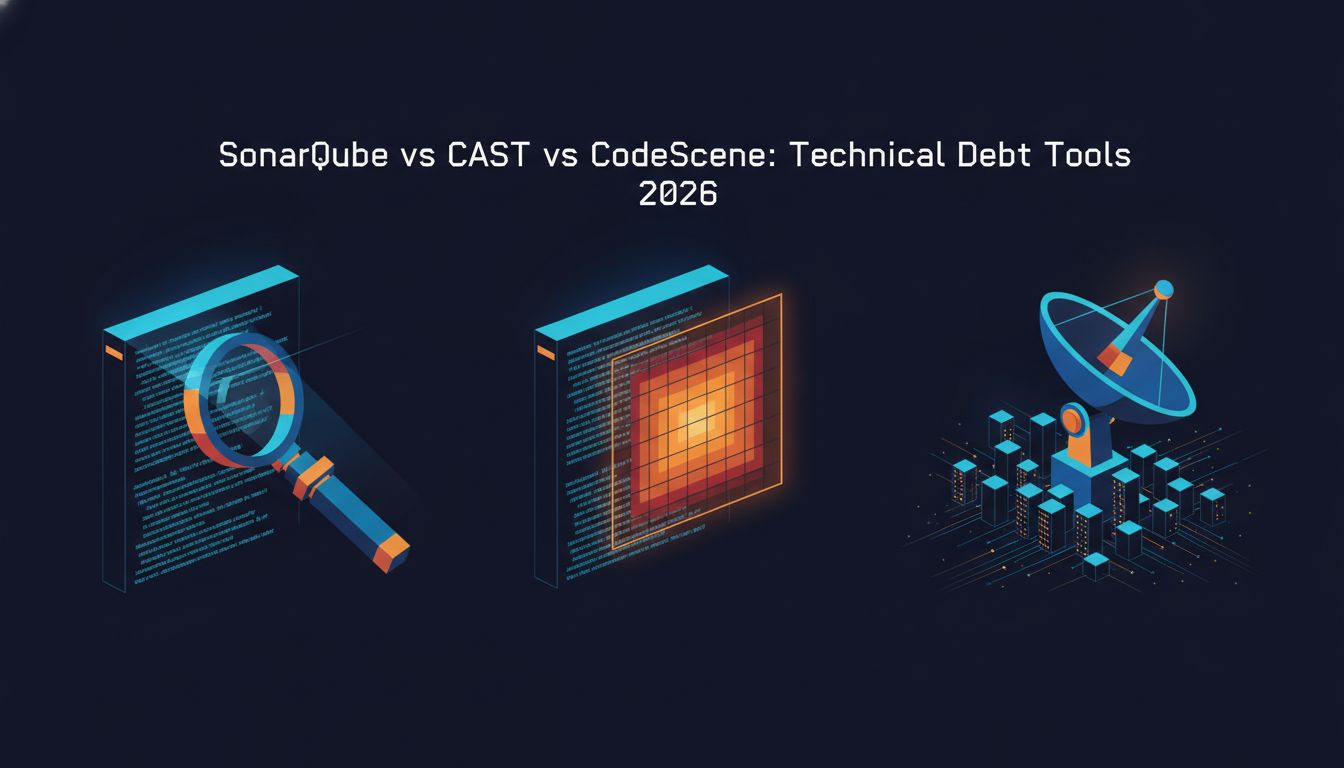
SonarQube vs CAST vs CodeScene: Technical Debt Tools 2026
Sonar vs CAST for technical debt: the short answer
SonarQube and CAST measure technical debt at different levels. SonarQube scans code on every pull request and flags rule violations inside one codebase. CAST Highlight scores a whole portfolio of applications for executives, and CAST Imaging maps architecture. Teams fixing code day to day want Sonar; CIOs ranking dozens of applications want CAST.
So.. this question used to be niche. Then in May 2026 Gartner published its first ever Magic Quadrant for Technical Debt Management Tools, both Sonar and CAST announced they were Leaders, and suddenly every engineering leader I talk to has a procurement question about it.
I look at a lot of codebases. Through technical due diligence for investors, as a fractional CTO, and more and more often on code that an AI wrote and nobody reviewed. The tools below are useful. They also get bought for the wrong job all the time. So this is what each one actually measures, what it costs at list price (read from each vendor's own pricing page on 29 October 2026), and when you need none of them.
The three kinds of technical debt tool
Most "SonarQube vs X" comparisons go wrong in the first paragraph, because they compare tools that answer different questions. There are three levels of technical debt, and each tool is built for one of them:
- Code-level debt. Rule violations, bugs, code smells, duplication, security issues in a file or a pull request. SonarQube, Codacy and JetBrains Qodana live here. They are static analysers with quality gates.
- Behavioural debt. Which bad code actually hurts, based on how often it changes and who changes it. CodeScene combines a code health score with git history to find "hotspots": unhealthy files your team touches every week.
- Architectural and portfolio debt. Tangled dependencies between modules, dead code, and which of your 40 applications is the riskiest. CAST Highlight (portfolio), CAST Imaging (architecture maps) and vFunction (architectural observability for big Java and .NET systems) live here.
This matters more every year. Gartner predicts that by 2027 architectural technical debt will account for 80% of all technical debt (as quoted by Sonar, which has its own reasons to quote it). A linter at level one will never see a problem at level three.
SonarQube vs CAST vs CodeScene vs vFunction vs Codacy vs Qodana
List prices as published on 29 October 2026, before VAT, in the currency each vendor quotes. None of them publish GBP prices.
| Tool | What it measures | How it's priced | List price (29/10/2026) | Best for | Where it falls short |
|---|---|---|---|---|---|
| SonarQube (Cloud and Server) | Code-level rules: bugs, smells, security, coverage, duplication. Quality gates on every PR | Lines of code | Cloud Team from $34/month for up to 100k LOC; free up to 50k LOC; Enterprise and Server on quote (Sonar pricing) | Day-to-day hygiene in CI, any team size | Findings are rule-level; it doesn't rank debt by how much it slows the team down |
| CodeScene | Code health score (1-10) weighted by change frequency, plus knowledge and team-coupling risk | Active authors (committed in the last 3 months) | Standard €18, Pro €27 per active author per month, billed yearly (CodeScene pricing) | Deciding what to refactor first, and making the case to the business | No security scanning listed in its plans; needs months of git history to find hotspots |
| CAST Highlight | Portfolio-level health, resilience, cloud readiness and open-source risk across many applications | Number of applications | $6.8K a year for one named application; Complete Edition $44K a year for up to 25 (CAST pricing) | CIOs and PE/M&A teams ranking a portfolio | Too coarse for a team fixing code this sprint |
| vFunction | Architectural debt in running Java and .NET apps: domains, dependencies, dead code, drift | Per application, sized by the app | Quote only; no free trial; often AWS-funded (vFunction pricing) | Modernising a big monolith (500k+ LOC) | Java and .NET only; overkill for smaller systems, by their own account |
| Codacy | Code-level quality and security (SAST, SCA, secrets), coverage gates | Developers | Team $18 per dev per month billed yearly, $21 monthly, up to 30 devs (Codacy pricing) | Small teams on GitHub, GitLab or Bitbucket cloud who want zero CI setup | No Azure Repos or self-hosted Git support |
| Qodana (JetBrains) | JetBrains IDE inspections run in CI, quality gates, licence audit | Active contributors (last 90 days) | Ultimate $5, Ultimate Plus $15 per contributor per month billed yearly, minimum 3 (JetBrains) | Teams already living in IntelliJ, PyCharm or Rider | Most useful when the team already works in JetBrains IDEs |
How does Sonar compare with CAST for technical debt management?
Think of SonarQube as the smoke alarm in each room and CAST as the building survey.
SonarQube runs on every commit. It catches the null-pointer bug, the hardcoded secret, the copy-pasted 200-line function, and it can block a merge until someone fixes it. Its "technical debt" number is the sum of estimated minutes to fix every rule violation. That number is handy for trends and weak for priorities. CodeScene's founder shows three lines of simple Java declarations scored as 45 minutes of debt, which tells you nothing about whether they matter.
CAST works a level up. Highlight scans a portfolio (and, per CAST, never needs your source code uploaded to the cloud) and tells a CIO which applications are fragile, hard to move to cloud or full of risky open-source. CAST says it covers more than 450 languages, databases and frameworks and applies the ISO 5055 standard. That breadth is why banks and governments buy it. It's also why a 12-person SaaS team doesn't need it.
So the honest answer to "Sonar or CAST?" is usually "both, at different levels of the org", or "Sonar only" if you have one or two products. If you're a PE firm looking at an acquisition target with 30 legacy apps, CAST Highlight's $6.8K single-app licence is a cheap way to get a first scan before people like us go in.
SonarQube vs CodeScene: read the 6x claim carefully
If you've searched this, you've seen CodeScene's headline: its code health metric is "6x more accurate" than SonarQube's maintainability rating, scoring an F-score of 83% against Sonar's 13.3% on a public dataset where 70 human experts rated 500 files from 9 Java projects. Human experts scored 88%.
The dataset is public and anyone can rerun it, which is more than most vendor benchmarks offer. It was also run by CodeScene, written up by its founder, on Java only, in 2024. I read it as a strong signal about maintainability scoring specifically. SonarQube was built as a rule engine and a merge gate, and the benchmark doesn't test that job.
The more useful evidence is older and also comes from CodeScene's founder, so the same caveat applies. In a 2022 study of 39 proprietary codebases (30,737 files), low quality code had 15 times more defects than high quality code, issues in it took 124% longer to resolve, and maximum cycle times were 9 times longer. It's from 2022, so it predates AI coding agents, but I haven't seen a better data set on what bad code costs in delivery time. Sonar's own State of Code survey adds the 2026 angle: 88% of developers report at least one negative impact of AI on their technical debt.
My take: SonarQube to stop new rubbish getting in, CodeScene to decide which old rubbish to fix first. They overlap less than the marketing suggests.
SonarQube vs Codacy for tracking technical debt over time
These two genuinely compete. Both are code-level scanners with PR gates, dashboards and trend lines. The differences that decide it:
- Pricing unit. Sonar charges by lines of code, Codacy by developer. A small team with a big legacy codebase is usually cheaper on Codacy; a big team on a small codebase is usually cheaper on Sonar. Do the maths with your own numbers.
- Setup. Codacy runs as a GitHub, GitLab or Bitbucket cloud app with no pipeline step. SonarQube runs as part of your CI/CD pipeline, Cloud or self-hosted Server.
- Where your code lives. Codacy says it doesn't support Azure Repos or self-hosted Git. If you're an enterprise on Azure DevOps or on-prem GitLab, that's the end of that conversation.
- Trend tracking. Both chart debt over time and both gate pull requests. Neither tells you which of the debt matters, which is the next section's problem.
If you're on JetBrains IDEs end to end, Qodana is the cheap third option at $5 per contributor per month for Ultimate, with the same inspections your developers already see in the IDE.
Sonar vs vFunction: different problems entirely
vFunction doesn't read your source code to start with. It runs an agent next to your Java or .NET application in production, watches what actually calls what, and shows you domains, cross-domain tangles, circular dependencies and dead code. It's built for "we have a 15-year-old WebSphere monolith and need to break it up".
The bit I respect: vFunction's own pricing page says it's for applications past roughly 500,000 lines of code or 1,000 classes, and that "below that, an AI coding tool with the codebase is usually enough". A vendor telling you when not to buy is rare. Listen to it.
What no technical debt tool will tell you
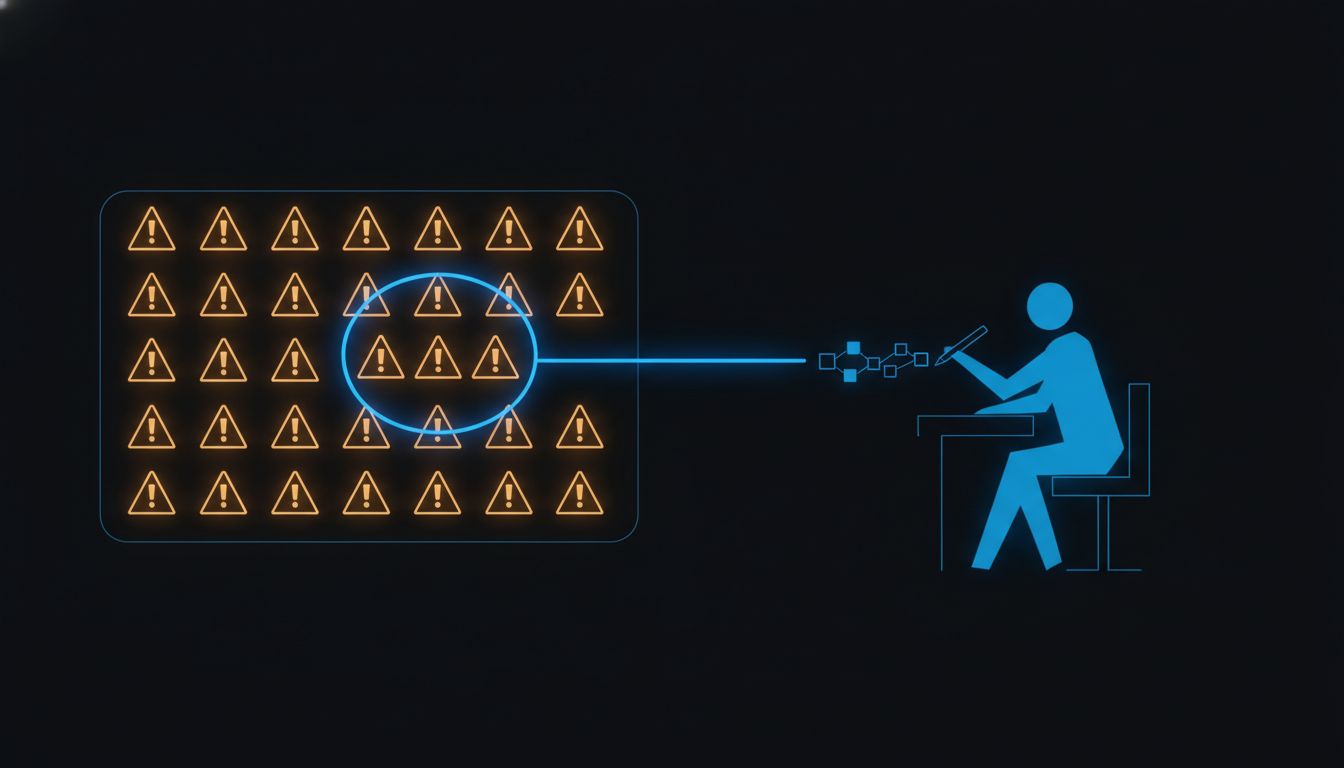
Every tool on this list will hand you a dashboard with thousands of findings. None of them will tell you which 10 matter for the thing you're trying to do next quarter: raise a Series A, pass an acquirer's DD, scale to 10x traffic, or let an AI agent loose on the codebase without it making things worse.
That's a judgement call, and it needs your roadmap as much as your repo. Our free technical debt prioritisation tool, Occam, does a first pass at it (there's a link at the end of this post).
When the stakes are higher, a person has to read the code. This is how a tool-only approach compares with the CTO-led one we run:
| Tool-only approach | CTO-led assessment (how Metamindz does it) | |
|---|---|---|
| Starting point | Scanner output, sorted by severity | Your roadmap, funding stage and the decision the assessment has to support |
| Architecture | Only if you bought a level-three tool | Reviewed by hand: data model, boundaries, the bits AI agents will trip over |
| Prioritisation | Rule severity and estimated minutes | Business impact, change frequency and cost of delay, item by item |
| Team and process | Invisible | Who knows what, how code gets reviewed, how releases happen |
| Output | Dashboard with thousands of findings | A written report with the specific lines of code to fix and the order to fix them in |
| Tool advice | Whatever you already bought | Which of the tools above you need, if any, and set up properly |
Which technical debt tool should you pick?
Short version, by situation:
- Startup, one product, under 20 engineers. SonarQube Cloud's free tier (up to 50k LOC) or the Team plan, plus your IDE's inspections. Spend the rest on someone senior reviewing PRs.
- Scale-up with a legacy core that slows every feature. Keep Sonar as the gate, add CodeScene to find the hotspots. For 15 active authors, Standard is €18 x 15 x 12 = €3,240 a year at list price.
- Enterprise with dozens of applications, or a PE/M&A team. CAST Highlight for the portfolio view, Sonar or Codacy in each team's pipeline.
- A big Java or .NET monolith you need to break up. Talk to vFunction, and to AWS about funding it if you're on AWS.
- A product an AI mostly wrote. Run Sonar first, it's cheap and fast. Then get a human to look at authorisation, data access and architecture, because that's where AI-generated code breaks in ways rule engines don't see. That's what our vibe-code fixes service is for.
- Preparing for investor technical due diligence. A clean SonarQube dashboard helps. It won't answer the questions investors actually ask. Our 30-day pre-raise sprint covers what to fix first.
If you want the broader list of trackers (including Jira-based approaches), the older roundup of seven technical debt tracking tools covers it, and technical debt vs feature development covers the "when do we stop and fix" argument.
Frequently asked questions
Which code quality tool handles tech debt tracking best?
For tracking debt over time inside one codebase, SonarQube is the safest default: pull request gates, trend history and broad language support. CodeScene is better at showing which debt actually slows delivery, because it weights code health by change frequency. Codacy suits small cloud-hosted teams who want no CI setup. Mature teams pair a scanner with prioritisation.
What are the best tools for portfolio-level technical debt reporting?
CAST Highlight is built for it: it scores many applications for resilience, cloud readiness and open-source risk, and is priced by number of applications ($6.8K a year for one, $44K for up to 25 at list price). CodeScene Pro adds a software portfolio overview across projects. SonarQube Enterprise offers portfolio dashboards too, but at code-rule level rather than architecture.
What are the alternatives to Codacy for tracking technical debt?
The closest alternatives are SonarQube (priced by lines of code, supports Azure DevOps and self-hosted setups), and JetBrains Qodana (cheapest per contributor at list price, best for teams already on JetBrains IDEs). If you want prioritisation rather than another scanner, CodeScene is the different-in-kind option, because it combines code health with git history to find hotspots.
Is SonarQube enough for technical due diligence?
No. A SonarQube report is a useful input to technical due diligence, and a clean one signals discipline. It says nothing about architecture, data model, security design, team knowledge risk or whether the system can scale. Investors and acquirers need those answered by someone who reads the code and talks to the team, with the tool output as supporting evidence.
So, back to Sonar vs CAST. They sit at different levels: one guards each pull request, the other ranks a portfolio. Pick the level your problem lives at, buy the cheapest tool that sees it, and get a human to decide what to fix first. If you'd like that human to be a CTO who has done this many times, book a free call and I'll tell you honestly whether you need us or just a properly configured SonarQube.