
Tech Recruitment Survey 2026: 87% of HR Leads Say Most Agency CVs Fail the Technical Interview
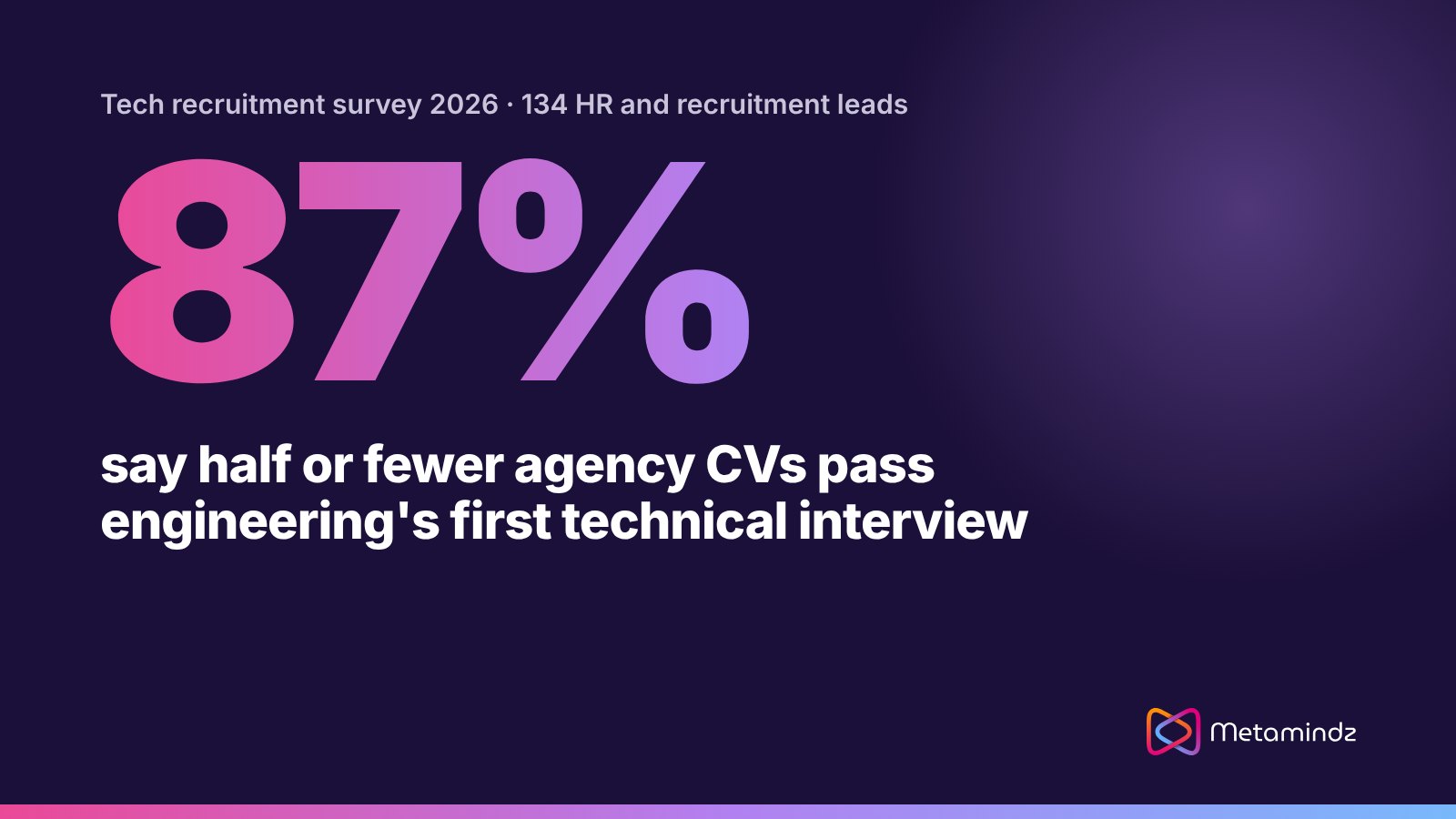
Most CVs that tech recruitment agencies send fail engineering's first technical interview. In our October 2026 survey of 134 HR and recruitment leads, 87% of those who use agencies said half or fewer agency CVs pass, and 32% said fewer than a quarter do. The most common reason, given by 58%, is that the CV looked right but the person couldn't do the job. HR leads want fewer, better CVs to fix it: 65% would accept fewer CVs, and only 7% would pay a higher fee.
I've been on both sides of this for years: as a CTO interviewing candidates agencies sent me, and as the person who now runs a recruitment service. I wanted real numbers instead of anecdotes, so we asked the people who sit in the middle of every technical hire. Below is everything we found, what other UK research says, and what I'd do about it.
The short version
- 87% of HR leads who use agencies say half or fewer agency CVs pass the first technical interview.
- 58% say the main reason is that the CV looked right, but the person failed the interview. Only 25% blame the wrong tech stack.
- 65% would accept fewer CVs to get ones that pass. 7% would pay a higher fee.
- 41% say their biggest frustration is being stuck between leadership (faster, cheaper) and engineering (better candidates).
- Only 10% took the blame alone the last time a technical hire failed. 44% shared it with the hiring manager.
Who we asked
We ran a two-minute, multiple-choice survey on Prolific, a paid research panel, between 5 and 7 October 2026. We didn't say it was from Metamindz. Everyone who took part said they work in HR or recruitment, at companies of 20 to 250+ staff. We kept 134 answers after removing 8 (7 people who changed their answers to get into the survey, and 1 with missing answers).
Their first answer, how they hire technical people, decided which questions they saw next.
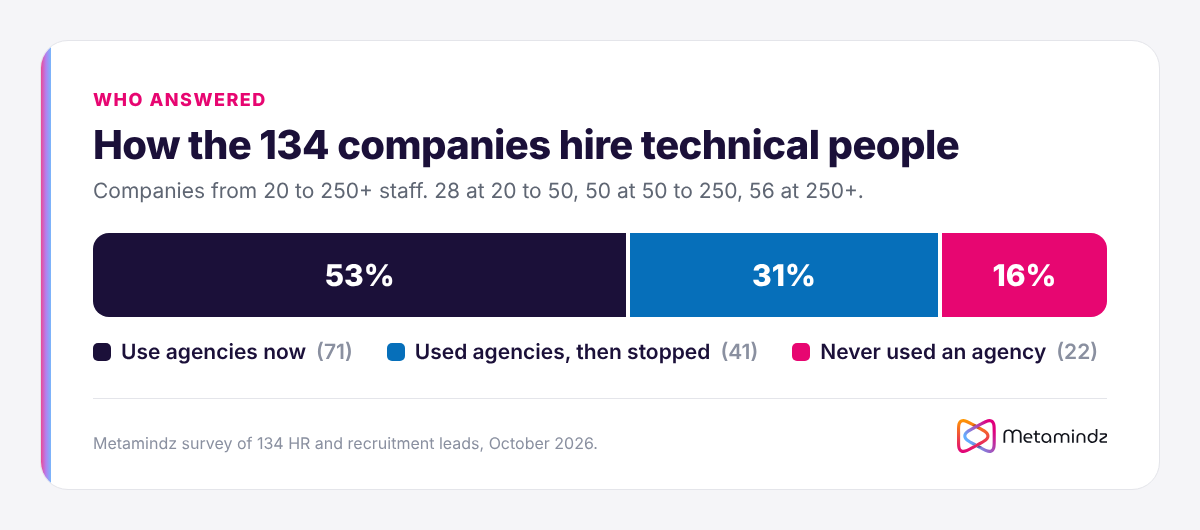
- 71 (53%) use recruitment agencies now.
- 41 (31%) used agencies, then stopped.
- 22 (16%) never used one.
For context, the CIPD's 2026 Resourcing and talent planning report, based on more than 1,000 UK employers, finds 53% hire without any agency1. So our sample leans towards agency users. That's useful for questions about agency CVs, but it means the "never used an agency" group is bigger in the real market than in our numbers. The full method and its limits are at the end.
Finding 1: most agency CVs fail the technical interview
We asked the 71 agency users how many agency CVs pass engineering's first technical interview.
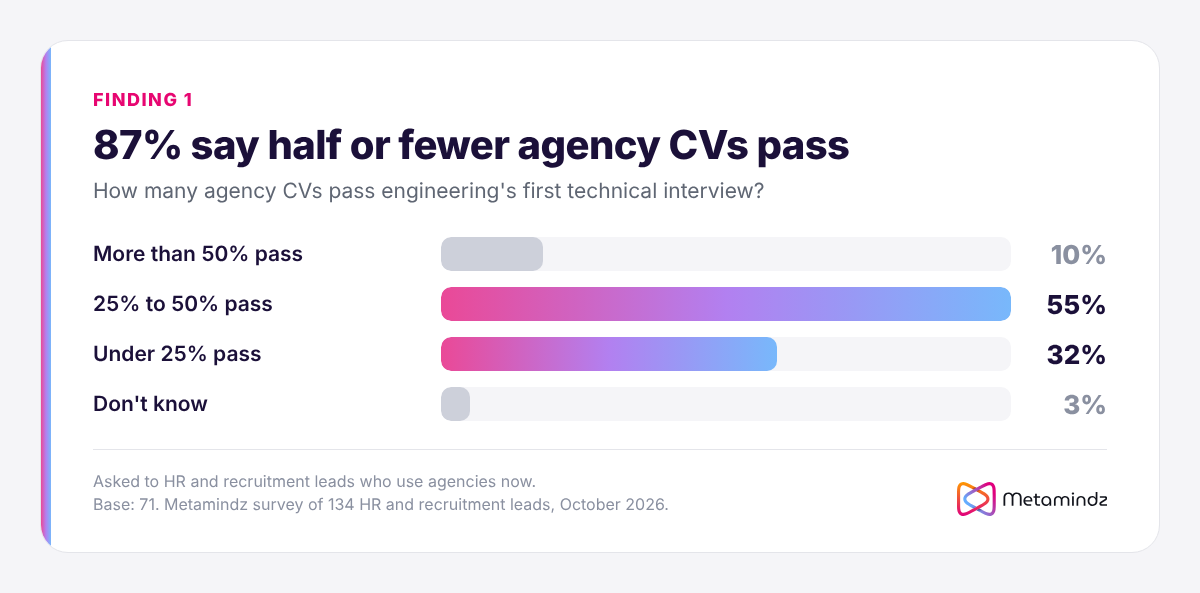
- 10% said more than half pass.
- 55% said 25% to 50% pass.
- 32% said fewer than 25% pass.
- 3% didn't know.
Two things stand out. HR already knows the number: 97% could answer. And the problem held across every company size we looked at, from 20 to 50 staff up to 250+.
If half or more of the CVs on a shortlist fail, every one of those failures is an hour or more of an engineer's time. Ashby's Q1 2026 data puts the average technical hire at 23.3 collective interview hours, against 12.2 for a business hire2. Weak CVs are a big part of why that number is so high.
Finding 2: the CV looks right, the person doesn't
We asked why engineering usually rejects agency candidates.
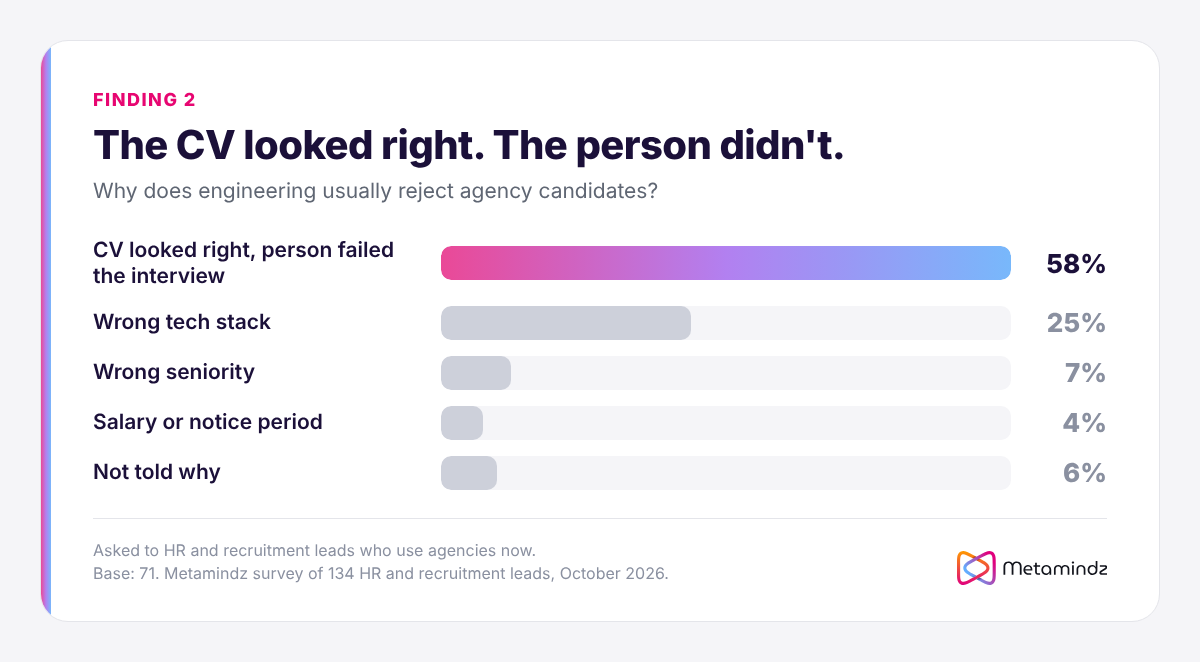
- 58%: the CV looked right, but the person failed the interview.
- 25%: wrong tech stack.
- 7%: wrong seniority.
- 4%: salary or notice period.
- 6%: not told why.
This is the most important number in the survey. Only a quarter of rejections are keyword mismatches, the thing a recruiter can check by reading the CV against the job description. The majority are candidates who matched on paper and couldn't do the job.
A CV that lists Postgres can't tell you whether someone can diagnose a slow query. A CV that lists React can't tell you whether they understand why a component re-renders 40 times. You find out by asking, and the person asking has to know the answer.
AI is making this worse. Robert Half's September 2026 UK research found 67% of hiring managers say AI-generated applications have made hiring take longer, and 27% struggle to tell AI-written CVs from genuine ones3. Gartner predicts that by 2028, 1 in 4 candidate profiles worldwide could be fake4. CVs are getting better at looking right, which makes reading them less useful as a filter.
Finding 3: HR will take fewer CVs, not a higher fee
We asked agency users what they'd give up to get CVs that pass.
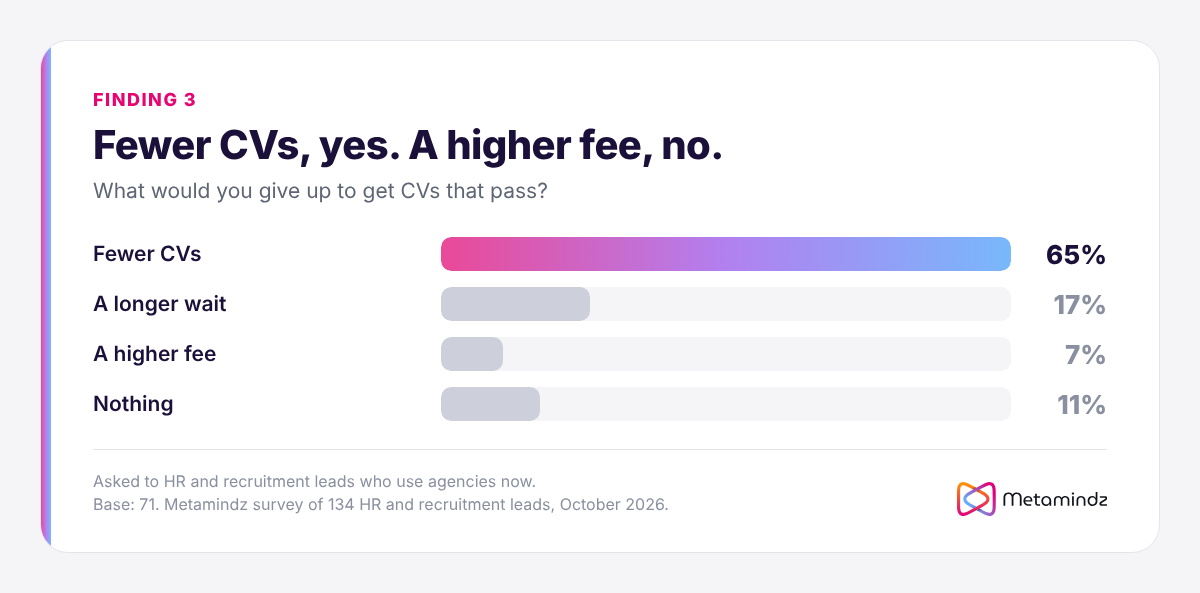
- 65% would accept fewer CVs.
- 17% would accept a longer wait.
- 7% would pay a higher fee.
- 11% wouldn't give up anything.
So 82% would trade volume or time for quality. Almost nobody would trade budget. That matches what we heard from the 41 people who stopped using agencies: the single biggest thing that would bring them back was a fixed fee (32%), ahead of a longer guarantee (27%) and engineers checking every CV (22%).
The standard agency model works against this. Most agencies are paid a percentage of salary on placement, so more CVs means more chances of a fee. A buyer who wants fewer, better CVs and a predictable price is asking for a different model.
Finding 4: HR is stuck in the middle
We asked agency users for their biggest frustration with recruitment agencies. This question was added after the first round, so 59 of the 71 answered.
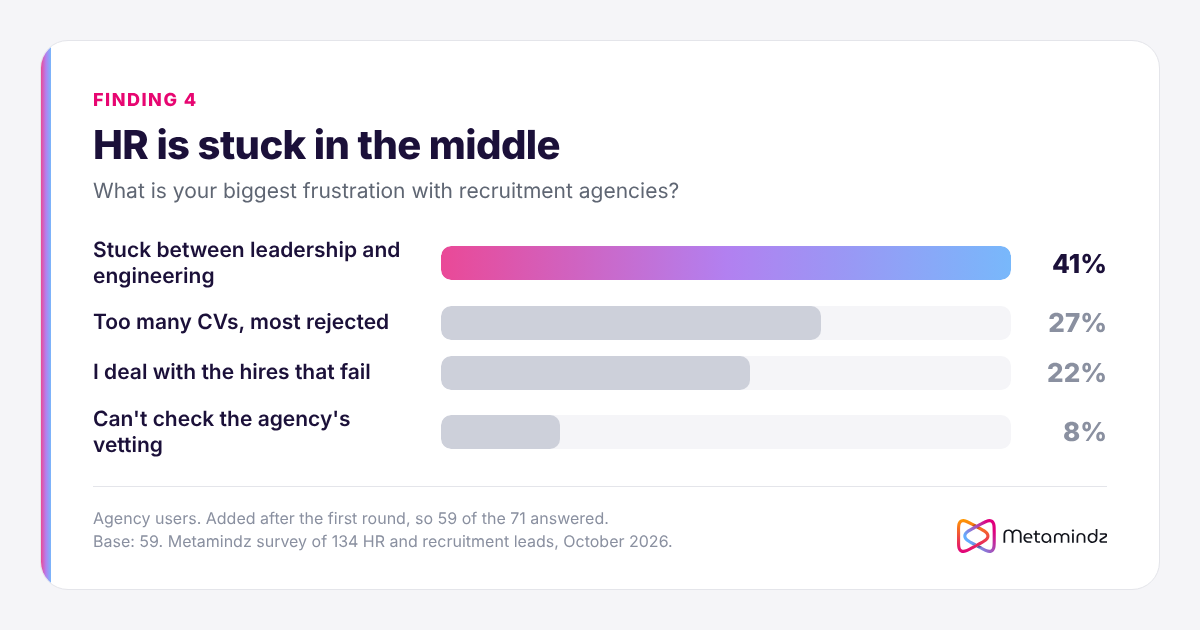
- 41%: leadership wants hires faster and cheaper, engineering wants better candidates, and I'm stuck between them.
- 27%: too many CVs, and engineering rejects most of them.
- 22%: I have to deal with the hires that fail.
- 8%: I can't check the agency's vetting.
I expected "too many CVs" to win. It didn't, although with 59 answers the gap between 41% and 27% is too small to be certain. Either way, the pattern is the same: HR's job in a technical hire is to find candidates that both leadership and engineering will accept, and the CV alone doesn't give them enough to do that.
Finding 5: HR doesn't take the blame alone
We asked who got the blame the last time a technical hire failed.
- 44%: me and the hiring manager together.
- 23%: the hiring manager.
- 17%: nobody.
- 10%: me.
- 7%: it's never happened.
Only 10% of HR leads took the blame alone. Failed technical hires are a shared problem between HR and engineering, which makes sense: HR runs the process, but engineering defines what "good" looks like.
What the wider UK research says
Our survey is small and focused. Here's how it lines up with larger studies:
| Source | Finding | Fits our data? |
|---|---|---|
| CIPD, Resourcing and talent planning 20261 | 53% of UK employers hire without an agency. 53% had difficulty attracting candidates, down from 64% in 20246 | Applicants are easier to find. Good ones aren't. |
| Experis Tech Talent Outlook, Q3 20267 | 73% of UK tech and IT employers struggle to find the skilled talent they need | Yes: skilled people are the scarce part |
| Robert Half UK, September 20263 | 67% of hiring managers say AI-generated applications lengthened hiring. 28% see more unqualified applicants | Yes: CVs are a weaker signal than they were |
| Gartner, 20254 | By 2028, 1 in 4 candidate profiles worldwide could be fake. 6% of candidates admitted interview fraud | Yes: identity and skill both need checking |
| Ashby, Q1 20262 | 23.3 collective interview hours per technical hire | Every failed CV costs engineering time |
| Michael Page5 | 85% of tech organisations assess on demonstrated ability over CVs | Yes: the market is moving away from CV matching |
A note on these sources: Robert Half and Michael Page sell recruitment services, and the published coverage of the Robert Half study doesn't give a sample size. Gartner's figure is a forecast. I've included them because they point the same way as our data, not because any one of them settles it.
Why this happens: no engineer sees the CV until the interview
Put the findings together and the cause is simple. At most companies, and at most agencies, the first person to read a CV can't judge technical skill. So the CV gets matched on keywords, it goes to engineering, and the engineer finds out an hour into the interview.
It shows up outside agencies too. Half of the people who never used an agency told us they check CVs themselves without any technical test, and 26% of those who quit agencies did so because they had to re-check every CV anyway. Moving the work in-house doesn't fix it if the same kind of person is still doing the first read.
Buyers can tell. Among the 22 people who never used an agency, the top thing that would make them try one was proof that engineers check every CV (59%). Every agency says its candidates are "technically vetted", and buyers have stopped taking it on trust. Michael Page's research points the same way from the employer side: 85% of technology organisations now assess candidates on demonstrated ability rather than CVs5.
The fix is to move the technical judgement earlier. Before a CV reaches your hiring manager, someone who could do the job should have spoken to the candidate. I wrote more on this in why a non-technical recruiter is costing you good developers.
What to do about it: a checklist for HR and founders
- Measure your pass rate. For your last three technical roles, count the CVs sent to engineering and how many passed the first interview. 97% of our respondents could estimate it, so you probably already know roughly.
- Ask your agency who reads the CV first. If the answer is a recruiter matching against the job description, expect the numbers above.
- Ask for fewer CVs. Three to five strong CVs a week beats twenty weak ones. 65% of HR leads would make that trade, so say it to your agency.
- Put a technical screen before the hiring manager. A 20 to 30 minute call with an engineer, built on real questions from the role. Our free take-home task generator builds a task from your job description if you'd rather test in writing.
- Agree what "good" looks like with engineering before you start. A clear brief on stack, seniority and the problems the person will solve prevents a lot of "wrong stack" and "wrong seniority" rejections.
- Check identity on remote interviews. With AI-written CVs and proxy interviews on the rise, cameras on and a live problem are now basic hygiene. More in deepfake interviews and your hiring process.
- Prefer a fixed fee where you can. It removes the incentive to send volume, and it's what 32% of people who left agencies said would bring them back.
How we run tech recruitment at Metamindz
We built our CTO-led technical recruitment around exactly what this survey found, so I'll be direct about how it works:
- An engineer screens every candidate before you see them. A developer or CTO who works in your stack runs a technical screen, and a CTO approves every CV.
- Fewer, better CVs. About 3 to 5 screened CVs a week, per role. We send fewer on purpose.
- A fixed fee for the first role: £5,000. Further hires are 15% to 17% commission. Technical screening is included. All fees exclude VAT.
- A 3 to 6 month guarantee on every hire, depending on seniority.
- No exclusivity required.
- Two routes. We screen and you run the deep interview, or we run a 1.5 to 2 hour live-coding and architecture interview with your final candidates too (£300 an hour).
- We start sourcing the same week as the intro call, and you usually get the first screened CVs within a week.
We hire across backend, frontend, full-stack, mobile, data, AI engineers, DevOps and cloud, product managers and CTO and VP Engineering roles.
Hiring now? Send us the role and we'll start sourcing this week. Not ready to share a job description? Book 25 minutes with a CTO and talk it through first.
How we ran the survey
- Panel: Prolific, a paid research panel. Two-minute, multiple-choice survey, not branded as Metamindz.
- Dates: a first round on 5 October 2026 and the main round on 6 to 7 October 2026.
- Sample: 134 HR and recruitment leads at companies of 20 to 250+ staff (28 at 20 to 50, 50 at 50 to 250, 56 at 250+). We removed 7 people who changed their answers to qualify and 1 with missing answers. Everyone passed an attention check, and removing the 23 fastest responses didn't change any finding.
- Who saw what: questions about agency CVs, blame and trade-offs went to the 71 current agency users. The frustration question was added after the first round, so 59 of them answered it. "What would bring you back" went to the 41 who stopped using agencies, and "what would make you try one" to the 22 who never used one.
- Limits: job titles are self-reported. 56% of respondents live in the UK, and their answers matched everyone else's. Some groups are small: with 71 agency users, a gap of fewer than 7 people between two answers could be chance, and the company size groups are smaller still. And this is what people said, not what they did.
If you'd like the full breakdown by company size for your own research or reporting, get in touch.
Frequently asked questions
What percentage of recruitment agency CVs pass the technical interview? In our 2026 survey, 87% of HR leads who use agencies said half or fewer agency CVs pass engineering's first technical interview, and 32% said fewer than a quarter pass. Only 10% said more than half pass.
Why do recruitment agency candidates fail technical interviews? 58% of HR leads said the most common reason is that the CV looked right but the person couldn't do the job. 25% said wrong tech stack. The person reading the CV first usually can't judge technical skill, so weak candidates are found only at interview.
What are the biggest recruitment challenges for tech roles in the UK in 2026? Finding skilled people rather than applicants. Experis reports 73% of UK tech employers struggle to find skilled talent, Robert Half reports 67% of UK hiring managers say AI-generated applications have slowed hiring, and in our survey 41% of HR leads said they're stuck between leadership's speed and cost demands and engineering's quality bar.
How much do tech recruitment agencies charge in the UK? Most agencies charge a percentage of the first year's salary on placement. Metamindz charges a £5,000 fixed fee for the first role, then 15% to 17% commission on further hires, with technical screening by an engineer included and a 3 to 6 month guarantee. All fees exclude VAT.
What is CTO-led recruitment? Recruitment where developers and CTOs, not generalist recruiters, screen and interview candidates. Every candidate gets a technical screen from an engineer before their CV reaches you, so the shortlist holds up in your engineering interview.
Would HR leads pay more for better candidates? Mostly not. Only 7% would pay a higher fee for CVs that pass. 65% would accept fewer CVs and 17% a longer wait instead.
Sources
- CIPD, Resourcing and talent planning report 2026, Figure 14 (1,014 UK employers).
- Ashby data, reported by IT Brew, Tech roles are notorious for lengthy hire times. Can we change that?
- Robert Half UK research, reported by Staffing Industry Analysts, AI-generated CVs flood employers and slow hiring in the UK, September 2026.
- Gartner, reported by HR Dive (July 2025 forecast), and DIGIT (interview fraud figure).
- Michael Page, reported by IT Brief UK, coverage of its skills-based hiring survey.
- Omni RMS, summary of the CIPD Resourcing and talent planning report 2026.
- ManpowerGroup, Experis Tech Talent Outlook Q3 2026.
- Metamindz, survey "How growing companies hire technical talent", 134 HR and recruitment leads, Prolific, 5 to 7 October 2026.